TheJakartaPost
Please Update your browser
Your browser is out of date, and may not be compatible with our website. A list of the most popular web browsers can be found below.
Just click on the icons to get to the download page.


Popular Reads
Top Results
No results found. Please check your search term and try again
Can't find what you're looking for?
View all search results
Popular Reads
Top Results
No results found. Please check your search term and try again
Can't find what you're looking for?
View all search resultsASEAN a ‘big ship’ that must not sink, Jokowi says
“This big ship must keep sailing; it must not sink, as we have a responsibility to the hundreds of billions of people living in the region,” Jokowi said in an ASEAN Day speech in Jakarta on Tuesday.
Change text size
Gift Premium Articles
to Anyone
Share the best of The Jakarta Post with friends, family, or colleagues. As a subscriber, you can gift 3 to 5 articles each month that anyone can read—no subscription needed!
P
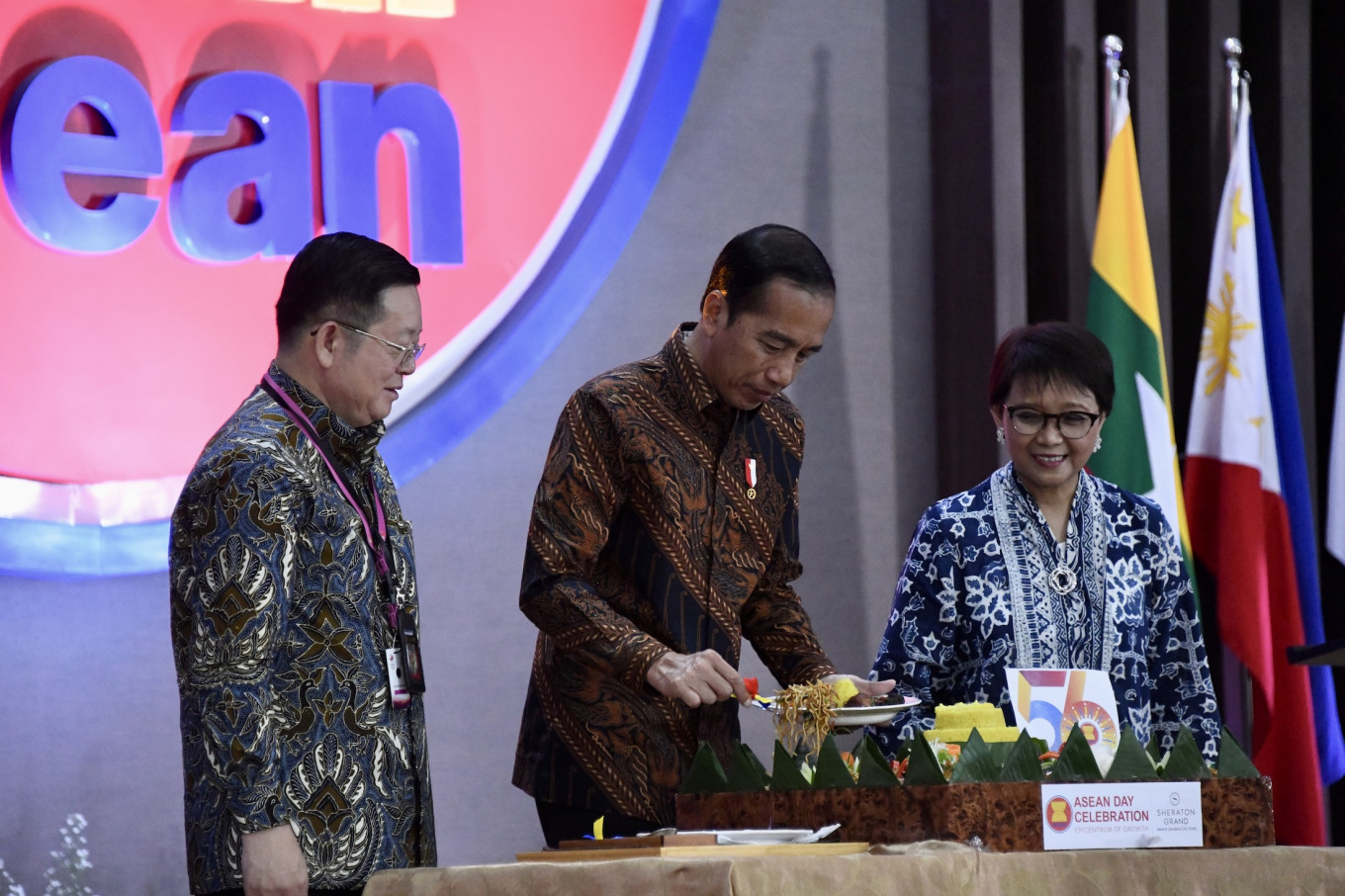
resident Joko “Jokowi” Widodo has likened ASEAN to an ark that must stay afloat in a sea of geopolitical challenges so that it can continue to carry the peoples of Southeast Asia toward better lives.
“This big ship must keep sailing; it must not sink, as we have a responsibility to the hundreds of millions of people living in the region,” Jokowi said on Tuesday in a speech at an ASEAN Day celebration in Jakarta.
The President, who is leading Indonesia’s chairmanship of the association this year, made his point as ASEAN marked 56 years since its founding by Indonesia, Malaysia, the Philippines, Singapore and Thailand on Aug. 8, 1967.
More than half a century later, ASEAN has expanded its membership to include Brunei Darussalam, Cambodia, Laos, Myanmar and Vietnam, while Timor-Leste is expected to join as the bloc’s 11th member in the coming years.
As host of the 43rd ASEAN Summit to be held in Jakarta next month, Indonesia was keen to help ASEAN maintain its central role in the region, Jokowi said, so that it could face the many challenges that lay ahead and respond effectively to global dynamics.
“Let us work together to make ASEAN matter [and turn it into an] epicentrum of growth,” he said.
Under Indonesia’s chairmanship, ASEAN has focused on its strengths as an economic community to develop programs to bolster regional health care and improve food and energy security in response to global developments such as COVID-19 and the war in Ukraine. It is also seeking to become a production hub for electric vehicles and strengthen regional financial stability and connectivity.
ASEAN Secretary General Kao Kim Hourn said the region’s 600 million people remained at the heart of the bloc’s priorities and that its success should be measured by whether it delivered “real, concrete and tangible benefits” for the lives of its citizens.
“In return, it is the people who will ultimately ensure the perpetuity of the ASEAN community,” he said in a speech on Tuesday.
Economic focus
In line with Indonesia’s economy-oriented chairmanship, Southeast Asians have been preoccupied with economic issues, according to the 2023 State of Southeast Asia study by the ISEAS-Yusof Ishak Institute.
The study, which involved 1,308 respondents from academia, business, government, civil society and media from across the region, found that nearly two thirds of respondents were most fearful of unemployment and economic recession.
Economic concerns were followed by climate anxieties (57.1 percent), while socioeconomic gaps and increased military tensions were tied for third place, with 41.9 percent of respondents flagging them as worrisome.
But despite the focus on the economy, some analysts say ASEAN must fulfill its duty to ensure regional peace.
“Most of the people of ASEAN do not yet understand the important role of ASEAN and take it for granted as if regional peace and security come on their own,” said Dewi Fortuna Anwar, a senior researcher at the National Research and Innovation Agency (BRIN), on Tuesday.
Regional peace, stability and security were prerequisites for economic development, she said.
“Peace and stability do not come on their own, they have to be nurtured,” Dewi added.
And while ASEAN has managed to provide regional perks such as visa-free travel and economic connectivity, its engagement with civil society in such efforts remained limited, said Randy Nandyatama, a researcher at Gadjah Mada University’s ASEAN Studies Center.
Randy said civil society engagement, an important aspect of making ASEAN people-oriented, depended on the rapport that member states had with such groups.
“If senior ASEAN officials are close to civil society, they are more willing to engage. But if they aren’t, or perhaps the ASEAN chair is less diplomatic, then there won’t be much engagement,” he said on Tuesday.
Security concerns
Indonesia’s ASEAN chairmanship comes at a critical point in the organization’s history, which has been colored by a disastrous pandemic and climate crisis and punctuated by economic upheaval and war.
Over the past few years, these issues, along with a stiff superpower rivalry brewing in its own backyard, have challenged the bloc’s unity and raised doubts about its consensus-based decision-making.
Even so, Jokowi reiterated his confidence in ASEAN, saying it set an example of how a highly diverse region could live in harmony and showed that differences between member states were not necessarily barriers to reaching common goals.
“Global challenges and dynamics today are not easy,” he said. “The global economy has not yet fully recovered, while rivalries are getting sharper. But I believe that ASEAN can weather it all, as long as it is united.”
Under Jakarta’s leadership, ASEAN has continued efforts to institutionalize human rights protections, strengthen its nuclear nonproliferation policies and complete a Code of Conduct in the South China Sea, one of its biggest flashpoints.
Jokowi also acknowledged that the bloc was still grappling with the Myanmar coup crisis and reiterated that ASEAN would stand by its Five-Point Consensus (5PC), a peace plan aimed at the junta in Naypyidaw.
“This situation can only be fixed if there is political will from all stakeholders in Myanmar,” he said. (tjs)