TheJakartaPost
Please Update your browser
Your browser is out of date, and may not be compatible with our website. A list of the most popular web browsers can be found below.
Just click on the icons to get to the download page.


Popular Reads
Top Results
No results found. Please check your search term and try again
Can't find what you're looking for?
View all search results
Popular Reads
Top Results
No results found. Please check your search term and try again
Can't find what you're looking for?
View all search resultsJokowi reignites ‘Bandung Spirit’ in week-long Africa tour
President Jokowi is on his first trip to sub-Saharan Africa and is bringing back dozens of deals from state visits in Kenya, Tanzania and Mozambique in the name of advancing South-South cooperation.
Change text size
Gift Premium Articles
to Anyone
Share the best of The Jakarta Post with friends, family, or colleagues. As a subscriber, you can gift 3 to 5 articles each month that anyone can read—no subscription needed!
P
resident Joko “Jokowi” Widodo embarked on his maiden trip to sub-Saharan Africa this week, bringing with him the “Bandung Spirit” as well as dozens of bilateral deals from state visits in Kenya, Tanzania and Mozambique – all in the name of advancing global South-South cooperation.
The timing for Jokowi’s first tour of duty on the continent lines up with Indonesia’s quest to expand its trade and investment portfolio into “non-traditional markets”, while also dovetailing into the prevailing sense that the current world order dominated by wealthy Western powers has failed to champion the interests of developing countries.
The Africa trip is built around the 15th BRICS Summit, which is entertaining the possibility of admitting new member states to make good on a pledge to become a counterweight to status quo forums such as the Group of Seven (G7) industrialized nations.
But the Africa connection runs especially deep for Jakarta, due to the historical connection that many countries from the continent have with Indonesia as host of the 1955 Asia-Africa Conference in Bandung, West Java, which galvanized the postcolonial movement and planted the seeds for nonalignment during the Cold War.
As a precursor to his attendance at a summit grouping together Brazil, Russia, India, China and South Africa, Jokowi traveled to Nairobi, Dar Es Salaam and Maputo, where he announced new cooperation initiatives mostly in trade, investment, infrastructure and health.
Jakarta, which previously affirmed its commitment to become an active player in “Africa’s economic success story”, will only intensify its efforts going forward, the Indonesian leader said.
“Indonesia will walk the talk to realize concrete collaboration with Africa. We are currently finalizing an infrastructure grand design plan for Africa over the next five years,” he said on Tuesday.
The government hosted the first Indonesia-Africa Investment Forum in Bali in 2018, giving state and business actors a platform to explore untapped economic opportunities and boost development cooperation.
Bilateral deals
Jokowi appears to be making good on his plan so far.
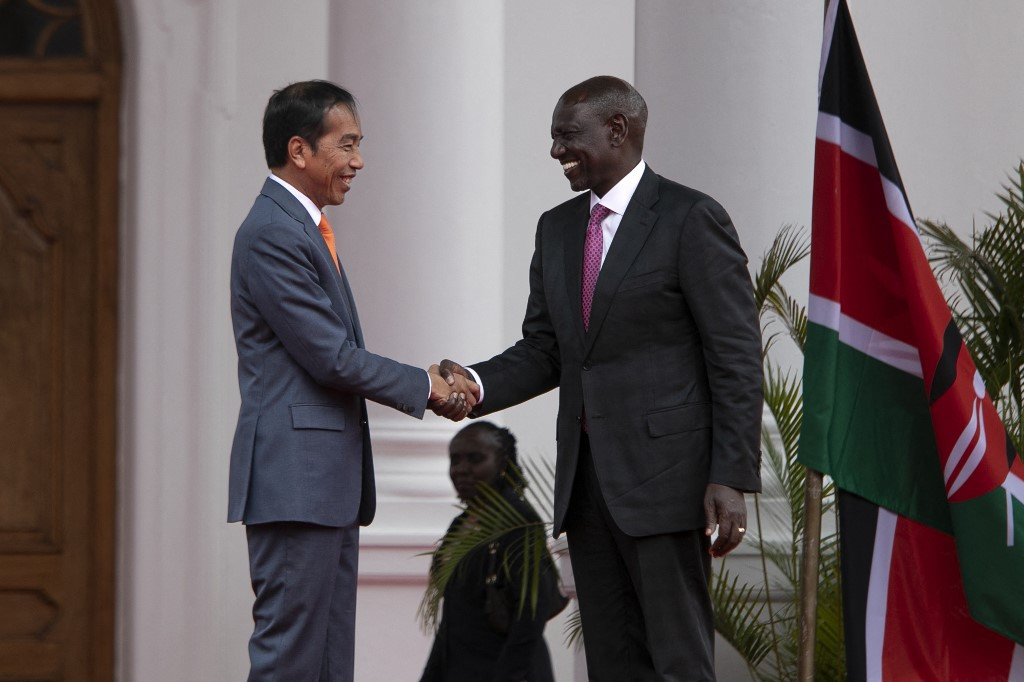
Meeting with Kenyan President William Ruto on Monday, Jokowi pushed for a preferential trade agreement (PTA) and a bilateral investment treaty (BIT) between the two countries, while also announcing a fresh pair of initiatives between Jakarta and Nairobi’s energy sector players worth US$2.2 billion in total.
Also pushing for health cooperation, Jokowi heralded the alliance between the two countries’ food and drug monitoring agencies and pharmaceutical companies, which expanded cooperation on health products.
Three memorandums of understanding (MoUs) between the two governments covered these new arrangements, on top of 11 other MoUs signed by both private companies and state-owned enterprises (SOEs).
“With the uncertainties of the current global situation, it is time that we solidify the Bandung Spirit and Global South cooperation,” Jokowi said in a statement in Kenya, according to readouts from the presidential press bureau.
“It is time for the world to hear the voices and interests of developing countries,” he added.
In Tanzania, the President also pushed for a PTA and a BIT, while also announcing new MoUs on energy, mining and health. In support of Tanzania’s infrastructure development, Jokowi said Jakarta was planning to contribute to its agriculture sector by revitalizing the Farmer’s Agriculture and Rural Training Center in Morogoro.
Foreign Minister Retno LP Marsudi, who attended the meeting with Tanzanian President Samia Saluhu on Tuesday, said the African leader expressed an interest in learning more about Indonesia’s infrastructure development and downstreaming industries.
“[Saluhu] also wanted to learn from Indonesia on how to expand its palm oil industries and [state-owned enterprises] management,” Retno said in a recorded video statement.
Both Tanzania and Kenya opened embassies in Jakarta last year.
On Tuesday evening, Jokowi arrived in Maputo, the capital of Mozambique, where he was welcomed by Energy and Mineral Resources Minister Joaquim Zacarias and State Secretary Manuel Vicente.
Unlike Kenya and Tanzania, Mozambique already has a PTA with Indonesia.
State-owned PT Bank Negara Indonesia (BNI) corporate and international banking director Silvano Rumantir in March said that closer Africa-Indonesia partnerships would be a profitable undertaking, with exports from Jakarta currently valued at $8.2 billion and unrealized trade potential of around $4.6 billion.
Among Indonesia’s most competitive exports to Africa were palm oil and its derivatives, rubber, coffee and motorized vehicles. It also imports a significant amount of oil and gas from countries like Nigeria and Angola.
The President is likely to spend one day in Maputo before heading off to South Africa to conclude his tour.
Renewed spirit
Indonesia’s drive in Africa is informed by its historical bond set out during the Asia-Africa Conference.
Spearheaded by the first Indonesian president Sukarno, the Bandung conference will celebrate its 70th anniversary in 2025, making Jokowi’s African tour strategically timed to make way for the jubilee, analysts have noted.
But while the Cold War between the United States and the Soviet Union is now of the distant past, and the relevance of the Non-Aligned Movement much questioned, these same experts also noted that today’s geopolitical tensions rooted in the US-China rivalry are reminiscent of that time.
Against this backdrop, Jokowi’s sojourn may be a timely strategy to replicate Sukarno’s vision before he ends his time in office next year.
“With the pressure brought on by the two giants, it’s time that Indonesia reignites the NAM and forge friendships with non-aligned countries. The catch here is that China is part of NAM, so Indonesia must tread with care to uphold inclusivity,” Fitriani, an international expert at the International Institute for Strategic Studies (IISS), told The Jakarta Post on Wednesday.
Despite the challenges, however, observers believe it is still a worthy undertaking for Indonesia to continue its nonaligned diplomacy considering the current stakes.
“Indonesia used to be an aid recipient country. Now we are a developing partner for less developed nations. [...] With this new capacity, Indonesia must start thinking about the future of these friendships for the sake of strategic autonomy,” said Lina Alexandra, head of the international relations department at the Centre for Strategic and International Studies (CSIS) in Jakarta.