TheJakartaPost
Please Update your browser
Your browser is out of date, and may not be compatible with our website. A list of the most popular web browsers can be found below.
Just click on the icons to get to the download page.


Popular Reads
Top Results
No results found. Please check your search term and try again
Can't find what you're looking for?
View all search results
Popular Reads
Top Results
No results found. Please check your search term and try again
Can't find what you're looking for?
View all search resultsASEAN releases climate statement, activists decry lack of ‘ambition’
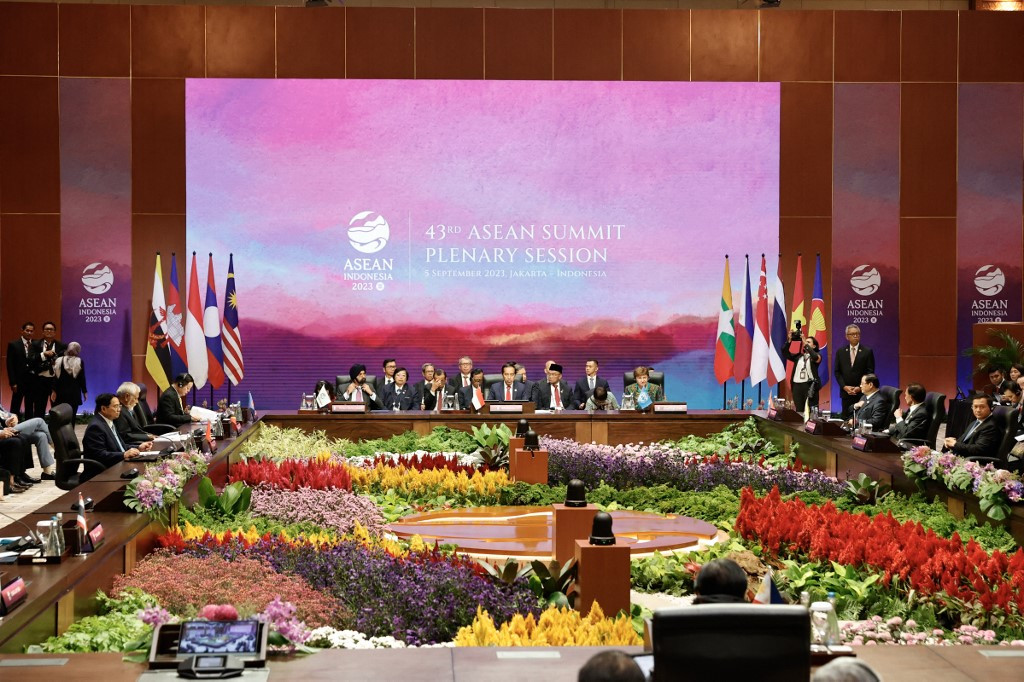
The joint statement was issued amid the ASEAN Summit and related summits in Jakarta, surrounded by artificial tropical jungle decorations and the thick pollution blanketing the capital.
Change text size
Gift Premium Articles
to Anyone
Share the best of The Jakarta Post with friends, family, or colleagues. As a subscriber, you can gift 3 to 5 articles each month that anyone can read—no subscription needed!
A
SEAN leaders have issued a joint statement on climate change and a regional carbon reduction strategy which outline each member state’s commitment as well as their collective attempts in the region in fighting the global climate crisis.
Civil representatives, however, are dissatisfied with the statement and strategy due to the limited civil participation in the climate efforts, warning the bloc not to be swayed by false solutions to the climate crisis.
ASEAN issued the statement in Jakarta amid the high-level summit between leaders of member states and dialogue partners, surrounded by the venue's artificial tropical jungle decorations and the thick pollution blanketing the Indonesian capital.
The statement was titled the ASEAN Joint Statement on Climate Change to the 28th Session of the Conference of the Parties to the United Nations Framework Convention on Climate Change.
In the statement, the bloc reaffirmed its commitment to the members’ respective climate pledges to reduce carbon emissions as underlined in their nationally determined contribution (NDC) documents.
Member states also agreed to push for “a strong outcome” on enhancing international cooperation for stronger action and support in meeting the Paris Agreement goals during the upcoming United Nations Climate Change Conference (COP28) in Dubai in November.
The Paris Agreement, signed during the 2015 climate conference, aims to limit global temperature increase to 1.5 degrees Celsius above preindustrial levels, or before the 1900s.
The bloc also urged developed nations to fulfill their pledge to help developing countries with US$100 billion in climate financing by 2023.
Net-zero strategy
During the event, ASEAN also adopted a strategy for carbon neutrality, a condition where the amount of carbon emissions removed from the atmosphere is equal to those emitted.
Some of the bloc’s core strategies to reach carbon neutrality are improving the green economy supply chain, developing carbon markets that are interoperable in the region and with other global markets and developing greenhouse gas removal reporting mechanisms that align with key markets.
However, neither of the documents set out a clear target on when the region would achieve net-zero emissions.
On the national level, only Brunei, Laos, Malaysia, Singapore and Vietnam have pledged to reach net-zero emissions by 2050. Indonesia, ASEAN’s largest member, has targeted “2060 or sooner”, while Thailand sets a 2065 goal. Myanmar, currently under the control of a military junta, has a partial net-zero goal for the land and forestry sector by 2040.
The Philippines is the only ASEAN member state with no net-zero goal so far.
Not ambitious enough
Civil society organizations decried the ASEAN climate statement and carbon neutrality strategy for their minimum inclusion of civil society in the process.
“[These documents] dashed out our dreams and wishes of ASEAN being an inclusive community that belongs to us all,” said a group of 10 organizations including Migrant Care and Oxfam Indonesia in a statement issued on Wednesday.
While the joint statement showed ASEAN giving enough priority to the issue of global warming, said Nadia Hadad of the Madani Foundation, it was still limited to demanding the financial responsibility of developed countries, rather than calling for a complete overhaul toward a more equitable climate.
“A group of Southeast Asian countries that has important assets and a role in the climate crisis should have been more ambitious,” Nadia said.
Another group of climate activists called on ASEAN leaders to strengthen cooperation for a just energy transition that focuses on abandoning fossil fuels for renewable energy sources.
The member states should also reject false climate solutions, including hydrogen-based fuel, cofiring coal and biomass in power plants and untested technology to capture and store carbon emissions, said Lidy Nacpil, coordinator of the Asian Peoples’ Movement on Debt and Development (APMDD).
“They must stop the expansion of gas energy in the region and the promotion of fossil-based technologies that only serve to legitimize continued fossil fuel extraction and use of coal-fired power plants.”