The Jakarta Post
Please Update your browser
Your browser is out of date, and may not be compatible with our website. A list of the most popular web browsers can be found below.
Just click on the icons to get to the download page.


Popular Reads
Top Results
No results found. Please check your search term and try again
Can't find what you're looking for?
View all search results
Popular Reads
Top Results
No results found. Please check your search term and try again
Can't find what you're looking for?
View all search resultsstandard-poors


Business 6 years ago
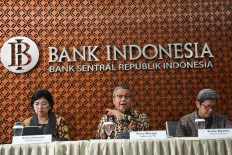
Bank Indonesia says S&P outlook cut not a reflection of fundamentals
The comments from the Bank Indonesia chief come after S&P cut its outlook for the nation to negative from stable, while affirming its long-term foreign currency debt rating at BBB, the second-lowest investment grade score.

Business 6 years ago
Rating agencies downgrade Indonesian companies on debt repayment concerns amid COVID-19
The rationale behind the ratings decisions varies for each company but revolves around liquidity risks, concerns over debt repayment ability, a sharp rupiah depreciation, low commodity prices and overall weak demand.


Business 9 years ago
PREMIUM
RI regains long lost S&P rating
It took exactly 20 years for Indonesia — since the 1997 Asian financial crisis — to fully regain its investment grade status, as Standard and Poor’s (S&P) followed on Friday two other global rating agencies in awarding such an influential rating to the country.

Business 9 years ago
Indonesia disappointed over S&P’s “uncertain” rating assesment
The government and central bank have expressed disappointment over Standard & Poor's (S&P) uncertain stance, making it less likely to grant Indonesia an investment grade rating in the near soon, ducking behind "additional concerns" on bad debts.
Business 10 years ago
BI pledges pro-resiliency policy as S&P rating unchanged
The central bank has reiterated its commitment to continue efforts to strengthen monetary resiliency in the wake of Standard and Poor's (S&P) decision to keep Indonesia’s sovereign rating unchanged at BB+ with a positive outlook.

Editor's Picks
Popular
- PISA gains belie Indonesia’s persistent education crisis
- Not the Ministry of Magic
- Suahasil seen to prioritize fiscal discipline, continuity
- The benefit of the doubt has expired
- Ed Sheeran struggles against Gaza tide
- Osama the gamer: A list of Bin Laden’s video games from his hard drive
- Another company flees Batam, abandons 1,025 workers
- Indonesian Navy welcomes former Italian warship as its first aircraft carrier
- Is Indonesia returning to fiscal orthodoxy?
- Saudi civil defense sends all-clear after alerts issued for capital Riyadh


