The Jakarta Post
Please Update your browser
Your browser is out of date, and may not be compatible with our website. A list of the most popular web browsers can be found below.
Just click on the icons to get to the download page.


Popular Reads
Top Results
No results found. Please check your search term and try again
Can't find what you're looking for?
View all search results
Popular Reads
Top Results
No results found. Please check your search term and try again
Can't find what you're looking for?
View all search resultsHow (not) to fight the globalization trilemma
Political economy explains why some economies thrive in a hostile world while others are punished by it.
Change text size
Gift Premium Articles
to Anyone
Share the best of The Jakarta Post with friends, family, or colleagues. As a subscriber, you can gift 3 to 5 articles each month that anyone can read—no subscription needed!
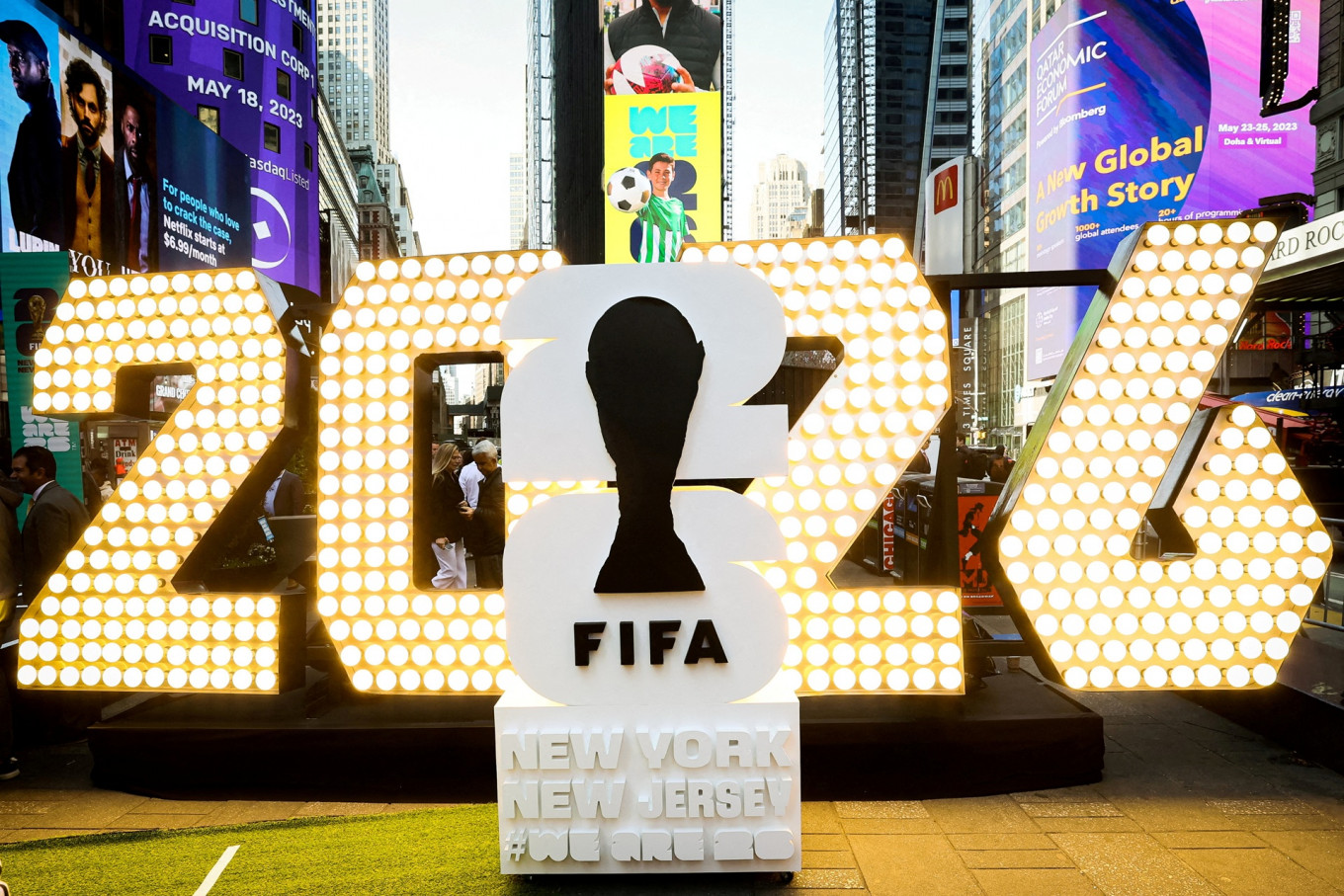 FIFA World Cup 2026 logo is revealed on May 18, 2023, during the kickoff event at Times Square in New York City, the United States. (Reuters/Brendan McDermid)
A
s the largest World Cup in history unfolds across North America, 48 nations are testing an old question on grass: how does a country become a champion? Political economy answered that question by explaining why some economies thrive in a hostile world while others are punished by it.
Begin with Dani Rodrik. His globalization trilemma holds that deep global integration, national sovereignty and democratic politics form an impossible trinity: a country may hold any two, but never all three. The mechanism is simple. The moment an economy opens to global capital, it acquires a second electorate - investors who vote every trading day, in the currency and bond markets - whose demands routinely collide with those of actual voters. A government can silence its investors by closing the economy, silence its voters by closing its politics or discipline itself so severely that both constituencies stay confident. What it cannot do is satisfy all three claims at once.
Susan Strange explains why the contest is unequal. In States and Markets, she distinguished relational power - making someone do something - from structural power: setting the frameworks within which everyone must operate. Structural power rests on four pillars: security, production, finance and knowledge, and Strange showed it migrating from governments to markets, which now write terms elected officials merely inherit. Her sharpest insight concerned the knowledge pillar: credit is belief, so whoever shapes what markets know and trust controls the casino before a single chip moves. A state that hides its books has disarmed itself in the decisive arena.
Robert Keohane supplies the escape route. In After Hegemony, he argued that states can recover collectively the governance they lose individually, through institutions, regimes and above all self-binding. A country that ties its own hands inside rules it cannot quietly break - an independent central bank, a hard fiscal ceiling, treaty disciplines - converts surrendered discretion into borrowed trust. The constraint is the strategy.
Daron Acemoglu adds the domestic foundation. Whether openness enriches or destroys, he argues, depends on the character of institutions: inclusive ones metabolize global capital into broad-based growth; extractive ones turn the identical inflows into palaces and crises. Markets, in this view, are mirrors: a collapsing currency is not an attack but a reading of whom a country’s institutions actually serve.
Alex Capri describes the new arena. In his account of techno-nationalism, the great powers are themselves dismantling hyperglobalization - weaponizing semiconductors, minerals and supply chains, sorting the world into blocs. Middle powers rush to play, but Capri’s caveat is severe: a resource confers leverage only with the refining, the technology and the captive customers behind it. A mine is not a chokepoint. Without the system around it, declared leverage is a bluff the market prices against your own currency.

Read together, the five define how not to fight the trilemma - because every way of fighting it is a form of denial: of the geometry (Rodrik), the structure (Strange), the credibility mechanism (Keohane), the institutional foundation (Acemoglu) or one’s actual position (Capri). The only non-losing move is the unglamorous one: choose corners deliberately, sequence capability before assertion and let self-binding do the work that bravado cannot. And the proof that this move wins is not theoretical. It is on display at the World Cup.