The Jakarta Post
Please Update your browser
Your browser is out of date, and may not be compatible with our website. A list of the most popular web browsers can be found below.
Just click on the icons to get to the download page.


Popular Reads
Top Results
No results found. Please check your search term and try again
Can't find what you're looking for?
View all search results
Popular Reads
Top Results
No results found. Please check your search term and try again
Can't find what you're looking for?
View all search resultsIndonesia and EFTA countries sign trade agreement
Change text size
Gift Premium Articles
to Anyone
Share the best of The Jakarta Post with friends, family, or colleagues. As a subscriber, you can gift 3 to 5 articles each month that anyone can read—no subscription needed!
 Set as preferred source
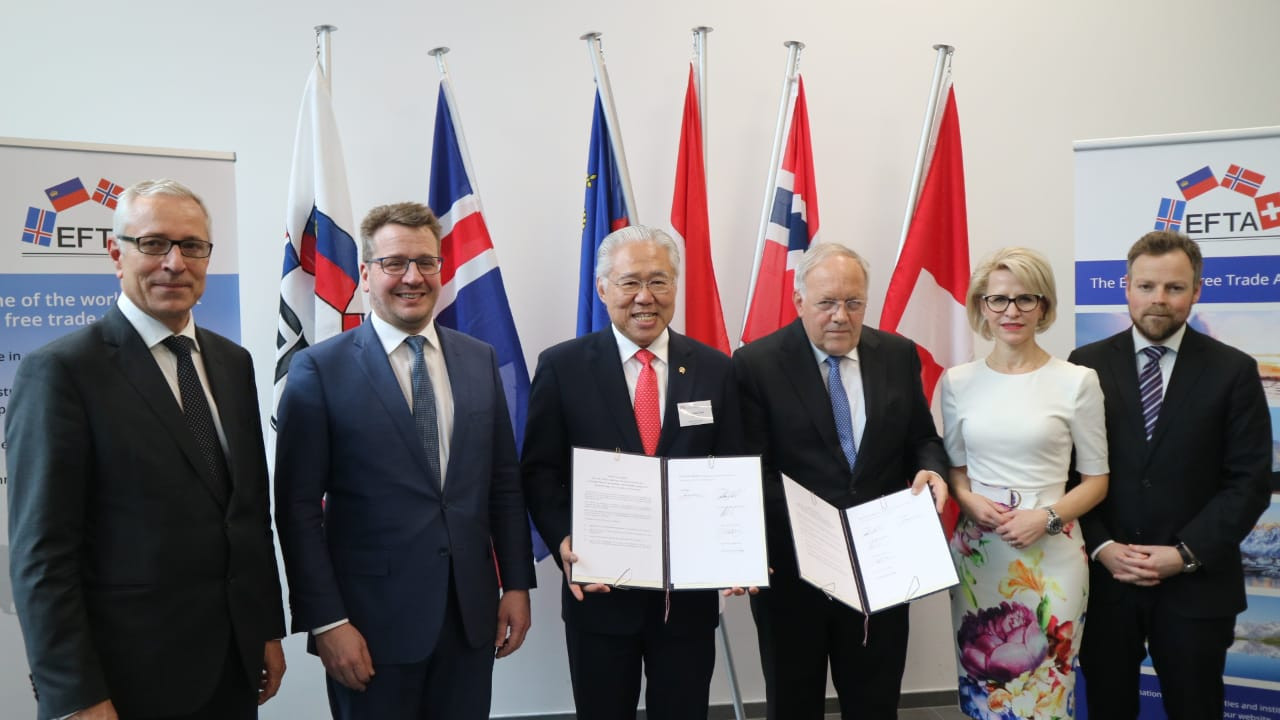 (Courtesy of Ministry of Trade)
T
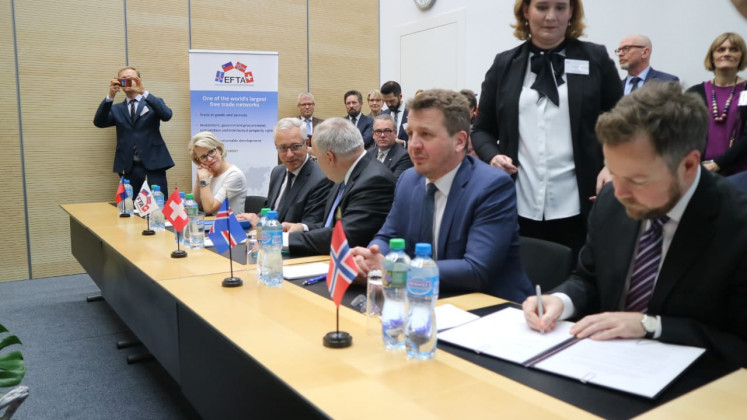
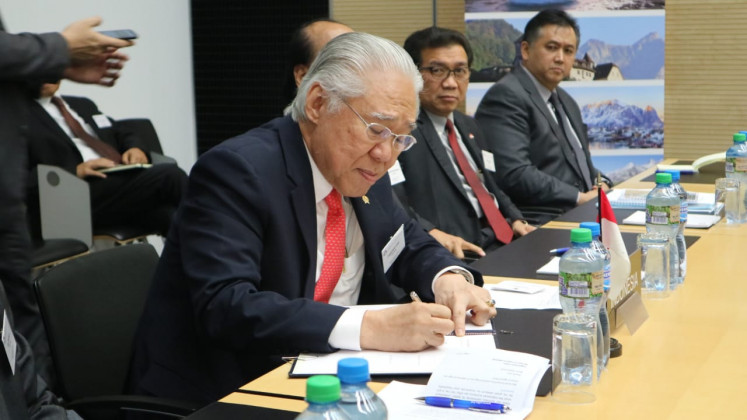
he Comprehensive Economic Partnership Agreement (CEPA) between Indonesia and the European Free Trade Association (EFTA) was signed on Sunday, Dec.16, 2018 in Jakarta.
Representing the signatory countries were Indonesia’s Trade Minister Enggartiasto Lukita, Switzerland’s Federal Councillor and the Federal Department of Economic Affairs, Education and Research Head of the Swiss Confederation Johann N. Schneider-Ammann, Liechtenstein’s Foreign Affairs, Justice and Culture Minister Aurelia Frick, Norway’s State Secretary Daniel Bjarmann-Simonsen, and Icelandic Ambassador and Chief of Protocol Hannes Heimisson.
The signing took place as Indonesia and the EFTA countries concluded an almost eight-year-long negotiation process on Nov.23, 2018 in Geneva, Switzerland. The CEPA negotiation was launched in July 2010, and the first round was held in early 2011. Since then, 15 rounds of negotiations and a number of Heads of Delegation and experts' meetings were held before both sides reached an agreement on Nov.1, 2018 in Bali, Indonesia.
The signing of the Indonesia-EFTA CEPA on Sunday marks a new milestone in the bilateral relations between Indonesia, Iceland, Liechtenstein, Norway and Switzerland. CEPA covers trade in goods (including provisions on trade remedies, trade facilitation, rules of origin, sanitary and phyto-sanitary measures, and technical barriers to trade), trade in services, investment, intellectual property rights, competition, government procurement, trade and sustainable development, cooperation and capacity building, as well as legal and horizontal provisions.
The IE-CEPA is expected to expand the market access of goods from Indonesia and EFTA, and increase economic cooperation and investments. On the trade of goods, Indonesia gets an increase in market access to its fishery, textile, furniture, bicycle, electronic, tire, coffee and palm oil products, as well as other agricultural products.
On services trade, Indonesia will get more access to intra-corporate trainees, contract service suppliers, independent professionals and young professionals of the EFTA. For example, the services that will get benefits include professional services, telecommunications, finance, transportation and education.
Indonesia will also get an increase in investments from member countries in sectors such as energy, mining, machineries, agriculture, infrastructure, fisheries, forestry and chemical industry.
Additionally, Indonesia will get opportunities in cooperation and capacity building in various sectors, including fisheries and marine, export promotion and tourism, and in small and medium enterprises (SMEs), cocoa, sustainability, maintenance, repair and overhaul (MRO) and vocational education.
“EFTA is a trade block in Europe that we haven’t yet tapped. With the signing of the IE-CEPA, we hope we can optimize the use of the markets in the respective countries that can be then the gateway to the European Union’s market. We also hope that this agreement will stand as a foundation for us to emulate other ASEAN countries as we have some catching up to do, especially with the Philippines and Singapore, which had finalized their trade agreements with EFTA,” Enggartiasto said.
Enggartiasto also convened at public discussions on IE-CEPA with stakeholders in Geneva, Switzerland on Friday (23/11), under the theme of “Optimizing the Benefits of the Indonesia-EFTA CEPA Agreement”.
The minister hopes that similar forums will be conducted to maximize on benefits from the Indonesia-EFTA agreement.
Based on data from Central Statistics Agency (BPS), EFTA is the 23rd destination for Indonesia’s non-oil gas exports and the 25th biggest region in terms of origins of imports for Indonesia. In 2017, trade between Indonesia and EFTA stood at US$2.4 billion. Indonesia’s exports to EFTA reached $1.31 billion and its imports from EFTA reached $1.09 billion, causing Indonesia to see a trade surplus at $212 million. Indonesia’s exports to EFTA include jewelry, optical devices, gold, telephone devices and essential oils, while its imports from EFTA include gold, turbo jet machines, medicines, fertilizers and industrial raw materials.
The investments of EFTA member countries in Indonesia in 2017 stood at to $621 million. (*)