TheJakartaPost
Please Update your browser
Your browser is out of date, and may not be compatible with our website. A list of the most popular web browsers can be found below.
Just click on the icons to get to the download page.


Popular Reads
Top Results
No results found. Please check your search term and try again
Can't find what you're looking for?
View all search results
Popular Reads
Top Results
No results found. Please check your search term and try again
Can't find what you're looking for?
View all search resultsPLN offers industrial investors access to renewable energy
Change text size
Gift Premium Articles
to Anyone
Share the best of The Jakarta Post with friends, family, or colleagues. As a subscriber, you can gift 3 to 5 articles each month that anyone can read—no subscription needed!
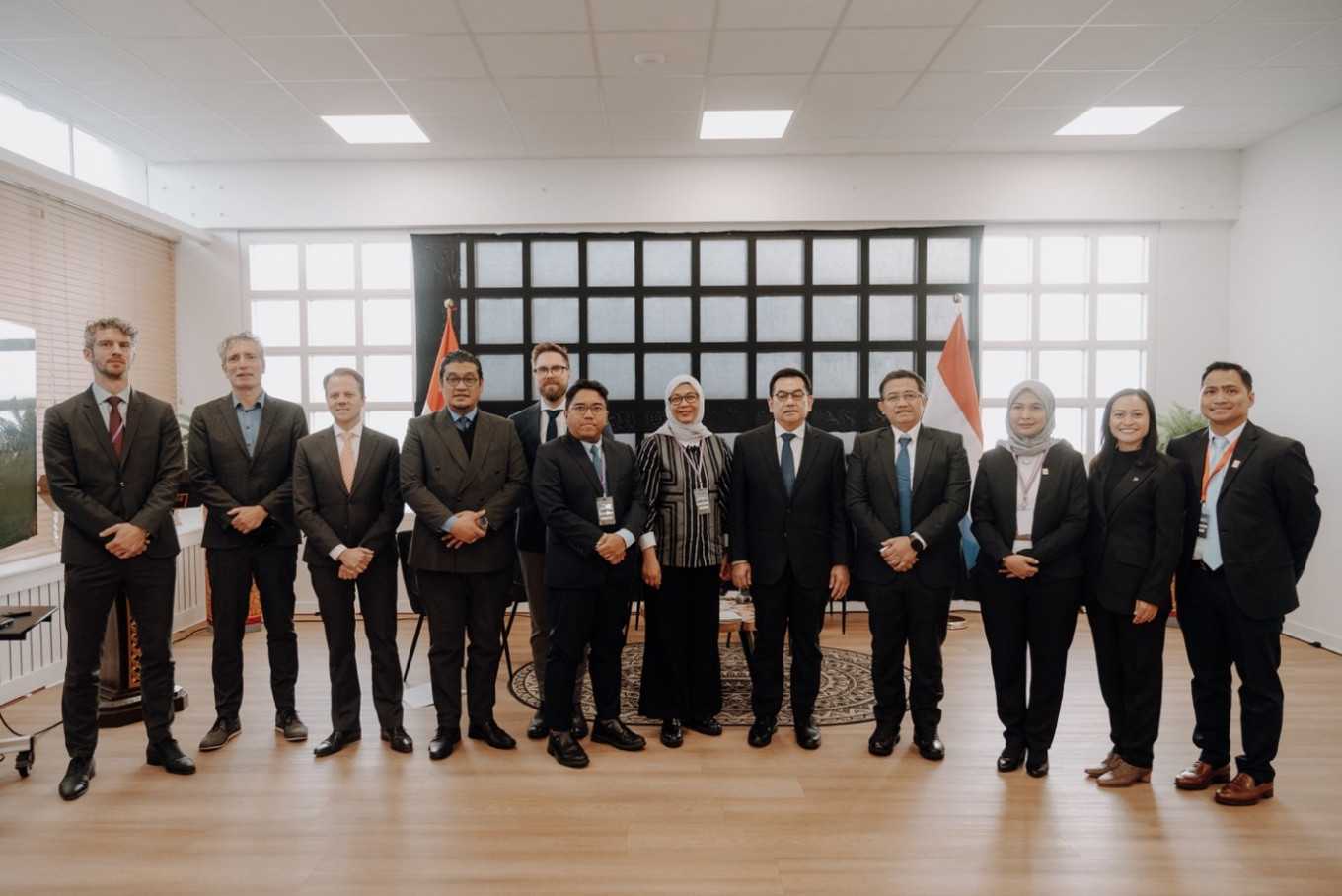 Members of the Indonesian delegation (from right) Fikri Praditya, manager for customer acquisition and green energy at PLN; Presthysa N. Lestari, vice president of global engagement and partnerships at Danantara; Dini Sulisyawati, executive vice president for sales and enterprise customer service at PLN; Prahoro Yulijanto Nurtjahyo, head of the Energy and Mineral Resources Ministry’s Human Resources Development Agency, Heldy Satriya Putera, deputy for strategic downstream investment at the Investment and Downstream Ministry; Farah Heliantina, assistant deputy for the acceleration of energy transition at the Office of the Coordinating Economy Minister; Edo Mahendra, executive chairperson of the Indonesia Energy Transition Implementation Joint Office; and Royhan Nevy Wahab, minister counsellor for economic affairs at the Indonesian Embassy to the Netherlands, stand alongside their Dutch counterparts during a photo-call on Nov. 24 at the Indonesia Investment Forum in Amsterdam.
S
tate-owned electricity company PT PLN has expanded its international outreach to industrial investors in the Netherlands and other parts of Europe, seeking to attract new investment to Indonesia. The utility firm has assured potential investors that it can meet their electricity needs, including from renewable sources, noting that 75 percent of its new generation capacity over the next decade will come from renewables.
Speaking on Nov. 24 at the Indonesia Investment Forum 2025 in Amsterdam, Dini Sulistyawati, PLN executive vice president for sales and enterprise customer service, outlined the company’s green electricity offerings for industrial clients.
In particular, Dini highlighted two main instruments, the dedicated source (DS) service and renewable energy certificates (RECs), which allow customers to choose renewable energy solutions that align with their operational requirements, sustainability commitments and procurement strategies.
Customers have the option to select electricity from existing or upcoming renewable energy projects within PLN’s portfolio, ensuring their consumption can be reported in line with the internationally recognized Scope 2 Guidance of the Greenhouse Gas Protocol.
Under the DS service, customers can secure their renewable electricity supply from specific projects listed in PLN’s Electricity Supply Business Plan (RUPTL). Clients may sign agreements linked to particular plants, whether operational or under construction. For the latter, once a plant begins commercial operation, it will supply power to the grid and issue RECs through APX’s TIGRs platform to prevent double counting.
Tracked through the same platform, RECs certify that 1 megawatt-hour of electricity originates from a renewable power plant, enabling companies to meet Scope 2, RE100 and Science Based Targets Initiative (SBTi) requirements with clear, verifiable claims. Customers can attribute their renewable energy consumption to specific projects, supported by annual matching reports. This mechanism also provides early-stage financial support for new renewable capacity in Indonesia.
PLN currently offers RECs from 10 certified renewable plants via an online platform supported by dedicated account managers.
Dini explained the DS service gave companies an opportunity to secure renewable supply from projects that would come online under the new RUPTL, allowing them to directly support clean energy development in Indonesia. She added that PLN was working closely with energy-intensive industries such as data centers, electric vehicle manufacturers and mining and processing companies to align their expansion plans with the commercial operation dates of the firm’s renewable projects.
Both the DS service and RECs are part of PLN’s Green Energy as a Service (GEAS). Since 2020, more than 600 companies have used GEAS, including global brands such as Nike, Uniqlo and ABB, underscoring PLN’s growing role as a trusted partner in corporate decarbonization.
Daniel Karmel Tampubolon, PLN executive vice president for new and renewable energy, stressed that Indonesia’s clean energy transition depended on stronger national transmission infrastructure.
Although the country has abundant renewable resources, including solar, wind, hydro, geothermal and bioenergy, many of these resources are concentrated in the eastern regions, whereas major demand centers are in the west. This geographic mismatch poses a structural challenge for integrating renewable energy.
Rather than seeing it as an obstacle, however, PLN views this as an opportunity to innovate and reshape Indonesia’s power system.
Central to this vision is PLN’s Green Enabling Supergrid, a national transmission backbone designed to interconnect islands, move renewable electricity across regions and stabilize the grid as renewable penetration increases. The current RUPTL calls for nearly 48,000 kilometers of new transmission lines.
This transmission backbone is expected to allow PLN to transmit renewable power from resource-rich areas, support emerging industrial hubs and unlock large-scale renewable development. In preparing this infrastructure, PLN aims to position Indonesia as a clean, interconnected and investment-ready energy market.