TheJakartaPost
Please Update your browser
Your browser is out of date, and may not be compatible with our website. A list of the most popular web browsers can be found below.
Just click on the icons to get to the download page.


Popular Reads
Top Results
No results found. Please check your search term and try again
Can't find what you're looking for?
View all search results
Popular Reads
Top Results
No results found. Please check your search term and try again
Can't find what you're looking for?
View all search resultsIPB, TSE Group emphasize importance of conserving pig-nosed turtles, birds-of-paradise
Change text size
Gift Premium Articles
to Anyone
Share the best of The Jakarta Post with friends, family, or colleagues. As a subscriber, you can gift 3 to 5 articles each month that anyone can read—no subscription needed!
 (Courtesy of TSE Group)
R
esponsible management of production forests and river systems continues to play a crucial role in protecting the habitats of pig-nosed turtles and the greater birds-of-paradise in Papua, despite increasing climate pressures, a four-year joint study by IPB University and Tunas Sawa Erma (TSE) Group has found.
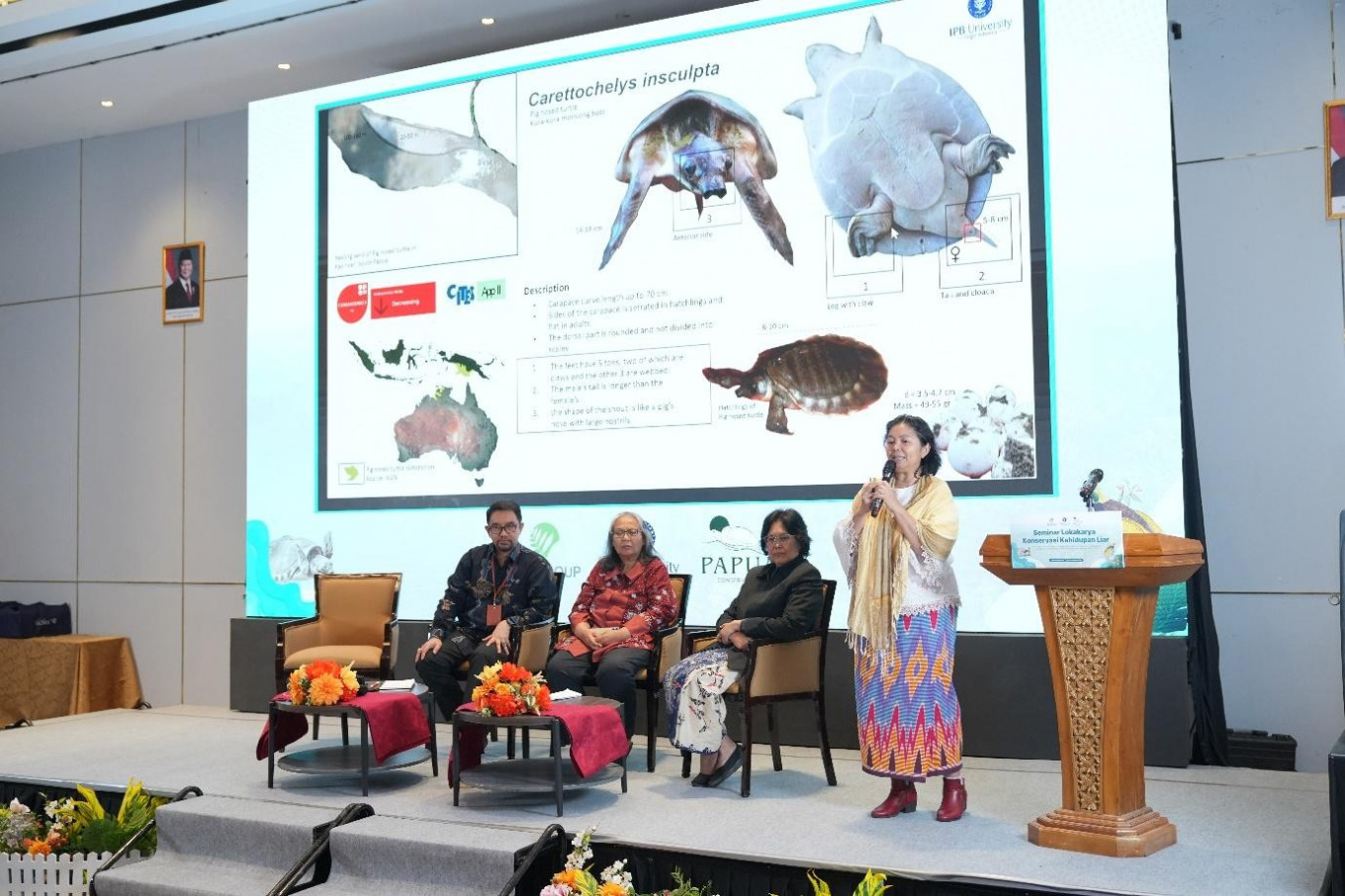
The findings were presented at a wildlife seminar and workshop titled “Melindungi Ikon Papua: Pemantauan Jangka Panjang Kura-kura Moncong Babi dan Cenderawasih” (Protecting Papua’s Icons: Long-Term Monitoring of Pig-Nosed Turtles and Birds-of-Paradise) held on Feb. 6. The event marked part of a long-term research collaboration between IPB University and TSE Group that has been underway since 2022.
The study recorded consistent occurrences of greater birds-of-paradise (Paradisaea apoda) within TSE Group’s managed forests, where selective harvesting practices are applied. Over the course of the research, more than 100 individual birds were identified across two forest concessions, with approximately half of the monitored area classified as having high habitat suitability.
Researchers also successfully documented lekking (mating) behavior and identified lek sites and food-producing trees that are critical to the species’ long-term survival.
Prof. Ani Mardiastuti, who led the greater birds-of-paradise research, noted that forest management practices which maintain high conservation value areas and apply selective harvesting contribute significantly to the preservation of endemic bird species in Papua.
On the freshwater side, the study found that climate change is becoming an increasingly decisive factor in the breeding success of pig-nosed turtles. Extreme rainfall and flooding events along the Kao River have caused repeated spawning failures during several observation periods, highlighting the need for conservation strategies that integrate habitat protection with climate adaptation measures.
Prof. Mirza D. Kusrini, who researches the pig-nosed turtle, emphasized the importance of long-term monitoring to understand the effects of weather anomalies on wildlife life cycles.
“Extended observation is essential for understanding how weather anomalies affect breeding success. By working closely with local communities, we can ensure conservation efforts continue sustainably,” he said.
TSE Group Director Wicklief F. Leunufna reaffirmed the company’s commitment to environmental and wildlife conservation.
“Through our research collaboration with IPB University, we aim to continuously align our operations with evidence-based conservation practices,” he said.
Dean of IPB University’s Faculty of Forestry and Environment, Prof. Dodik Ridho Nurrochmat, expressed hope that the research would inform future regional policymaking.
“We hope this forum serves as a platform for knowledge exchange, as well as a source of stakeholder input and mandate to ensure our research remains aligned with the need for actionable policies,” he said.
South Papuan Governor Apolo Safanpo stressed the importance of data-driven research in public policy formulation. “Credible scientific studies ensure that development decisions and natural resource management respect both people and the planet,” he said.
Overall, the joint project between IPB University and TSE Group encompasses wildlife population monitoring, protection of high conservation value areas, and the development of technical recommendations for managing key species. The results are expected to serve as an important reference for local administrations, businesses and other stakeholders in strengthening wildlife and ecosystem conservation efforts in Papua, particularly amid the growing challenges from climate change.