TheJakartaPost
Please Update your browser
Your browser is out of date, and may not be compatible with our website. A list of the most popular web browsers can be found below.
Just click on the icons to get to the download page.


Popular Reads
Top Results
No results found. Please check your search term and try again
Can't find what you're looking for?
View all search results
Popular Reads
Top Results
No results found. Please check your search term and try again
Can't find what you're looking for?
View all search resultsElusive wild cat feared extinct rediscovered in Thailand
Flat-headed cats are among the world's rarest and most threatened wild felines which range is limited to Southeast Asia and they are endangered because of dwindling habitat.
Change text size
Gift Premium Articles
to Anyone
Share the best of The Jakarta Post with friends, family, or colleagues. As a subscriber, you can gift 3 to 5 articles each month that anyone can read—no subscription needed!
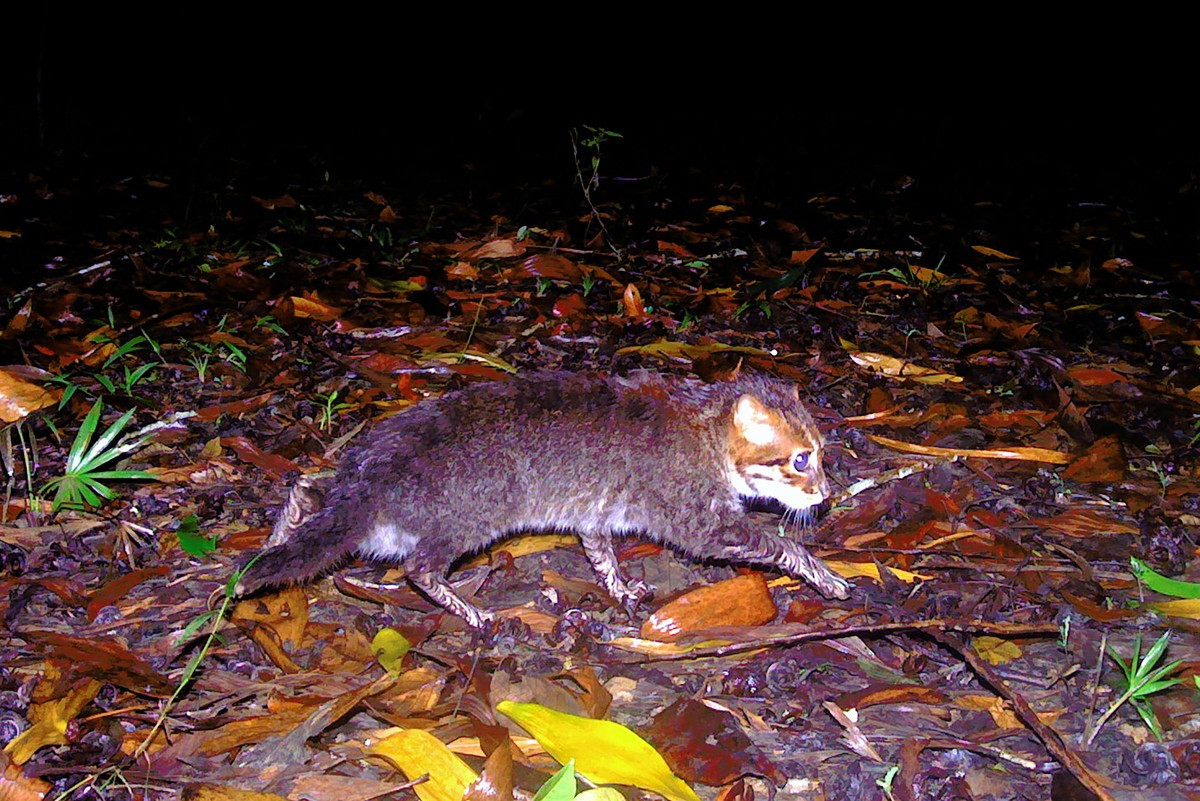 This handout picture taken with a camera trap and released on Dec. 26, 2025, by Thailand's Department of National Parks, Wildlife and Plant Conservation (DNP) and Panthera Thailand shows a recently rediscovered flat-headed cat in southern Thailand's Princess Sirindhorn Wildlife Sanctuary. An elusive wild cat long feared extinct in Thailand has been rediscovered, nearly three decades after the last recorded sighting, conservation authorities said on Dec. 26, 2025. (AFP/Handout/Thailands's Department of National Parks, Wildlife and Plant Conservation (DNP)/Panthera Thailand)
A
n elusive wild cat long feared extinct in Thailand has been rediscovered three decades after the last recorded sighting, conservation authorities and an NGO said Friday.
Flat-headed cats are among the world's rarest and most threatened wild felines. Their range is limited to Southeast Asia and they are endangered because of dwindling habitat.
The domestic cat-sized feline with its distinctive round and close-set eyes was last spotted in a documented sighting in Thailand in 1995.

But an ecological survey that began last year, using camera traps in southern Thailand's Princess Sirindhorn Wildlife Sanctuary, recorded 29 detections, according to the country's Department of National Parks, Wildlife and Plant Conservation and wild cat conservation organisation Panthera.
"The rediscovery is exciting, yet concerning at the same time," veterinarian and researcher Kaset Sutasha of Kasetsart University told AFP, noting that habitat fragmentation has left the species increasingly "isolated".
It was not immediately clear how many individuals the detections represent, as the species lacks distinctive markings so counting is tricky.
But the findings suggest a relatively high concentration of the species, Panthera conservation programme manager Rattapan Pattanarangsan told AFP.
The footage included a female flat-headed cat with her cub; a rare and encouraging sign for a species that typically produces only one offspring at a time.
Nocturnal and elusive, the flat-headed cat typically lives in dense wetland ecosystems such as peat swamps and freshwater mangroves, environments that are extremely difficult for researchers to access, Rattapan said.
Globally, the International Union for Conservation of Nature estimates that around 2,500 adult flat-headed cats remain in the wild, classifying the species as endangered. In Thailand, it has long been listed as "possibly extinct".
Thailand's peat swamp forests have been heavily fragmented, largely due to land conversion and agricultural expansion, said Kaset, who was not involved in the ecological survey but has researched wild cats for years.
The animals also face mounting threats from disease spread by domestic animals, and they struggle to reproduce across isolated areas.
While the rediscovery offers hope, it is only a "starting point" for future conservation efforts, he said.

"What comes after this is more important: how to enable them to live alongside us sustainably, without being threatened."


More from The Weekender

Show up, show off and call it self-care: Strong is the new flex
With toned arms as the new status symbol, maybe it’s time we rethink why we come to the gym and pick up those dumbbells.

When a friend becomes a stranger: Healing after a platonic breakup
We expect heartbreak in romance, but no one warns us how much it hurts when a friendship falls apart.

The power of small acts: Glimmers of hope from 2025
In a year marked by despair, it was small, human acts that broke through the noise, reminding us that hope doesn’t vanish. It’s passed hand to hand, one person to another.