TheJakartaPost
Please Update your browser
Your browser is out of date, and may not be compatible with our website. A list of the most popular web browsers can be found below.
Just click on the icons to get to the download page.


Popular Reads
Top Results
No results found. Please check your search term and try again
Can't find what you're looking for?
View all search results
Popular Reads
Top Results
No results found. Please check your search term and try again
Can't find what you're looking for?
View all search resultsWhy Indonesian K-pop fans are boycotting a Korean bank
They are putting pressure on Hana Bank to end loans tied to coal-fired power in Indonesia.
Change text size
Gift Premium Articles
to Anyone
Share the best of The Jakarta Post with friends, family, or colleagues. As a subscriber, you can gift 3 to 5 articles each month that anyone can read—no subscription needed!
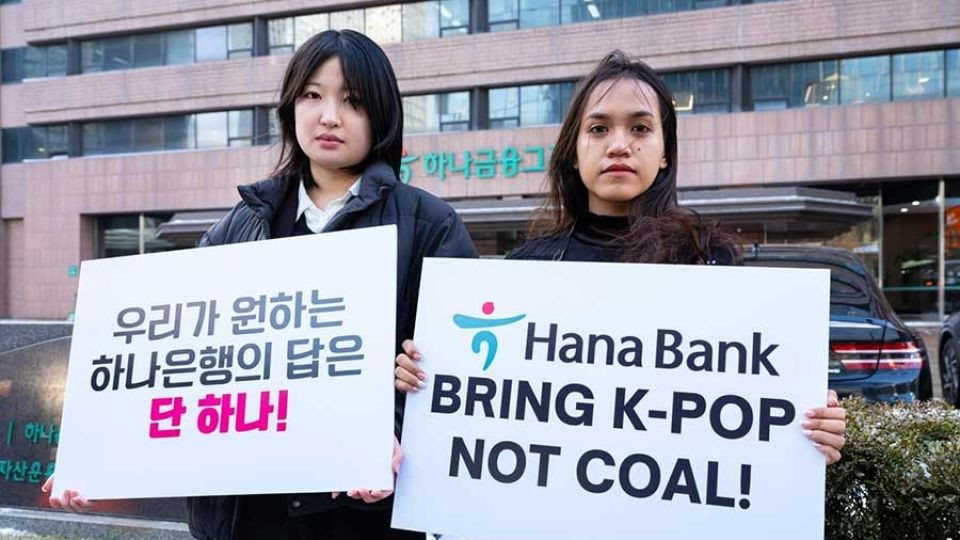 Lee Da-yeon (left) and Nurul Sarifah of Kpop4planet, a global K-pop fans forum, hold signs demanding that Hana Bank cease funding nickel projects on Feb. 2, 2026. (ANN/The Korea Herald/Kpop4planet)
I
ndonesian K-pop fans are calling out a major South Korean bank over its financing of coal-linked industrial projects, showing fan communities’ potential to mobilize as political and social actors.
Kpop4planet, a global climate advocacy platform created by K-pop fans, voiced opposition against Hana Bank’s overseas lending to Indonesia’s major nickel producer Harita Group. It said that the company’s use of coal-fired power stations negatively affects the climate, contradicting the bank’s climate pledges and its public image that K-pop stars have helped to shape.
Hana Bank, a Korean financial institution widely used by Indonesians, has employed K-pop stars including G-Dragon and Ive’s Ahn Yu-jin to promote its brand among young users.

Representing more than 280,000 followers across social media, Kpop4Planet and 12 Indonesian K-pop fan clubs have been staging the “Hana, Bring K-pop, Not Coal” campaign since December.
They argue the bank has continued lending to Harita Group on Obi Island in North Maluku, where new coal-fired power plants supply energy to a rapidly expanding nickel-processing industry.
Obi Island has rapidly transformed into a major industrial hub as global demand for nickel surges, fueled by the rise of electric vehicles and battery production. Much of its nickel-processing activity depends on coal-fired power stations.
According to Indonesian media outlets and Dutch-based watchdog Recourse, Hana Bank’s Indonesian subsidiary helped arrange a syndicated loan worth $530 million in 2022 for a Harita Group affiliate.
The funds were used for debt repayment and the construction of a nickel smelter on the island. Global Energy Monitor estimates the coal plants powering facilities there already exceed 1,630 megawatts, with Harita planning to expand capacity beyond 4 gigawatts.
Harita’s annual emissions already account for around 1 percent of Indonesia’s total and are projected to nearly double by 2028.
Campaigners say the practice contradicts Hana Financial Group’s own pledge to exit coal financing, announced in 2021.
“What used to be a lush Obi Island is now suffering from severe environmental destruction,” the fan groups said in their open letter to Hana Bank. “The carbon emissions and pollution from coal expansion, enabled by Hana Bank’s financing, will fall squarely on future generations.”
Responding to the criticism, Hana Bank told The Korea Herald that it has not provided project financing for any new coal-related ventures since declaring its coal-exit policy in 2021.
The bank emphasized that its involvement in the Indonesian nickel smelter project was not as an arranger but as a minor participant in a syndicated loan.

Hana Bank confirmed that its Indonesian subsidiary joined a $530 million syndicated loan extended in 2022 to an affiliate of Harita Group alongside DBS and UOB, but said its contribution amounted to only $15 million and has since been fully repaid.
The bank said it later participated in a $500 million refinancing round in 2024 with a $30 million commitment, of which about $25.5 million remains outstanding.
The bank also contended that avoiding all lending to companies that indirectly use electricity generated from coal-fired power plants is “realistically difficult,” noting that this is a challenge shared by other financial institutions operating in emerging markets.
Kpop4Planet campaigner Nurul Sharifah said that the sensitivity of coal-fired industrial plants in regions like North Maluku, where many communities still lack stable electricity.
“In places like South Halmahera, where Obi Island is located, people still struggle to access electricity, so self-sustaining coal plants that bring no community benefit are a major point of criticism,” she said.
Sharifah, who traveled to Seoul to deliver fans’ views directly to Hana Bank, described herself as a decadelong fan of Exo’s D.O., saying she felt “betrayed” when she learned a Korean bank supported a coal-dependent project abroad.
“We love K-pop, so we care about the future our idols will live in,” Sharifah said.
Founded in 2021, Kpop4planet describes itself as a platform where K-pop fans advocate for climate justice in solidarity with communities often excluded from environmental debates — including young people, Indigenous groups, women, the Global South and LGBTQ+ communities.
Scholars have described K-pop fans as among the most mobilized online collectives on the planet — long recognized for their digital coordination.
K-pop fan communities maintain dense communication networks across social media platforms, operate volunteer-run teams and have experience coordinating mass donations, fundraising drives and campaigns.
“While fandoms typically organize around artists, they have evolved into communities with strong internal norms around justice, inclusion and collective action,” culture critic Ha Jae-geun explained.
In Indonesia, where K-pop has a massive youth following, fans have previously mobilized for social causes ranging from disaster relief to political transparency.
“The campaign against Hana Bank highlights how global fandoms now expect corporations endorsed by K-pop stars to uphold social and climate responsibility, not just leverage idol images for marketing,” Ha added.
“The issue is not only environmental, but also relational. There is a sense that corporate behavior should align with the values associated with the artists they admire,” Ha said.
The Indonesian fan groups say they will continue their campaign until Hana Bank clearly commits to ending coal-related financing. “We will not stop until Hana Bank provides a clear answer and ends financing for industries dependent on coal-fired power,” the group said.
“K-pop fans are known for their solidarity and persistence.”
More from The Weekender

The price you pay for living in Jakarta
It doesn't really matter where you live, Jakarta is expensive everywhere. The only real choice is what you're willing to pay with: your money, your time or your sanity.

Success isn’t at the top of the corporate ladder anymore
My generation watched our parents give everything to a company. We decided to give it to ourselves instead. But it's more complicated than that.

Our second Instagram account is the real one
In an act of rebellion against overexposure and performative social media, Gen Z are turning to smaller, controlled spaces on social media where they can be their authentic selves.