TheJakartaPost
Please Update your browser
Your browser is out of date, and may not be compatible with our website. A list of the most popular web browsers can be found below.
Just click on the icons to get to the download page.


Popular Reads
Top Results
No results found. Please check your search term and try again
Can't find what you're looking for?
View all search results
Popular Reads
Top Results
No results found. Please check your search term and try again
Can't find what you're looking for?
View all search resultsNASA defense test changed asteroid's orbit around the sun: Study
The successful experiment to deflect an asteroid as well as additional analysis offers a solid data point to mount a defense if any such eventual threat is detected, researchers said.
Change text size
Gift Premium Articles
to Anyone
Share the best of The Jakarta Post with friends, family, or colleagues. As a subscriber, you can gift 3 to 5 articles each month that anyone can read—no subscription needed!
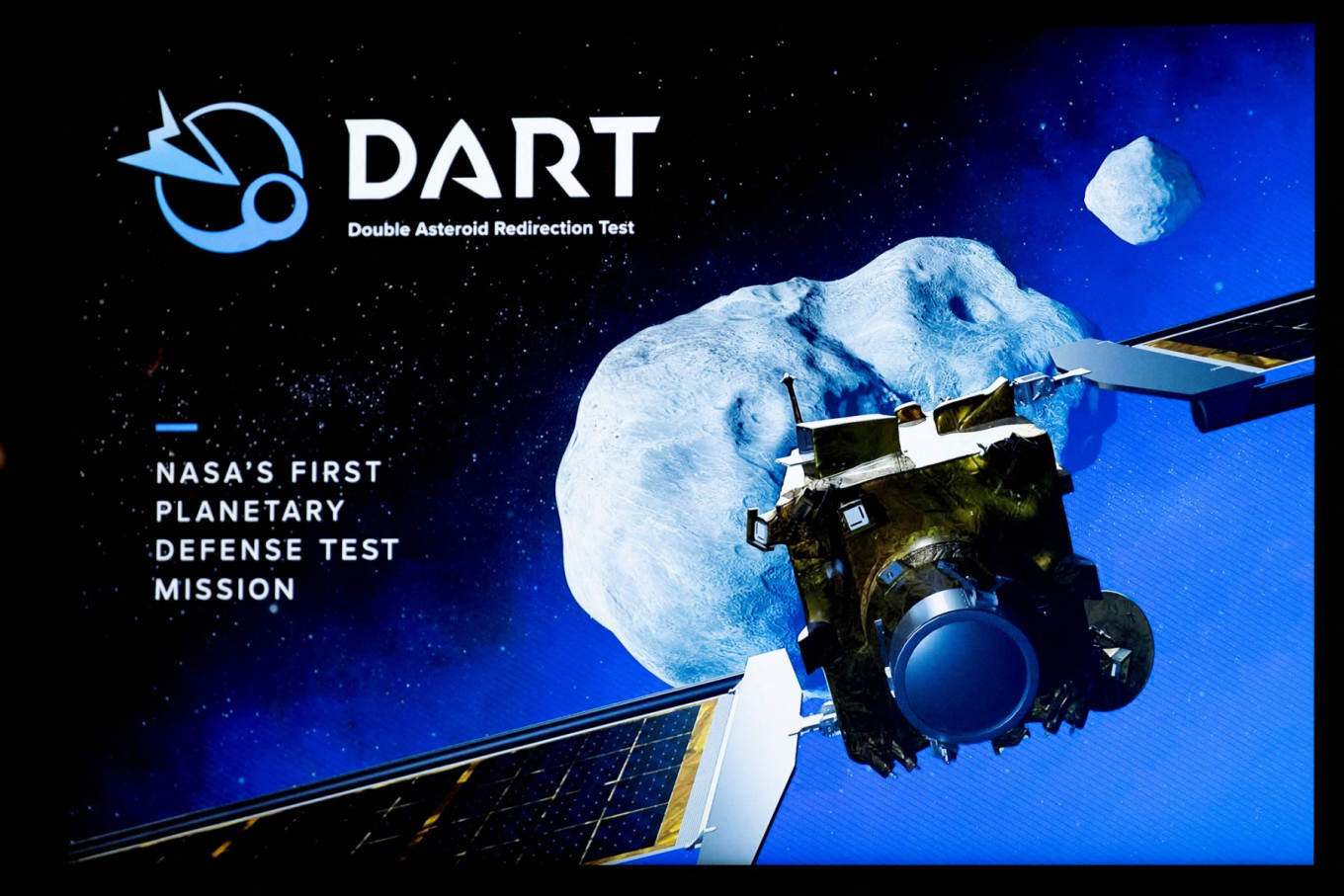 A placard hangs on the wall during the Double Asteroid Redirection Test (DART) Technology Media Workshop Telecon Briefing and tour at the Johns Hopkins Applied Physics Laboratory in Laurel, Maryland, the United States on Sept. 12, 2022, ahead of the Sept. 26 project test mission. The DART mission aims to shift an asteroid's orbit through kinetic impact, specifically by smashing a spacecraft into the smaller member of the binary asteroid system Didymos. (AFP/Jim Watson)
F
our years ago, NASA purposely smashed a spacecraft into a small asteroid to see if they could deflect it, a test to prove humanity could protect Earth from threatening space rocks.
The experiment pushed the moonlet asteroid Dimorphos into a smaller, faster route around its sibling Didymos. And according to new research out Friday, it also pushed the pair into a slightly different orbit around the Sun.
The test on Dimorphos was never based on any actual threat to our planet. But the successful experiment and additional analysis offers a solid data point to mount a defense if any such eventual threat is detected, researchers said.
"This study marks a notable step forward in our ability to prevent future asteroid impacts on Earth," the team of international researchers wrote in their new paper published in the journal Science Advances.
Their observations detailed in the paper showed that the Double Asteroid Redirection Test (DART) in 2022 marked "the first time a human-made object has measurably altered the path of a celestial body around the Sun," NASA said in a statement.
Rahil Makadia, the study's lead author, told AFP his team tracked stellar occultations, or the moment when an asteroid passes in front of a star and causing a brief dimming for less than a second, to obtain hyper-precise measurements of the asteroid's position, speed and shape.
Obtaining this data is no small feat. The team relied on volunteer astronomers from around the globe, who recorded 22 of these stellar occultations.
Using that data along with years of additional observations, Makadia said the team was able to measure Didymos's orbit around the sun with precision.
"We were able to measure what this change was exactly," he said, and make computations that could assist with future "planetary defense efforts."
The orbital change was miniscule, just 0.15 seconds. But it's enough to make a difference, scientists say.
"This is a tiny change to the orbit, but given enough time, even a tiny change can grow to a significant deflection," said Thomas Statler, lead scientist for solar system small bodies at NASA Headquarters in Washington, in a statement.
"The team's amazingly precise measurement again validates kinetic impact as a technique for defending Earth against asteroid hazards and shows how a binary asteroid might be deflected by impacting just one member of the pair."