The Jakarta Post
Please Update your browser
Your browser is out of date, and may not be compatible with our website. A list of the most popular web browsers can be found below.
Just click on the icons to get to the download page.


Popular Reads
Top Results
No results found. Please check your search term and try again
Can't find what you're looking for?
View all search results
Popular Reads
Top Results
No results found. Please check your search term and try again
Can't find what you're looking for?
View all search resultsGerman philosopher Jurgen Habermas dies age 96
He died at the age of 96 in Starnberg, in southern Germany, she said, citing information from the family of the politically engaged theorist.
Change text size
Gift Premium Articles
to Anyone
Share the best of The Jakarta Post with friends, family, or colleagues. As a subscriber, you can gift 3 to 5 articles each month that anyone can read—no subscription needed!
 Set as preferred source
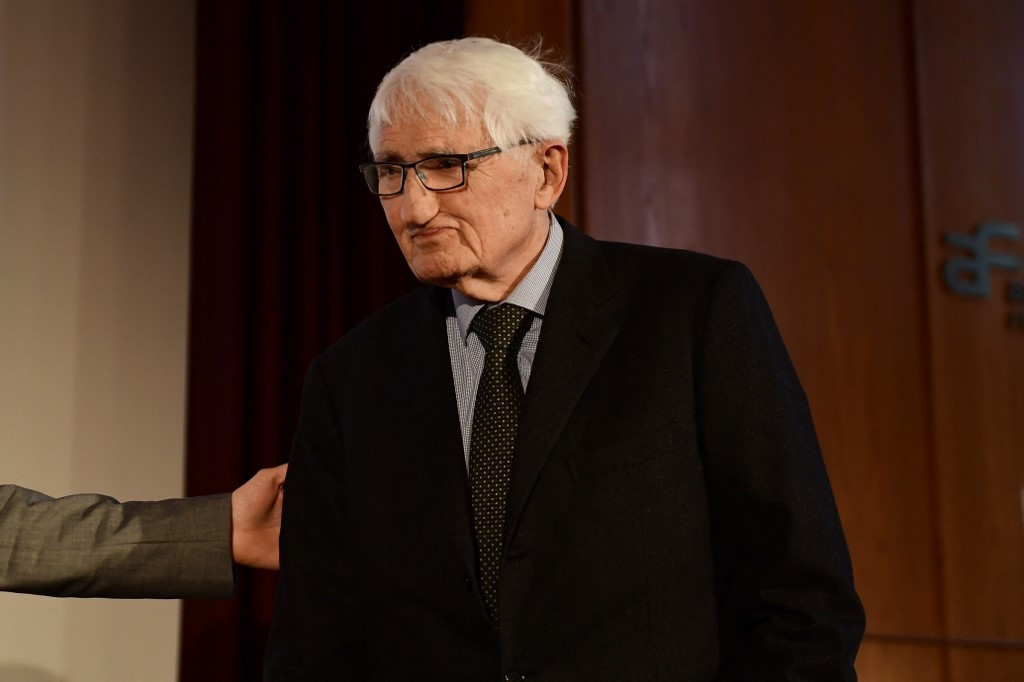 German philosopher Juergen Habermas comes on stage prior for a discussion on Europe's future with German Vice Chancellor and Foreign Minister Sigmar Gabriel, French presidential election candidate for the En Marche! movement Emmanuel Macron at the Hertie School of Governance in Berlin on March 16, 2017. (AFP/Tobias Schwarz)
The German philosopher Jurgen Habermas has died, a spokesperson for his publishing house, Suhrkamp Verlag, told AFP on Saturday.
He died at the age of 96 in Starnberg, in southern Germany, she said, citing information from the family of the politically engaged theorist.
Habermas was considered the most influential German philosopher of his generation, involved in all the major postwar debates and seeing a united Europe, in his view, as the only remedy for the rise of nationalism.

In his later years, he devoted himself to promoting a federal European project and prevent the continent from falling, as it did in the 20th century, into nationalist rivalries.
Throughout his life, Habermas linked philosophy and politics, thought and action.
After serving as the voice of German student protest in the 1960s, he became its target thirty years later while warning of the risks of "left-wing fascism".
In 1989, he criticised the terms of German reunification, guided essentially by the demands of the market, and which made "the Deutsche mark its standard."
Born on June 18, 1929 in Duesseldorf, Habermas had been enrolled in the Hitler Youth, but he was too young to have taken an active part in the war. As a teenager, he was deeply marked by the collapse of Nazism.
In 2021, Habermas reversed an earlier decision to accept the one-million-dirham ($272,000) prize from the UAE's Sheikh Zayed Book Award, saying he had been unaware of its links to the government.
According to a statement sent to Der Spiegel by his publisher, Suhrkamp, Habermas saw his initial acceptance of the award as "the wrong decision which I am now putting right".
"I hadn't informed myself about the close link between the institution that gives these prizes in Abu Dhabi and the political system there," he added.
The Sheikh Zayed Book Award, named after the UAE's founding father, hands out gold medals and cash prizes totalling some $1.9 million each year.
It had declared Habermas "Cultural Personality of the Year" on April 30 "in recognition of a long career that extends for more than half a century", according to a statement.
"The Sheikh Zayed Book Award expresses its regret for Mr Jurgen Habermas' decision to retract his acceptance of the award but respects it," it said in another statement on Monday.
"The award embodies the values of tolerance, knowledge and creativity while building bridges between cultures, and will continue to fulfil this mission."

More from The Weekender
Travels in the land of Gen Z (Part 2)
Beyond the fragility and short attention span, my students proved sharper, more open-minded and more generous than I’d expected. Second of two parts. Read the first here.

Is AI really making us better workers?
AI can make our work faster and more polished. But by eliminating the struggle, mistakes and imperfections, it may also be eliminating some of the ways we learn and become better workers.

Travels in the land of Gen Z
To become a professor to Gen Z today is to take a disorienting journey to an exotic land. First of two parts.