The Jakarta Post
Please Update your browser
Your browser is out of date, and may not be compatible with our website. A list of the most popular web browsers can be found below.
Just click on the icons to get to the download page.


Popular Reads
Top Results
No results found. Please check your search term and try again
Can't find what you're looking for?
View all search results
Popular Reads
Top Results
No results found. Please check your search term and try again
Can't find what you're looking for?
View all search resultsGrowth without gain: Why Indonesians don't feel the economy
While Indonesia's headline GDP suggests an economic triumph, a deeper look at GNP reveals a hollow growth, where wealth flows outward rather than into households. The country’s impressive statistics are failing to move the needle for the middle class and the informal workers who anchor the economy.
Change text size
Gift Premium Articles
to Anyone
Share the best of The Jakarta Post with friends, family, or colleagues. As a subscriber, you can gift 3 to 5 articles each month that anyone can read—no subscription needed!
 Set as preferred source
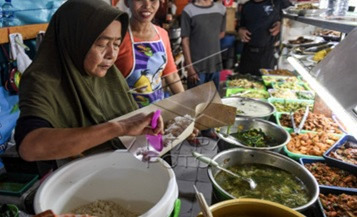 A food vendor serves customers in Jakarta on Feb. 22, 2024, at her ‘warteg’, a food stall specializing in the cuisine of Tegal, Central Java. (Antara/Muhammad Adimaja)
I
ndonesia's economy grew at a steady 5.2 percent through 2025 and into early 2026. On paper, that is a success story. Yet in practice, millions of Indonesians aren't buying it, because they aren't feeling it.
Household budgets remain tight, the middle class has stopped expanding, and a quiet frustration is building between what the macroeconomic data says and what people actually experience at the market, at the fuel pump and at the end of the month.
This is not a uniquely Indonesian problem. The United States posted roughly 2 percent growth in the first quarter of 2026, yet Americans remain consumed by anxieties over housing costs, grocery bills and a softening job market.
The pattern is the same on both sides of the development spectrum: The economy grows, but the people do not prosper. What was once a temporary divergence is beginning to look structural. The transmission belt that used to carry growth into household income is slipping.
In the US, the culprit is concentration. Growth has been concentrated in capital-intensive sectors like technology, where windfalls flow overwhelmingly to asset owners rather than to workers. Meanwhile, costs for housing, health care and education have outpaced median incomes for years. Gross domestic product climbs while purchasing power of ordinary families falls.
Indonesia's story is structurally different but arrives at the same unhappy destination. Data from Statistics Indonesia (BPS) show the middle class has stopped expanding: a striking reversal for a country that spent two decades lifting tens of millions out of poverty. Deposit data from the Deposit Insurance Corporation (LPS) reveal that savings are increasingly concentrated among higher-income groups. Growth is happening and the gains are going somewhere; they just aren't reaching most people.

To understand why, it helps to look beyond GDP to a measure that receives far less attention: gross national product. GDP measures the total value of goods and services produced within a country's borders, regardless of who owns the factors of production. GNP, however, measures the income that actually accrues to a country's residents, capturing what flows in from abroad and subtracting what flows out. In an economy increasingly shaped by foreign investment and multinational supply chains, that gap matters enormously.