The Jakarta Post
Please Update your browser
Your browser is out of date, and may not be compatible with our website. A list of the most popular web browsers can be found below.
Just click on the icons to get to the download page.


Popular Reads
Top Results
No results found. Please check your search term and try again
Can't find what you're looking for?
View all search results
Popular Reads
Top Results
No results found. Please check your search term and try again
Can't find what you're looking for?
View all search resultsOutsourcing reform: Protection with two-tier responsibility
A new regulation stated that the protection of outsourced workers, including wages, overtime, social security and severance, is the responsibility of the outsourcing firm, while the principal company's role is to ensure compliance.
Change text size
Gift Premium Articles
to Anyone
Share the best of The Jakarta Post with friends, family, or colleagues. As a subscriber, you can gift 3 to 5 articles each month that anyone can read—no subscription needed!
 Set as preferred source
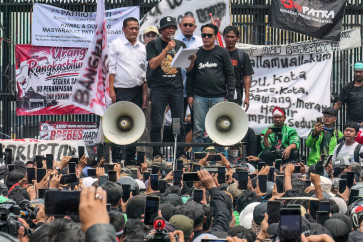
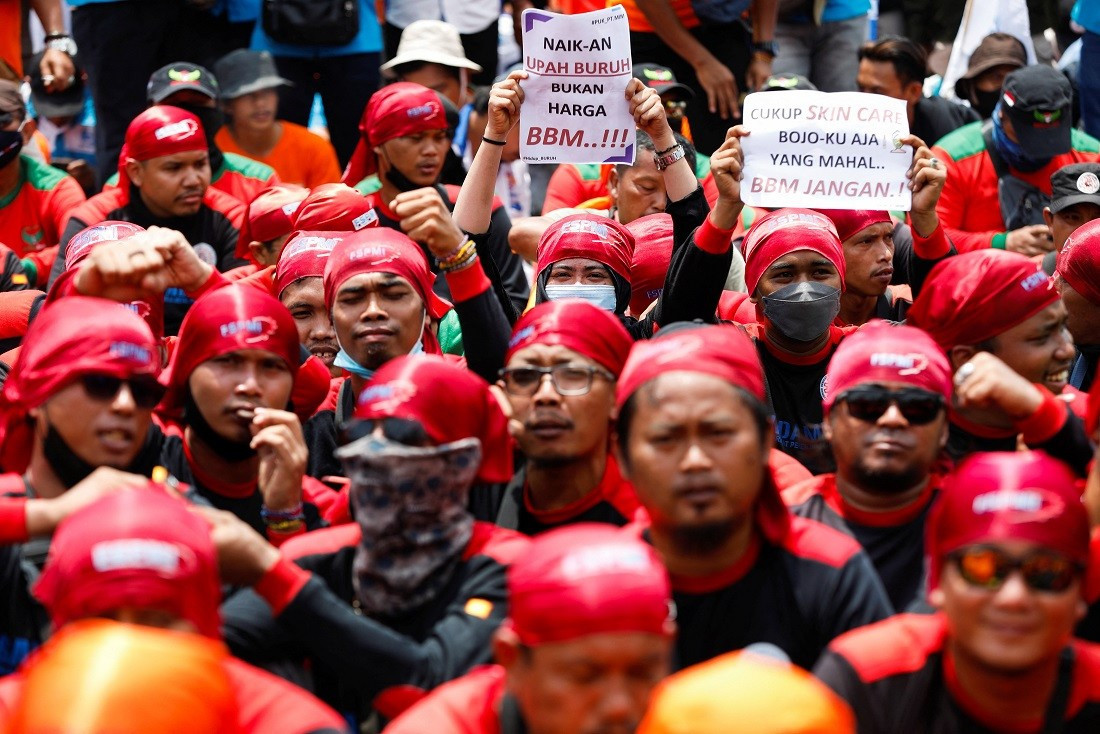 Members of labor organizations protest on Sept. 6, 2022, outside the House of Representatives building in Central Jakarta. (Reuters/Ajeng Dinar Ulfiana)
O
ne day before International Labor Day 2026, the government signed a long-awaited regulation on outsourced work. Manpower Minister Regulation (Permenaker) No. 7/2026 restores limits on the types of work that can be outsourced, reversing the broad flexibility introduced by the Job Creation Law five years earlier.
At its core, the regulation is not simply a pro-labor correction. It is an attempt to rebuild Indonesia's outsourcing market around a clearer bargain: companies may still buy specialization, but they should no longer buy ambiguity over who is responsible for workers' rights.
Indonesia's outsourcing rules have come full circle in two decades. The 2003 Labor Law originally treated outsourcing as a narrow exception, permitted only for noncore supporting activities. For years, the principle was clear: outsourcing belonged at the periphery of business operations, not at their core.
The 2020 Job Creation Law changed that balance. By removing the restrictions on which jobs could be outsourced, it gave companies wider flexibility to contract out work across business functions.
The intention was to improve investment competitiveness and labor market flexibility. But in practice, the change also blurred the line between genuine business specialization and regulatory arbitrage. Outsourcing could be used not only to improve efficiency, but also to limit employer obligations and weaken employment stability.
The Constitutional Court, through Decision No. 168/PUU-XXI/2023, pushed the system back toward clearer limits. Permenaker 7/2026 is the operational response to that ruling. It limits outsourcing to supporting activities, including cleaning services, food and beverage provision, security, driver and worker transportation, operational support and supporting work in mining, oil and gas, as well as electricity.

The economic logic deserves emphasis. Outsourcing should indeed be a form of economic specialization that enhances productivity at principal companies while relying on specialized providers for supporting activities. A manufacturer does not need to build an in-house catering company. A bank does not need to operate its own security training system. A mining company may need specialized support services that require technical capability beyond its internal structure.
The most important feature of the new framework is the "two-tier responsibility" architecture. Article 4 of the Permenaker is explicit: the protection of outsourced workers, including wages, overtime, social security and severance, is the responsibility of the outsourcing firm. The principal company's role is to ensure compliance, not to bear direct obligations.
This division is important. If properly implemented, it can reduce ambiguity in the outsourcing market. Principal companies gain certainty, outsourcing firms gain space to develop as specialized industries and workers receive consistent protection from accountable employers.
The Permenaker has thus moved toward the right architecture and serves as a bridge to the new Labor Law. Yet the success of this architecture will depend less on the legal text itself and more on three factors: how clearly the boundaries are enforced, how capable outsourcing firms are and whether workers' accumulated rights are preserved when vendors change.
The first issue is boundary clarity. The regulation limits outsourcing to supporting activities, but one category deserves close attention: operational support. Without clearer guidance, this phrase risks becoming a gray zone, allowing firms to relabel core functions as supporting work.
But the boundary problem is not only about what types of work can be outsourced. It is also about how workers inside outsourcing companies are employed. Using BPS data (2025), our calculation suggests the scale of this challenge: among 18.4 million workers in fixed-term arrangements (PKWT), 23.7 percent have been employed for more than 10 years and nearly two-thirds have worked beyond two years. These figures suggest that fixed-term contracts have, in practice, become long-term arrangements rather than temporary ones. The new law can clarify that outsourcing companies are expected to act as genuine employers building stable workforces, not merely renewing fixed-term contracts indefinitely.
The second concerns the capacity and accountability of outsourcing firms. The two-tier architecture works only if the first tier is strong enough to bear its responsibilities. If outsourcing firms are thinly capitalized, poorly governed or dependent on short-term contracts with principal companies, workers' rights remain vulnerable. Regional experience offers useful reference points. Vietnam requires outsourcing firms to obtain a Labor Outsourcing License and provide a financial guarantee fund. The Philippines requires contractors to maintain a paid-up capital of 5 million peso (US$81,000). These requirements are not protectionist barriers but quality controls that protect workers, principal companies and the integrity of the outsourcing market itself.
The third is the portability of accumulated rights when an outsourcing vendor changes. When a vendor changes while the underlying work continues, workers' tenure-based benefits effectively reset to zero. The right solution lies in portability between outsourcing firms through an industry-wide fund or expanded coordination with the existing social security system. South Korea has built such mechanisms with notable success and Indonesia is well-positioned to design one tailored to its own context.
A notable consequence of this policy shift is the likely increase in organic hiring. As companies can no longer outsource core functions, they will need to open permanent positions. While this offers better stability, it also raises the bar for qualifications. This is a crucial moment for workers in non-supporting sectors to upgrade their skills. The government, in turn, must expand development programs to facilitate this transition.
Permenaker 7/2026 has laid an important foundation. It restores the principle of specialization and clarifies the allocation of responsibility. The forthcoming Labor Law has the opportunity to complete this architecture by ensuring outsourcing firms are accountable, employment is stable and workers' accumulated rights are preserved.
Indonesia does not need to choose between worker protection and business flexibility. A better outsourcing regime can provide both. But that requires a clear rule of the game: companies may outsource specialization, but they should not outsource responsibility.
*****
The writer is an analyst at Mandiri Institute.