The Jakarta Post
Please Update your browser
Your browser is out of date, and may not be compatible with our website. A list of the most popular web browsers can be found below.
Just click on the icons to get to the download page.


Popular Reads
Top Results
No results found. Please check your search term and try again
Can't find what you're looking for?
View all search results
Popular Reads
Top Results
No results found. Please check your search term and try again
Can't find what you're looking for?
View all search resultsCurrency under pressure: Has de-dollarization begun?
One long-term consequence of the Trump administration's current policies is that the US dollar could start to lose its status as the world’s currency.
Change text size
Gift Premium Articles
to Anyone
Share the best of The Jakarta Post with friends, family, or colleagues. As a subscriber, you can gift 3 to 5 articles each month that anyone can read—no subscription needed!
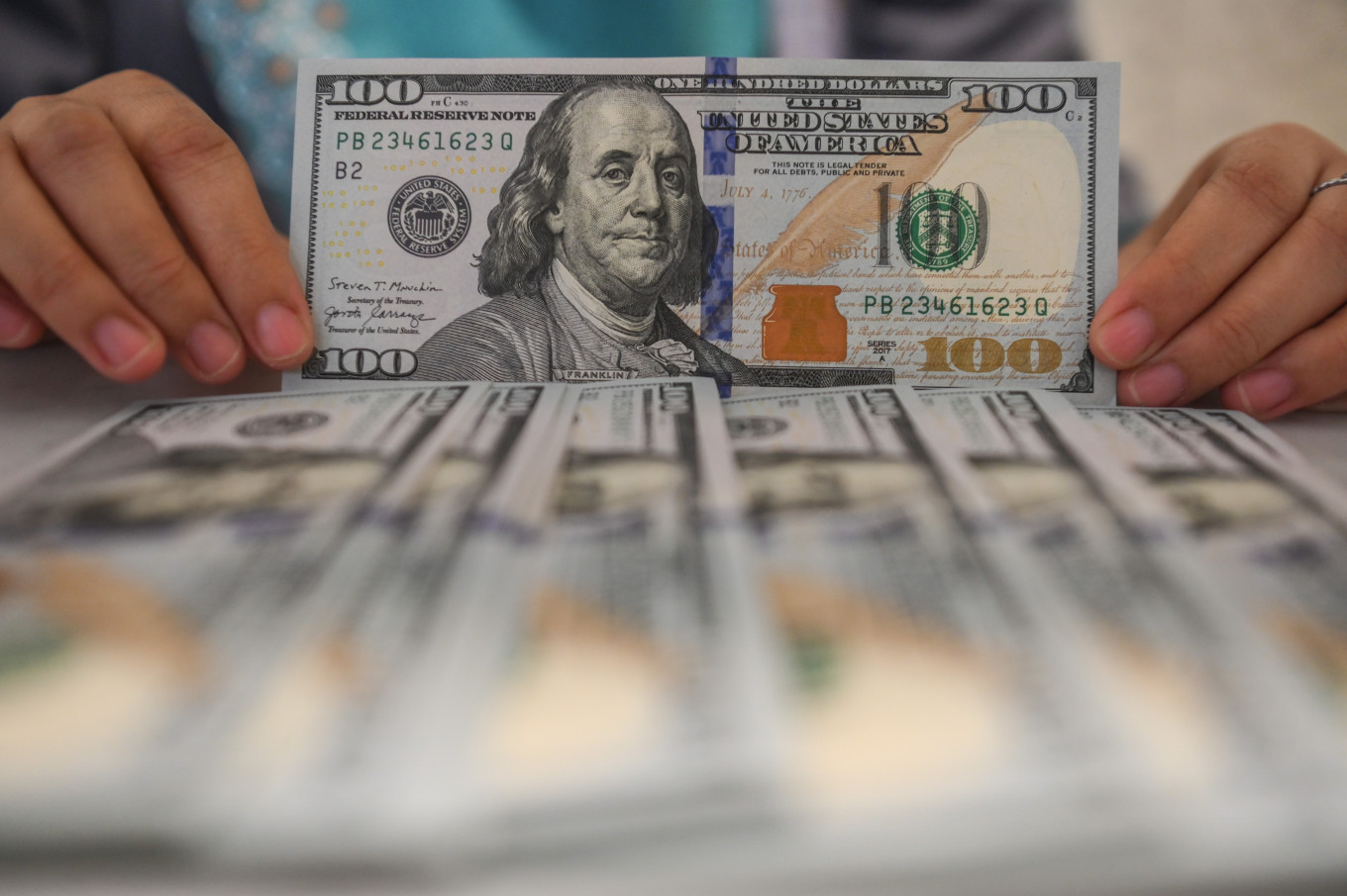 A clerk holds up a United States banknote on Jan. 21, 2026, at a Bank Syariah Indonesia branch in South Tangerang, Banten. (Antara/Hafidz Mubarak A)
A
s the economic consequences of United States President Donald Trump’s war against Iran become evident, policymakers around the world are running out of patience. The recent Spring Meetings of the International Monetary Fund and World Bank in Washington made this abundantly clear, with the United Kingdom’s Chancellor of the Exchequer Rachel Reeves lamenting the “folly” of a war that is “not ours.”
But much of the cost will be borne by the US itself. The immediate effects are visible: a sharp rise in gas prices, inflation climbing to a two-year high and growing concerns that, as consumers cut back on spending to offset higher costs, unemployment will rise. While these short-term shocks are serious, a major risk that has received less attention is that the dollar could lose its status as the world’s primary trade and reserve currency.
The decline of a reserve currency is a slow process: The British pound ceded its dominance to the US dollar over roughly two decades that began in the 1920s. As Barry Eichengreen has noted, the Roman denarius, arguably the world’s first international currency, also unraveled over a long period that started when Emperor Nero debased it in the 1st century AD.
Any international currency ultimately depends on trust. I witnessed this during my time as chief economic adviser to the Indian government under prime minister Manmohan Singh.
On Aug. 5, 2011, S&P downgraded the US long-term credit rating from AAA to AA+, fueling fears of immediate capital flight. Instead, the opposite happened: Money flowed into the US economy. In the face of global turbulence, investors trusted that the US would honor its obligations, no matter the cost.
That trust, a cornerstone of soft power, is rapidly eroding.

Samantha Power, the former administrator of the US Agency for International Development (USAID), highlighted this in a recent lecture at Cornell University, where she criticized the Trump administration’s decision to dismantle the agency. The abrupt and “heartless” manner in which it was shut down, she said, halted humanitarian aid without warning, leading to immense suffering among populations around the world that had depended on its continuity.