The Jakarta Post
Please Update your browser
Your browser is out of date, and may not be compatible with our website. A list of the most popular web browsers can be found below.
Just click on the icons to get to the download page.


Popular Reads
Top Results
No results found. Please check your search term and try again
Can't find what you're looking for?
View all search results
Popular Reads
Top Results
No results found. Please check your search term and try again
Can't find what you're looking for?
View all search resultsHumans far behind as robot breaks record at Beijing half marathon
Spectators lined the roads in Yizhuang in the capital's south to watch the machines and their human rivals race, each group in a separate lane to avoid accidents or collisions.
Change text size
Gift Premium Articles
to Anyone
Share the best of The Jakarta Post with friends, family, or colleagues. As a subscriber, you can gift 3 to 5 articles each month that anyone can read—no subscription needed!
 Set as preferred source
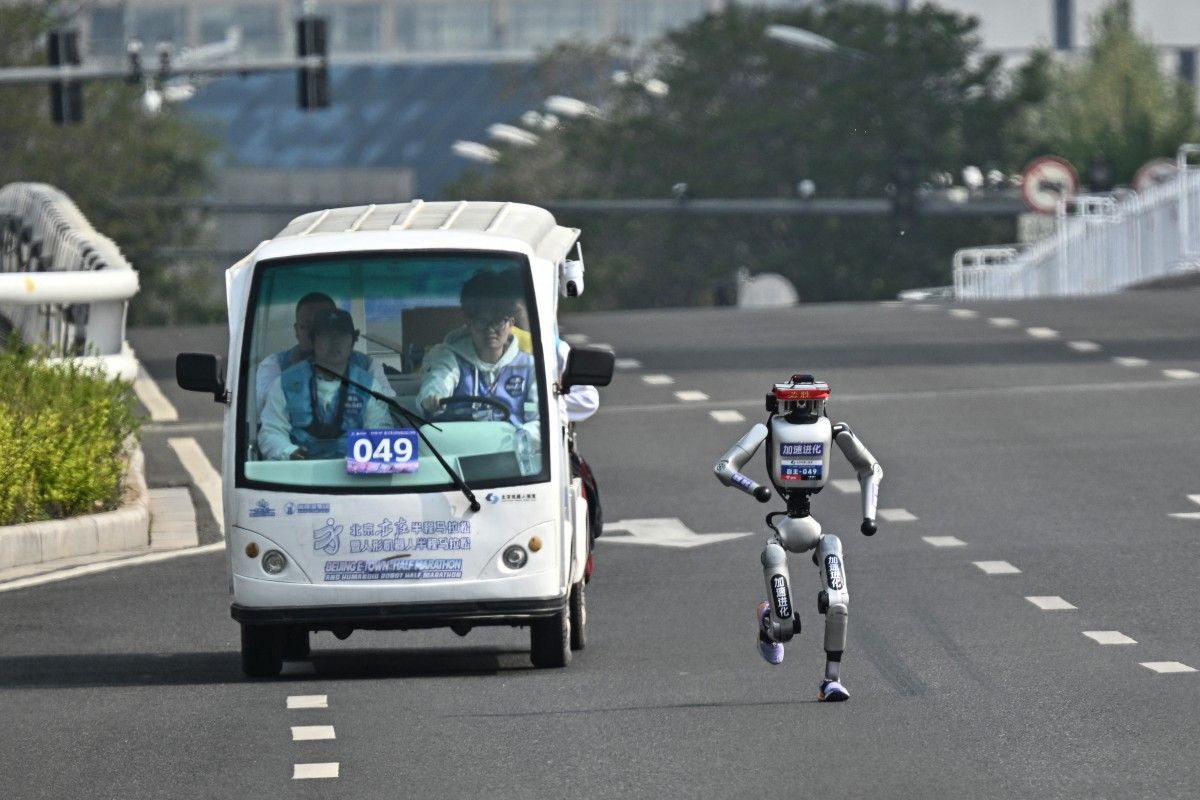 A robot and its engineers take part in the second Beijing E-Town Half Marathon and Humanoid Half Marathon in Beijing on April 19, 2026. (AFP/Pedro Pardo)
A
humanoid robot competing against flesh-and-blood runners broke the world record at a Beijing half marathon on Sunday, showcasing the rapid technological advancement achieved by Chinese makers.
Spectators lined the roads in Yizhuang in the capital's south to watch the machines and their human rivals race, each group in a separate lane to avoid accidents or collisions.
Some of the robots were highly agile, moving like famous runners such as Usain Bolt, while others had more basic capabilities.

The winning humanoid, equipped with an autonomous navigation system and running for Chinese smartphone maker Honor, completed the roughly 21-kilometre (13-mile) course in 50 minutes and 26 seconds, at an average speed of about 25 kilometres per hour, according to state broadcaster CCTV.
That was far faster than the top human in Sunday's race, while also surpassing the current men's world record of 57:20 held by Ugandan runner Jacob Kiplimo.
The result represented spectacular progress from last year, when robot-runners fell repeatedly and the best took more than two hours and 40 minutes to finish.
The number of humanoid entries jumped from around 20 last year to more than 100, according to organisers, a sign of the sector's growing popularity.
Han Chenyu, a 25-year-old student who watched the race from behind a safety barrier, barely had time to take out her phone and snap a picture of the leading robot as it whizzed past.
She told AFP she was enthusiastic about such leaps in technology and thought the event was "pretty cool".
But, she added, "as someone who works for a living, I'm a little worried about it sometimes. I feel like technology is advancing so fast that it might start affecting people's jobs", particularly with artificial intelligence growing increasingly sophisticated.
Humanoid robots have become a common sight in China in recent years, in the media as well as in public spaces.
Xie Lei, 41, who watched Sunday's race with his family, said robots could "become part of our daily lives" within several years, potentially used for "things like housework, elderly companionship or basic caregiving" or "dangerous jobs, even firefighting".
The humanoid half marathon aims to encourage innovation and popularise the technologies used in creating and operating such machines.

In a sign of the industry's strength, investment in robotics and so-called embodied AI amounted to 73.5 billion yuan ($10.8 billion) in China in 2025, according to a study by a government agency.
"For thousands of years, humans have been at the top on planet Earth. But now, look at robots. Just in terms of autonomous navigation, at least in this specific sport event, they're already starting to surpass us," Xie said.
"On one hand, it does make you feel a little bit sad for humanity. But at the same time, technology, especially in recent years, has given us so much imagination."
While economically viable applications of humanoid robots mostly remain in a trial phase, the half-marathon's showcasing of these machines' physical prowess highlights their potential to reshape everything from dangerous jobs to battlefield combat.
However, Chinese robotics firms are still struggling to develop the AI software that would enable humanoids to match the efficiency of human factory workers.
Experts said the skills on display during the half-marathon, while entertaining, do not translate to the widespread commercialisation of humanoid robots in industrial settings, where manual dexterity, real-world perception and capabilities beyond small-scale, repetitive tasks are crucial.
China is seeking to become a global powerhouse in this frontier industry, and it has enacted a wide range of policies from subsidies to infrastructure projects to cultivate local firms.
The country's most-watched TV show, the annual CCTV Spring Festival gala, in February showcased China's push to dominate humanoid robots and the future of manufacturing.
That included a lengthy martial arts demonstration where over a dozen Unitree humanoids performed sophisticated fight sequences waving swords, poles and nunchucks in close proximity to human children performers.



More from The Weekender

Of cats and writers
After 19 years, a beloved cat leaves behind more than memories: he survives in a family’s lore, two novels, and the peculiar bond between writers and their feline muses.

The girl I chose to forget
Growing up complicated a childhood love of Indonesia. Years later, an old song offers one young writer a way back: not to innocence, but to a more difficult kind of belonging.

A year after Affan: The anger that stayed
A year after Affan Kurniawan’s death, the fury that spilled into Jakarta’s streets has not disappeared. It has settled into other forms: exhaustion, distrust and a lingering sense that nothing has really changed.