The Jakarta Post
Please Update your browser
Your browser is out of date, and may not be compatible with our website. A list of the most popular web browsers can be found below.
Just click on the icons to get to the download page.


Popular Reads
Top Results
No results found. Please check your search term and try again
Can't find what you're looking for?
View all search results
Popular Reads
Top Results
No results found. Please check your search term and try again
Can't find what you're looking for?
View all search resultsFrustration in flood-stricken Sumatra as survivors await aid
In affected regions, there is growing frustration among survivors of catastrophic flooding and landslides over the pace of the rescue effort and aid delivery.
Change text size
Gift Premium Articles
to Anyone
Share the best of The Jakarta Post with friends, family, or colleagues. As a subscriber, you can gift 3 to 5 articles each month that anyone can read—no subscription needed!
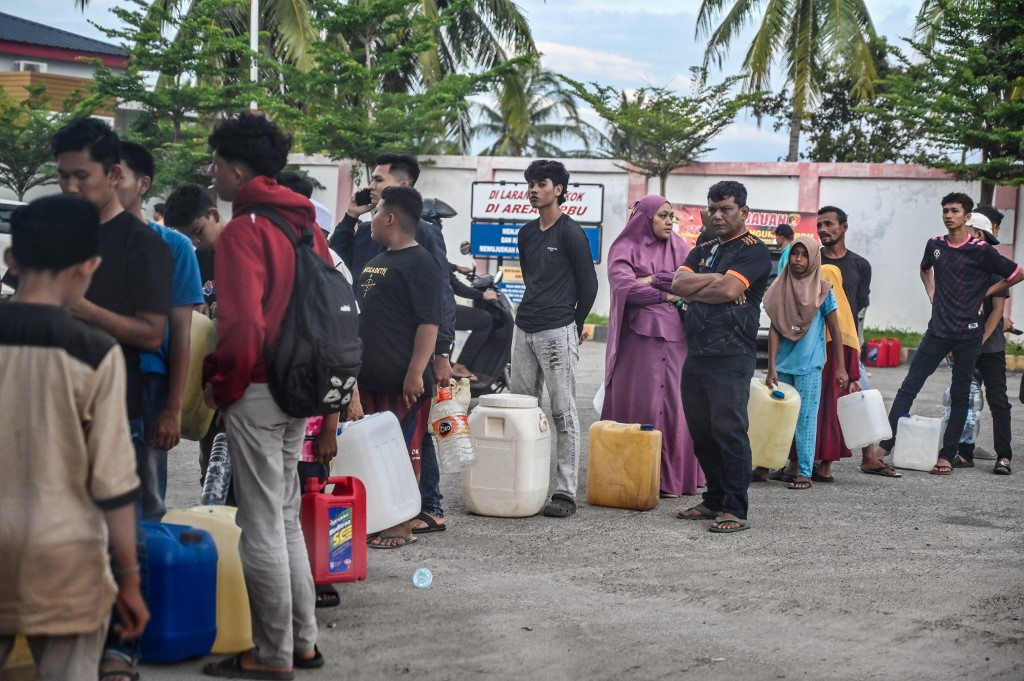 Flood-affected residents wait in line to receive fuel at a gas station in Samahani, Aceh province on December 2, 2025. (AFP/Chaideer Mahyuddin)
O
fficials battled Wednesday to reach survivors of deadly flooding in remote, cut-off regions as the toll in the disaster that hit Indonesia topped 700.
In affected regions, there is growing frustration among survivors of catastrophic flooding and landslides over the pace of the rescue effort and aid delivery.
Humanitarian groups said the scale of the challenge was almost unprecedented even for a country that has faced no shortage of natural disasters.
Monsoon rains paired with two rare tropical storm systems, sometimes known in the region as cyclones, dumped record deluges across Sri Lanka, and parts of Sumatra, southern Thailand and northern Malaysia last week.
In Indonesia, the toll hit 753 on Wednesday, but the number of missing also increased to 650.
The rising figures reflect information that is only trickling in as many regions remain either physically cut off by flood damage or isolated by electricity and communications failures, or both.

"It's very challenging logistically to respond," said Ade Soekadis, executive director of Mercy Corps Indonesia, an aid group.
"The extent of the damage and the size of the affected area is really huge."
The group is hoping to send hygiene equipment and water both from Jakarta and locally.
He said reports of food and water shortages were already "very concerning" and the situation will be "more problematic as time goes by".
At an evacuation centre in Padan, 52-year-old Reinaro Waruwu told AFP he was "disappointed" in the government's immediate response and the slow arrival of aid.
"Some waited a day and night before receiving help, so they couldn't be saved," he said, surrounded by evacuees sitting on mats on the floor in the hall-turned-shelter.
"I am frustrated, it doesn't need to be said twice. The response was not quick," he added.
Like many, he described the arrival of floodwaters and landslides as a disaster without precedent.
"It came like an earthquake.. I thought 'Well, if I am going to die, then so be it,'" he said, beginning to sob heavily.
He managed to escape the rising waters, but his neighbours were buried alive in debris.
Traumatised, he could not even eat on arrival, and since then food has been patchily available, though vegetables arriving on Tuesday offered a "semblance of hope", he said.
Nearby, Hamida Telaumbaunua, 37, described watching her entire kitchen swept away by floodwaters.
"My heart... this was the first time I experienced such a flood," she said.
Her home was lost entirely, along with everything but the few possessions she took when she left.
"It's hard to think about what lies ahead. Maybe as long as we're still here, it's okay, but later... I don't know what will happen."
The weather system that hit Indonesia also brought heavy rains to Thailand, killing at least 176 people, and Malaysia, where two people were killed.
Close to 900 people have been killed in floods and landslides that have wreaked havoc in Indonesia, Malaysia and Thailand, which follow months of adverse and deadly weather in Southeast Asia, including successive typhoons that struck the Philippines and Vietnam and added to frequent and prolonged flooding elsewhere.
Environmental experts and local officials have said deforestation on Sumatra has led to a disproportionately deadly toll
The National Disaster Mitigation Agency said teams were prioritising distributing aid via land, sea and air, clearing blocked roads and repairing damaged infrastructure.
"We do hope that we can speed up the logistics distribution," spokesperson Abdul Muhari said.