The Jakarta Post
Please Update your browser
Your browser is out of date, and may not be compatible with our website. A list of the most popular web browsers can be found below.
Just click on the icons to get to the download page.


Popular Reads
Top Results
No results found. Please check your search term and try again
Can't find what you're looking for?
View all search results
Popular Reads
Top Results
No results found. Please check your search term and try again
Can't find what you're looking for?
View all search resultsThe ART of the bad deal
The ART's own fine print could quietly close the door it claims to open.
Change text size
Gift Premium Articles
to Anyone
Share the best of The Jakarta Post with friends, family, or colleagues. As a subscriber, you can gift 3 to 5 articles each month that anyone can read—no subscription needed!
 Set as preferred source
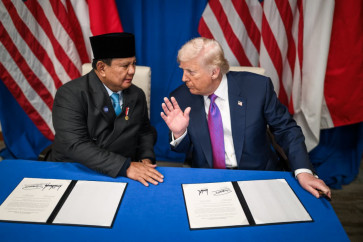
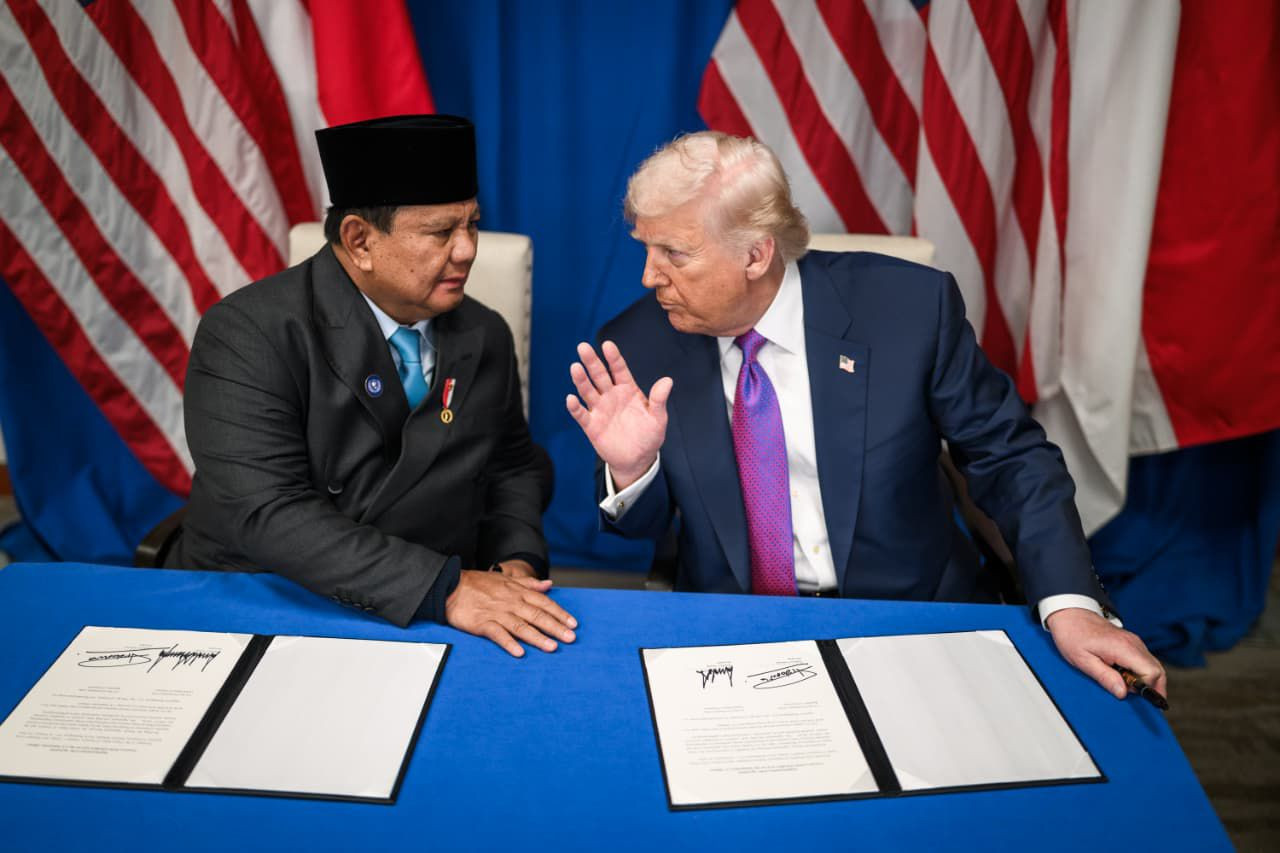 President Prabowo Subianto (left) speaks to United States President Donald Trump on Feb. 19 during the signing of the US-Indonesia Agreement on Reciprocal Tariffs (ART) in Washington, DC. (Courtesy of Presidential Secretariat/White House)
I
ndonesia's Arrangement on Reciprocal Trade (ART) with the United States is heralded as a diplomatic win: a deal that helps secure Indonesia’s market access to the US and signals that Jakarta is a serious partner in Washington's eyes. And perhaps, on the surface, it is. But deeper, the picture is more complicated.
While the government has touted the ART as a win for Indonesian small-time agriculture exporters and textile workers, the data suggests that the actual economic impact is likely to be marginal.
Out of Indonesia's total exports to the US, only 24 percent are covered by the additional 0 percent reciprocal tariff (1,819 product lines). When viewed against Indonesia’s total global export, this so-called “more secure” market access only accounts for a mere 2 percent.
More telling still: the US is not even the primary destination for most of the products that were "secured" in the deal. Palm oil is mostly exported to India, while coconut and fatty acids, a derivative of palm oil, are mostly shipped to China. Other important commodities, such as coffee and cocoa, are mostly exported to the European Union.
The textile sector, often seen as a primary beneficiary, faces a significant catch too. To qualify for the 0 percent tariff, Indonesian producers must use US-sourced cotton or man-made fibers. However, US raw materials are often two to four times more expensive than those from China or Vietnam, and Indonesian businesses do not typically source them from the US. This price discrepancy could cancel out any benefits from the 0 percent additional tariff, potentially disrupting existing supply chains without offering real gains in competitiveness.
Then, where will a meaningful economic benefit come from? One argument is that it can be used to push through many structural reform agendas that are politically difficult to do without any external pressure.

The problem is that the ART's own fine print could quietly close the door it claims to open.