TheJakartaPost
Please Update your browser
Your browser is out of date, and may not be compatible with our website. A list of the most popular web browsers can be found below.
Just click on the icons to get to the download page.


Popular Reads
Top Results
No results found. Please check your search term and try again
Can't find what you're looking for?
View all search results
Popular Reads
Top Results
No results found. Please check your search term and try again
Can't find what you're looking for?
View all search resultsTrade balance improves, but still in the red
Indonesia’s trade showed a slight improvement in January although it still suffered a deficit as imports continued to increase during the month, according to the latest trade data
Change text size
Gift Premium Articles
to Anyone
Share the best of The Jakarta Post with friends, family, or colleagues. As a subscriber, you can gift 3 to 5 articles each month that anyone can read—no subscription needed!

I
ndonesia’s trade showed a slight improvement in January although it still suffered a deficit as imports continued to increase during the month, according to the latest trade data.
Exports contracted by 1.2 percent to US$15.38 billion in January from a year earlier, according to the latest data reported by the Central Statistics Agency (BPS) on Friday. The year-on-year drop in the country’s total exports in January was lower than the 10 percent fall recorded in December thanks to an increase in exports of palm oil, coal and rubber.
The increase in exports of commodities led to 2.7 percent growth in non-oil gas exports to $12.76 billion in January, showing an improvement from the previous month during which non-oil exports fell by 8.5 percent year-on-year,
“The better performance of exports was particularly helped by an increase in prices of commodities, such as palm oil, coal and rubber, that have begun to pick up,” BPS deputy chief Sasmito Hadi Wibowo said on Friday in Jakarta after the announcement of the new trade data.
The country’s total imports, on the other hand, climbed by 6.8 percent to $15.55 billion in January on an annual basis. Imports continued to pick up in January, particularly on the back of inflows of inter-mediary goods, including iron and steel, chemicals and plastics, which support investment. Total imports fell 5.4 percent year-on-year in December.
BPS reported that with the slight improvement in exports, the deficit in the trade balance dropped to $170 million in January from $189 million in December.
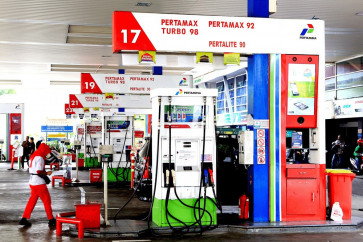
Separately, Trade Minister Gita Wirjawan said that the government anticipated the surge in non-oil and gas exports to persist throughout the year, although the value might not be able to cover the deficit caused by the high increase in oil imports. Imports of oil and gas rose by 33.82 percent to $4.04 billion in January from a year earlier.
Gita estimated there would be a moderate deficit of roughly $500 million in the trade balance in the first quarter of the year and about $2 billion during 2013 as total exports were slated to remain stagnant at $190.04 billion during the year.
“Last year, non-oil and gas trade recorded a surplus of nearly $4 billion, but in January the surplus had already reached $1 billion,” Gita said, indicating that he was quite confident that the growth in non-oil and gas exports would be higher this year as compared to those booked in 2012.
Non-oil and gas exports settled at $153.05 billion last year, while non-oil and gas imports stood at $149.13 billion, generating a surplus of $3.49 billion last year. For a comparison, non-oil and gas exports were $12.76 billion in January, whereas imports reached $11.51 billion.
Indonesia is heavily reliant on domestic consumption, a factor which helped it maintain a robust expansion of more than 6 percent last year despite the fall in the country’s exports. But concerns have been ripe as the trade deficit could cause the depreciation of the local currency, the rupiah, which for several months has been among the worst-performing currencies in the world.
An economist from the Institute for Development of Economics and Finance, Aviliani, said that Indonesia needed to expand its exports to new markets or reduce imports of raw materials, intermediary goods and capital goods as a way to solve the trade imbalance. “But the better way to lower the trade deficit is to reduce imports of fuel,” she said.
“While reducing subsidies to raise fuel prices is not likely to happen, what the government can do is to increase the use of gas in order to lessen dependence on oil,” Aviliani said.
To do this, the government would require a massive development of energy infrastructure, and if the state budget could not provide the necessary funding, the government could seek alternative solutions to raise money, such as issuing infrastructure bonds, she added.