TheJakartaPost
Please Update your browser
Your browser is out of date, and may not be compatible with our website. A list of the most popular web browsers can be found below.
Just click on the icons to get to the download page.


Popular Reads
Top Results
No results found. Please check your search term and try again
Can't find what you're looking for?
View all search results
Popular Reads
Top Results
No results found. Please check your search term and try again
Can't find what you're looking for?
View all search resultsCommodities boost exports in November
Change text size
Gift Premium Articles
to Anyone
Share the best of The Jakarta Post with friends, family, or colleagues. As a subscriber, you can gift 3 to 5 articles each month that anyone can read—no subscription needed!
 (-/-)
(-/-)
A
sharp increase in palm oil and coal delivery significantly pushed up exports in November, giving an early sign of recovery for Indonesia’s dwindling overseas shipments.
Exports in November jumped by 21.34 percent, to US$13.5 billion from the same month last year, boosted by a surge in palm oil shipment volume amid a persistent low price and a rise of coal shipments by both volume and value, the Central Statistics Agency (BPS) announced Thursday.
“This is the highest growth rate since 2011. [...] Hopefully, the export surge can continue until next year,” said BPS deputy head for distribution and statistics Sasmito Hadi Wibowo.
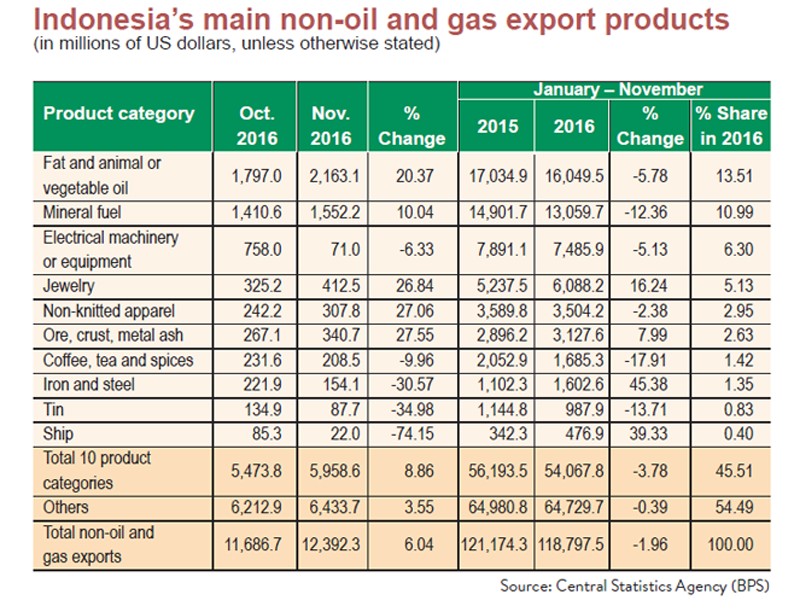
Palm oil exports rose by 20.37 percent to US$16.05 billion, while coal exports climbed by 10.04 percent to $13.06 billion.
Other commodities that contributed to the jump in monthly exports included jewelry, ore and clothing.
Despite a marked year-on-year increase, exports only rose slightly, by 5.91 percent, on a month-on-month basis.
Similarly, overall exports from January to November dropped by 5.63 percent to $130.65 billion, with non-oil and gas exports declining moderately by 1.96 percent to $118.8 billion.
After hitting an all-time high of $203.4 billion in 2011, Indonesia’s exports have steadily fallen, dropping to only $150.2 billion last year.
Economic slowdown in its major trading partners, including China and India, have put strong pressure on its exports as demand drops.
In addition, the majority of the country’s exports are commodities such as palm oil, coal and rubber, of which prices are vulnerable to movements in the international market and with the global economic crisis, exacerbated by a supply glut for some of the commodities, economists have warned that price increases are unlikely.
Maintaining a gloomy outlook for 2016, the World Trade Organization (WTO) lowered in September its forecast for worldwide trade growth from 2.8 percent to 1.7 percent.
In a return to a past trend, trade growth has stopped outperformed global economic growth, according to the global trade governing body.
Monthly imports also recorded an increase — although not as significant as exports — climbing 9.88 percent to $12.66 billion from the corresponding month in 2015, while import figures were up by 10 percent compared to October.
Total imports for the first eleven months also slipped by 5.94 percent to $122.9 billion.
With this result, Indonesia enjoyed a surplus of $7.79 billion so far this year, thanks to a non-oil-and-gas trade surplus of $13.01 billion that balanced the deficit from the oil and gas trade of $5.2 billion.
“Exports and imports seem to have returned to their normal pattern, which usually sees high growth at year-end. In recent years, it has usually been bad even at year-end,” said Sasmito. He referred to exports of palm oil, coal and winter clothes to northern countries as well as the rest of the world that were boosted by year-end holidays.
Centre of Reform on Economics (CORE) Indonesia director Mohammad Faisal predicted that despite remaining uncertainties in the global economy next year, Indonesia could possibly expect bigger exports as prices of its commodities have shown an upward trend.
“The coal price, for example, has been rising in the third quarter of this year and there is reason to hope that the trend will continue next year,” he said in an economic outlook publication from the Trade Ministry.
The research body estimates that the contribution of trade to the country’s gross domestic product will expand next year. Exports’ contribution will increase to 1 percent in 2017, up from 0.8 percent this year, while imports’ contribution will rise to 0.9 percent, from 0.3 percent.
Separately, Development Planning Board (Bappenas) director for trade, investment and international cooperation Yahya Rachmana Hidayat projected that exports would climb further next year as, according to his claim, Indonesia has successfully diversified its range of export destination countries to include non-traditional markets like South Africa and Russia.