TheJakartaPost
Please Update your browser
Your browser is out of date, and may not be compatible with our website. A list of the most popular web browsers can be found below.
Just click on the icons to get to the download page.


Popular Reads
Top Results
No results found. Please check your search term and try again
Can't find what you're looking for?
View all search results
Popular Reads
Top Results
No results found. Please check your search term and try again
Can't find what you're looking for?
View all search results‘Indisch’ Music steps out of shadows
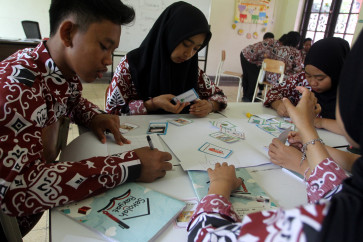
Musical blend: Visitors read information panels on Indisch, a genre with classical Western and traditional Indonesian music influences
Change text size
Gift Premium Articles
to Anyone
Share the best of The Jakarta Post with friends, family, or colleagues. As a subscriber, you can gift 3 to 5 articles each month that anyone can read—no subscription needed!

Musical blend: Visitors read information panels on Indisch, a genre with classical Western and traditional Indonesian music influences.
A Yogyakarta exhibition sheds light on Indisch, a musical genre that was born in the Dutch colonial era.
The tune of “Ketjoeboeng” as played on the piano filled the concert hall of the Indonesian Arts Institute Yogyakarta (ISI Jogja).
The piano man is 63-year-old Dutch pianist and anthropologist Henk Mak van Dijk.
“Ketjoeboeng is a beautiful flower but it’s a dangerous, mystical bloom,” Van Dijk explained about the charming, yet poisonous, devil’s trumpet (Datura metel).
“In this composition, the music seems to soar and [then] disappears suddenly,” he said.
“Ketjoeboeng” falls into the Indisch genre, a blend of Western music and Indonesian cultural elements – including Malay and Javanese quatrains – that developed during the Dutch colonial era in the Indonesian archipelago (then known as the Dutch East Indies).
Van Dijk also played several other Indisch compositions featuring vocalist Ika Sri Wahyuni during the afternoon mini concert, which marked the opening of “Out of the Shadow” Indisch music exhibition that runs from April 8 to May 12.
The genre is relatively unknown in both Indonesia and the Netherlands, and is even lesser known compared to the mooi Indie (beautiful Indies) music that developed during the same colonial era.
“I may be the only one [intensely] studying Indisch music,” said Van Dijk, who began studying the genre after a foundation invited him in 2003 to perform Indisch compositions.
Van Dijk has been collaborating with the National Music Institute in The Hague since 2004 to trace the development of Indisch music through researching historical documents and interviewing the descendants of Indisch composers. One of his interviewees was a direct descendant of Paul Sellig, who gave him a dusty collection of sheet music.
The research was published in De Oostenwind Waait naar het Westen (The Eastern Wind Blows to the West). It was then later adapted into a series of informational panels that were displayed at The Hague’s City Hall in May 2018 before they came to the Yogyakarta exhibition.
The panels invite exhibition visitors to retrace the history of Indisch music and the lives of its composers, including “Ketjoeboeng” composer Linda Bandara (1881-1960), through text and old photographs.

Born in Temanggung, Central Java, Bandara was born to an Austrian couple who owned an estate in the region. She studied Javanese gamelan from a young age and made recordings with Walter Spies, a musicologist, composer and mooi Indie painter.
“Linda faced a tough challenge as a woman of the era. Few people believed her capability,” said Van Dijk, but that her perseverance helped break down the gender barrier.
Bandara reached the pinnacle of her musical career in 1922, when the Vienna Philharmonic played her symphonic poem, “Landliche Stimmungsbilder” (“Rural Impressions”). The concert was a huge success and the composer became known as the first to introduce the blend of Western music and Javanese gamelan music to Europe.
Another outstanding Indisch composer is Constant van de Wall (1871-1945), born in Surabaya, East Java, who is known for his curious creations that incorporate quatrains, wayang, Islam and Javanese dances. Van de Wall composed many pieces of Indisch music for vocals, piano, orchestra and chamber ensembles, as well as operas.
“He might be the first Indisch music composer,” noted Van Dijk.
Van de Wall’s opera, Attima, about a triangle love between a dancer, a gamelan player and a Dutch soldier, was first staged in 1917 at the Royal Theater in The Hague.
Another Indisch composer, Richard Holl (1825-1904), made a composition for cello and piano called “Saidjah”, based on Eduard Douwes Dekker’s critical 1860 novel Max Havelaar. Dekker, who is better known by his pen name Multatuli, revealed the cruelty of colonial rule in the Dutch East Indies in his novel, which prompted efforts by the Dutch colonial government to develop the colony, including through educational reform.
ISI Jogja rector Agus Burhan suggested that Indisch culture developed as a result of the large number of European immigrants that arrived after the Dutch East Indies economy was deregulated in the mid-19 century.
“Consequently, interactions occurred not only in the political sphere, but also in culture,” Burhan pointed out, adding that Indisch music reflected the prevailing socio-cultural conditions of the period.
Nanik Kristiana Ohmar, who founded the Amazing House of Music in Yogyakarta, is one of the very few Indonesian musicians promoting the lesser-known musical genre at home.
Nanik encourages piano teachers, music lecturers and students to perform Indisch music.
“I once organized a music festival [...] that required Constant van de Wall’s Indisch composition as mandatory,” she said.

— Photos by JP/Bambang Muryanto