TheJakartaPost
Please Update your browser
Your browser is out of date, and may not be compatible with our website. A list of the most popular web browsers can be found below.
Just click on the icons to get to the download page.


Popular Reads
Top Results
No results found. Please check your search term and try again
Can't find what you're looking for?
View all search results
Popular Reads
Top Results
No results found. Please check your search term and try again
Can't find what you're looking for?
View all search resultsFalse national heroes
Soeharto cannot be a true hero, only a false one, not until we clarify his role in the military-led mass killing campaigns in the mid-1960s that led to his seizure of power.
Change text size
Gift Premium Articles
to Anyone
Share the best of The Jakarta Post with friends, family, or colleagues. As a subscriber, you can gift 3 to 5 articles each month that anyone can read—no subscription needed!
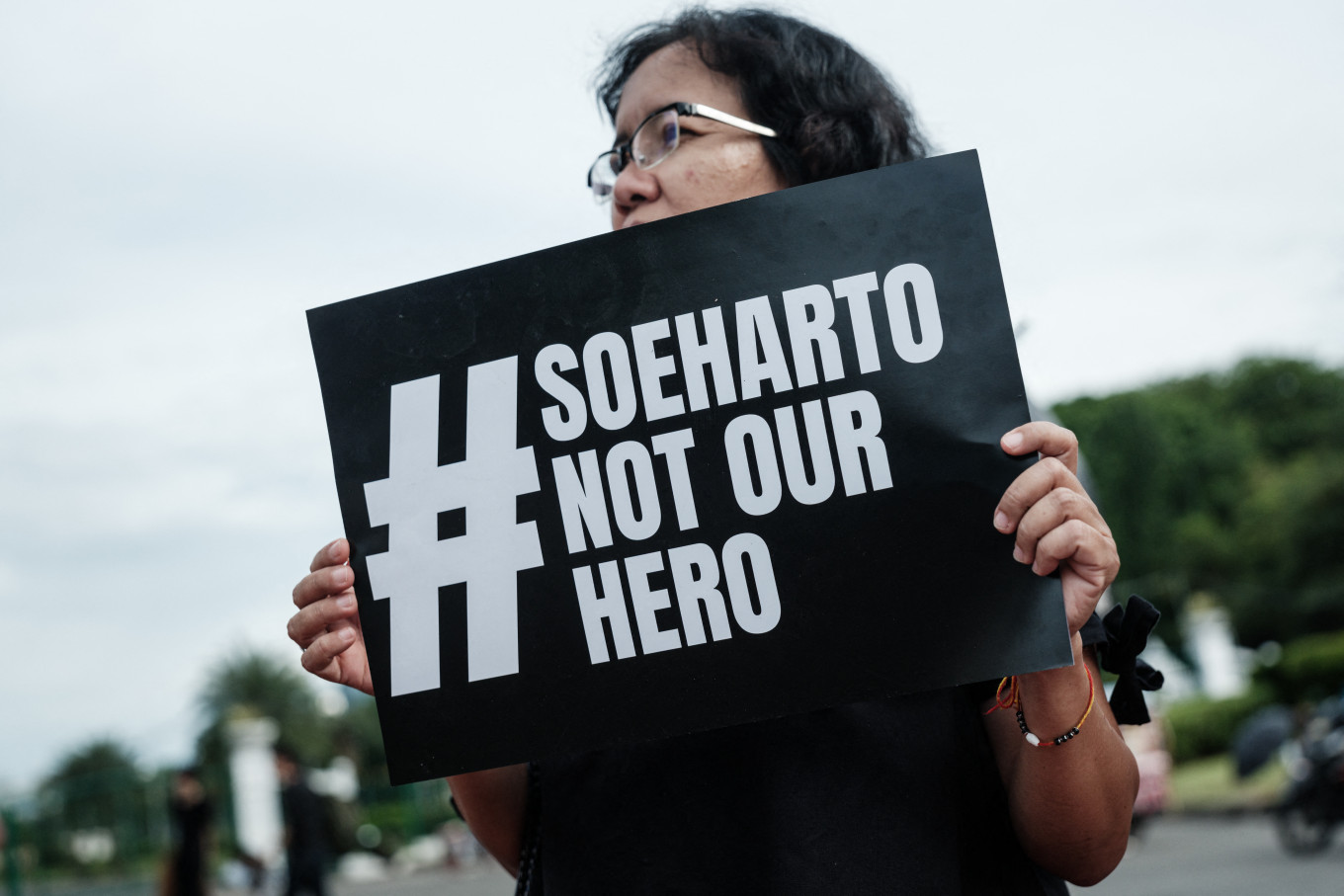 A member of a civil society group holds a poster during a rally on Nov. 6 opposing the Indonesian government's plan to grant former president Soeharto a “National Hero“ title near the Presidential Palace in Jakarta. Former president Soeharto, who died in 2008 aged 86, ruled Indonesia with an iron fist for more than three decades after grabbing power in 1967 following a failed military coup. The former military general's rule was marred by allegations of corruption and human rights abuses, including violent crackdowns on political dissent. (AFP/Yasuyoshi Chiba)
P
resident Prabowo Subianto has created a new sub-category of National Hero, an official title which the country awards to its best sons and daughters for outstanding services to the nation.
This new category is for “false heroes” to accommodate Indonesia’s second president Soeharto, who ruled the country from 1966 to 1998 with an iron fist and with lots of bloods on his hands. He may be a hero to some, but to the nation, he cannot be but a false one, not until we clarify his role in the military-led mass killing campaigns in the mid-1960s that led to his seizure of power which he held on to for over three decades.
We lament that President Prabowo ignored the protests these past few weeks in opposition to the plan to confer the title on Soeharto on National Hero Day on Monday. Adding insult to injury, he added the name of Sarwo Edhie Wibowo, the chief of the Army’s Special Forces who led the military’s extrajudicial slaughter in the mid-1960s, to the list of this year’s recipients of the hero title.
It is an affront to the nation’s sense of justice, and goes against the values enshrined in the state ideology of Pancasila.
Massive corruption during Soeharto’s reign brought the country to the brink of an economic collapse in 1998. He squandered massive windfalls from the oil booms of the 1970s and 1980s when Indonesia was a net oil exporting country. He enriched his family, relatives and cronies but left most of the nation impoverished.
Conferring the national hero title on Soeharto and Sarwo Edhie reopens an old national wound that has hardly healed from the bloodbath of the 1960s, when they led the Army campaign to crush the Indonesian Communist Party (PKI) through extra-judicial mass killings conducted in collaboration with paramilitary groups.

We will never know the extent of the deaths because the military keeps preventing any attempt to dig into the truth about the circumstances of the political struggle that forced Sukarno, Indonesia’s first president, to hand over power to Soeharto. But we know it was bloody and traumatic, and it has left a deep impact on the nation’s psyche to this day.