The Jakarta Post
Please Update your browser
Your browser is out of date, and may not be compatible with our website. A list of the most popular web browsers can be found below.
Just click on the icons to get to the download page.


Popular Reads
Top Results
No results found. Please check your search term and try again
Can't find what you're looking for?
View all search results
Popular Reads
Top Results
No results found. Please check your search term and try again
Can't find what you're looking for?
View all search resultsDiscriminating against teachers
While the government funds "elite" schools and free meals, the 237,000 "honorary" teachers who form the backbone of the nation are being left behind in a growing gap of privilege and pay.
Change text size
Gift Premium Articles
to Anyone
Share the best of The Jakarta Post with friends, family, or colleagues. As a subscriber, you can gift 3 to 5 articles each month that anyone can read—no subscription needed!
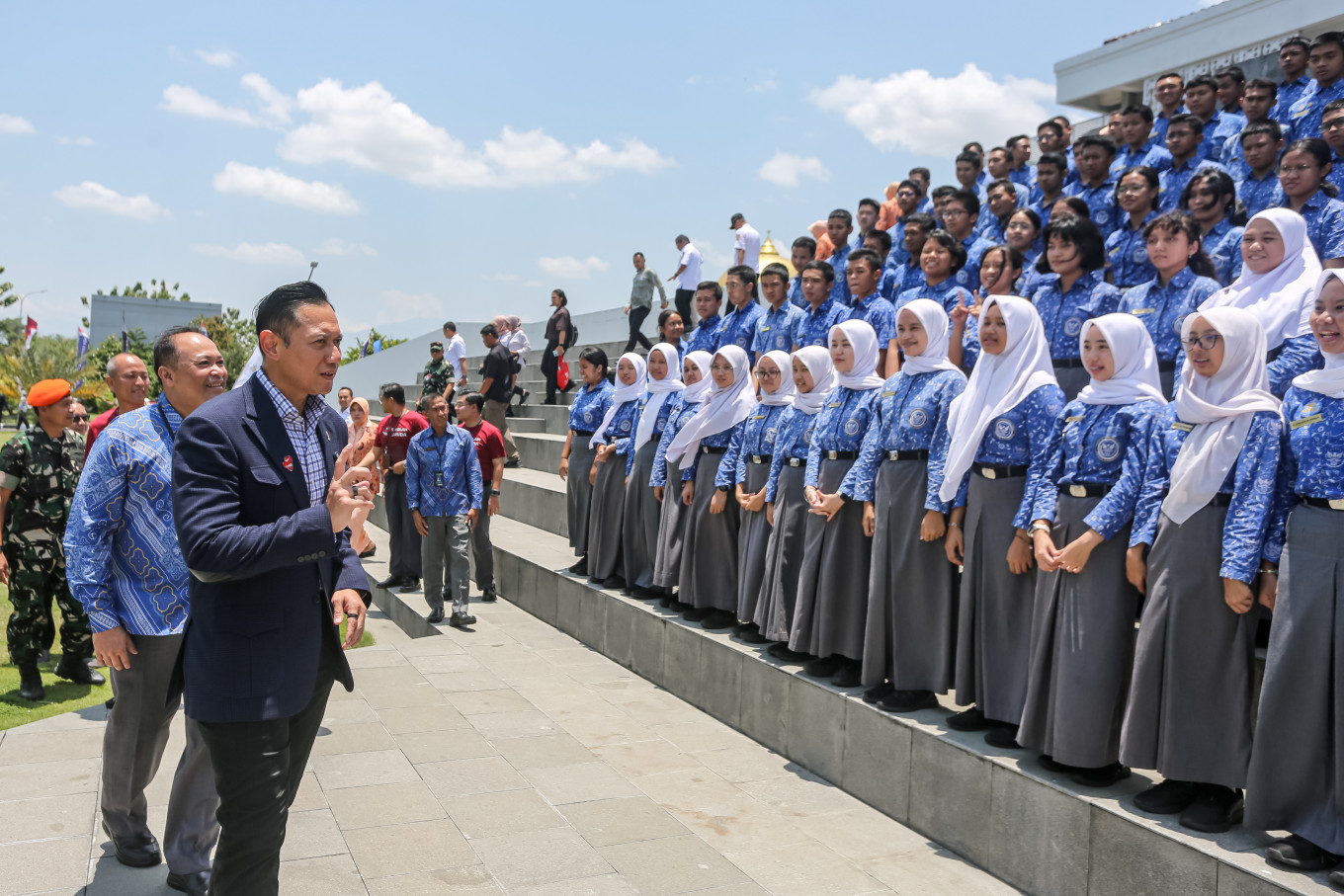 New intake: Coordinating Infrastructure and Regional Development Minister Agus Harimurti Yudhoyono (second left), accompanied by SMA Pradita Dirgantara senior high school president director Ari Presmena Tarigan, chats with students on Wednesday at the Get to Know Garuda Transformation School event in Boyolali, Central Java.
(Antara/Mohammad Ayudha)
New intake: Coordinating Infrastructure and Regional Development Minister Agus Harimurti Yudhoyono (second left), accompanied by SMA Pradita Dirgantara senior high school president director Ari Presmena Tarigan, chats with students on Wednesday at the Get to Know Garuda Transformation School event in Boyolali, Central Java.
(Antara/Mohammad Ayudha)
T
o ensure the country’s progress, the Constitution mandates that the government raise the collective intelligence and character of society through education. This noble goal necessitates an ecosystem that empowers teachers, the vanguard of national education, to elevate their professional standards.
However, the government’s commitment to developing the education sector has come into serious question following a massive budgetary shift. Specifically, Rp 223.5 trillion (US$13.2 billion), or 47.5 percent of the education budget, has been reallocated to the National Nutrition Agency (BGN) to fund President Prabowo’s signature free nutritions meals program this year.
This fiscal pivot has sparked heated controversy. Critics argue it may violate the Constitution, which obligates the state to earmark 20 percent of its budget specifically for education. Beyond the legalities, the policy casts a shadow over the future of 237,000 contract teachers whose prospects of becoming civil servants now look dim. In a stark contrast, 99,000 free meal field workers have been promised a fast-track admission into the civil service.
Adding insult to injury, the government is now offering elite benefits to those who qualify as staff for Sekolah Garuda (Garuda Schools). This is another pet project of the President, designed to boast international-standard education. Recruitment is currently underway for four Garuda Schools in East Belitung, Bangka Belitung, Bulungan, North Kalimantan, Konawe, Southeast Sulawesi and South Timor Tengah, East Nusa Tenggara.
Successful candidates for these positions will receive "competitive salaries" and landed housing, a luxury that ordinary teachers across the archipelago can only dream of. These perks have sparked public outcry, particularly because many teachers, both permanent and contract, still earn meager wages. Many are forced to moonlight in second jobs just to make ends meet.
The Garuda School program has already divided the nation, with critics warning of social segregation. The privileges awaiting Garuda teachers will only accelerate this divide. While Second Deputy Higher Education, Science and Technology Minister Stella Christy stated that Garuda Schools aim to break inequality by offering top-quality education to those who cannot afford private schools, the project risks sharpening the very inequality it seeks to address.

Prioritizing teachers for state-sponsored "elite" schools over dedicated "honorary" (contract) teachers is a policy fraught with danger. It discriminates against the very people who form the backbone of the nation's school system. By concentrating resources in a few locations, the government risks demoralizing the majority of the teaching workforce.