TheJakartaPost
Please Update your browser
Your browser is out of date, and may not be compatible with our website. A list of the most popular web browsers can be found below.
Just click on the icons to get to the download page.


Popular Reads
Top Results
No results found. Please check your search term and try again
Can't find what you're looking for?
View all search results
Popular Reads
Top Results
No results found. Please check your search term and try again
Can't find what you're looking for?
View all search resultsHow the G20 can lead the fight against global inequality
Inequality has become an emergency that must be treated with the same urgency as climate change.
Change text size
Gift Premium Articles
to Anyone
Share the best of The Jakarta Post with friends, family, or colleagues. As a subscriber, you can gift 3 to 5 articles each month that anyone can read—no subscription needed!
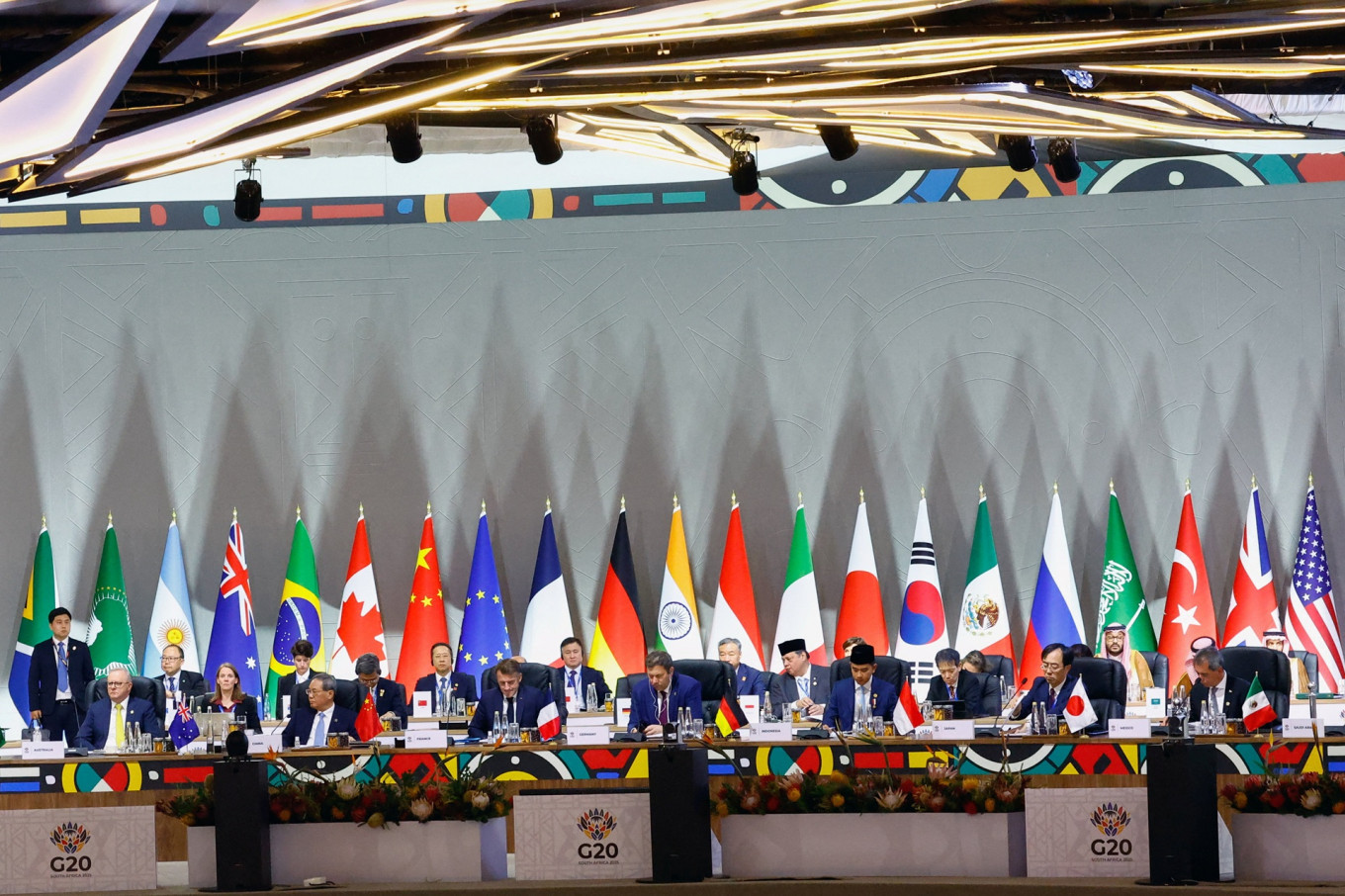 Leaders attend a plenary session on the opening day of the G20 leaders' summit on Nov. 22, at the Nasrec Expo Centre in Johannesburg, South Africa. (Reuters/Pool/Thomas Mukoya)
This month’s G20 Summit in Johannesburg marked several historic firsts. For starters, it was the group’s first-ever summit in Africa, and the first to include the African Union as a full-fledged member. It also set less encouraging precedents: it was the first meeting boycotted by a key founding member, the United States, on spurious grounds, and the first in which that same country tried to prevent the host from issuing a final declaration. Equally, unprecedented was South Africa’s decision to ignore the US threat and issue one anyway.
As G20 chair, South Africa invited delegations from Africa and other parts of the world to participate as guests, underscoring the continued importance of multilateral dialogue and cooperation. Building on the momentum generated by last year’s summit in Brazil, the group also expanded its agenda to include issues of particular relevance to Africa and the broader developing world.
South Africa’s inclusive approach paved the way for another landmark moment: for the first time, G20 leaders formally addressed the issue of global inequality. The impetus was the recent report by the Extraordinary Committee of Independent Experts on Global Inequality. Chaired by Nobel laureate economist Joseph Stiglitz, the committee (of which I was a member) synthesized a large body of research and drew on consultations with 80 prominent scholars to present a comprehensive picture of economic disparities worldwide.
The conclusions are hardly reassuring: although global inequality has declined since the early 2000s, this is largely due to rising incomes in China. For the world as a whole, inequality remains stubbornly high and has begun to rise again. While inequality between countries has fallen, the gulf between the richest and poorest countries remains unacceptably wide. Nine out of 10 people now live in countries with high inequality, even by the World Bank’s relatively conservative standards.
The distribution of income within countries is equally distorted. Wage shares of national income have declined in most economies over the past few decades, while capital income has become increasingly concentrated. Large firms now account for the bulk of corporate profits, with multinational corporations taking the lion’s share.
These developments reflect a broader trend: the concentration of income and wealth at the very top. Of the two, wealth is far more unequally distributed, as its explosive growth in recent decades has been overwhelmingly skewed toward those who were already rich. More than 40 percent of the wealth generated since the start of the century has gone to the wealthiest 1 percent, while the bottom half of the world’s population received just 1 percent.

Even within the top 1 percent, the gains have been largely captured by the ultra-wealthy, arguably the most extreme concentration of wealth in human history. The result is a class of global plutocrats whose unprecedented resources enable them to shape laws, institutions and policies; influence public opinion through their control of media; and tilt judicial systems in their favor.