The Jakarta Post
Please Update your browser
Your browser is out of date, and may not be compatible with our website. A list of the most popular web browsers can be found below.
Just click on the icons to get to the download page.


Popular Reads
Top Results
No results found. Please check your search term and try again
Can't find what you're looking for?
View all search results
Popular Reads
Top Results
No results found. Please check your search term and try again
Can't find what you're looking for?
View all search resultsWhy China is hesitant on global green leadership
Though the world sees it as an emerging superpower, China sees itself as a developing country, and so is reluctant to take on climate responsibilities on a par with major powers like the EU or the US.
Change text size
Gift Premium Articles
to Anyone
Share the best of The Jakarta Post with friends, family, or colleagues. As a subscriber, you can gift 3 to 5 articles each month that anyone can read—no subscription needed!
 Set as preferred source
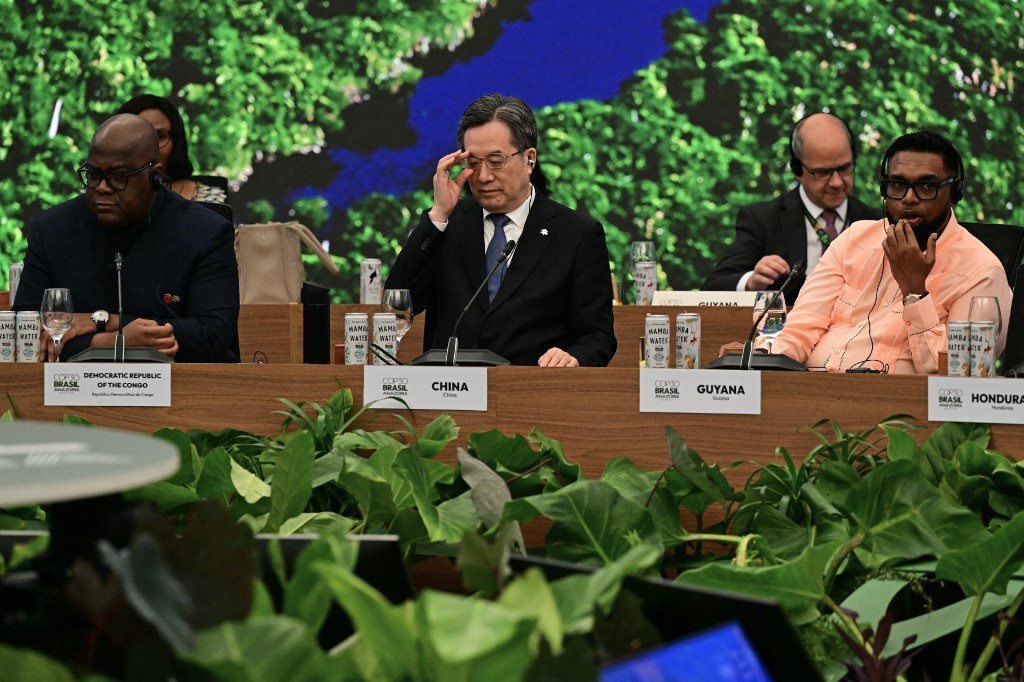 Greening dilemma: Heads of state (from left, front) Congolese President Felix Tshisekedi, Chinese Deputy Prime Minister Ding Xuexiang and Guyanese President Irfaan Ali attend the leaders’ roundtable on Nov. 6 to launch the Tropical Forest Forever Facility (TFFF) during the pre-COP Belém Climate Summit in Brazil. (AFP/Pablp Porciuncula)
A
head of this year’s United Nations Climate Change Conference (COP30), China appeared keen to take on the mantle of a new global leader on climate change, stepping into the gap left by the United States’ withdrawal from the top spot under Donald Trump.
In trying to understand what China wants from this role, it’s worth examining three areas motivating Beijing to take over leadership and two others it is trying to avoid.
First, China is attempting to reshape climate talks along “tech and trade” lines. At COP30, it presented itself as a “clean tech” superpower that is ambitious, technologically capable and cooperative.
Certainly, the country’s capacity for renewable energy generation has more than tripled in 10 years, reaching 1,876,646 megawatts in 2024. Solar energy has shown astonishing growth: 20 times higher than in 2015.
In 2024, China, the world’s largest greenhouse gas emitter, invested US$290 billion in renewable energy: That’s $80 billion more than the combined total of the European Union, the United Kingdom and the US.
China needs to address its domestic energy planning for the world to achieve significant emissions reductions. Renewable energy is critical, particularly as the rapid scaling of AI and data centers drives a surge in electricity consumption. China is shaping the global agenda in favor of low-carbon technologies and their global expansion.

A second priority for China in taking on global green leadership is using it to grow the country’s export economy. China gains a trade advantage by making clean energy cheaper. Lower costs allow these clean technologies to access international markets easily.
Since 2018, China has shipped out close to $1 trillion worth of batteries, solar components, electric vehicles and wind power systems globally. But some of these industries are facing overcapacity, so China must find new markets for its products. Its traditional markets, Europe and the US, have recently added trade barriers, including tariffs on Chinese EVs and solar panels.
At COP30, China used global climate negotiations to set out its opposition to these barriers, positioning free trade in clean technologies as essential for reaching global climate goals. But they are also ideal for Chinese economic growth.
Shipping to other emerging markets is an alternative to these more established markets. China’s EVs exports to Southeast Asia saw explosive growth in 2025. Its new customers are large, energy-intensive economies such as Indonesia and India. China wants to keep them and everybody else committed to net-zero emissions in order to maximize its clean tech trade benefits.
It also wants to strengthen cooperation across developing countries. Shared trade interests are only one driver of climate action alignment between competing economies, such as between China and India at the recent talks. Regional security is another.
China hopes to increase its political power in countries and regions of strategic interest, such as via its economic and trade partnership, the Belt and Road Initiative, and also in the Pacific. It has already increased its investments in new security allies, such the Solomon Islands and the Cook Islands, competing in the region with the US, Australia and New Zealand.
To repackage this strategy under the name of climate change, China launched the China-Pacific Island Countries Climate Change Cooperation Center in 2022. Addressing global climate change enables China to legitimize its involvement in these countries and regions.
China is being seen as stepping up to a leadership position on climate change. But assuming full leadership and historical responsibilities for climate change are beyond its comfort zone.
China’s delegates entered COP30 meeting rooms being praised for new leadership, but Beijing is struggling to meet its current pledges. The latest analysis suggests that its carbon emissions are falling slowly. The country’s emission reduction pledges, announced ahead of COP30, are regarded as insufficient.
The biggest threat is its own economy: weak factory output, low consumer spending, high youth unemployment and lower state taxation to encourage growth. Local governments have difficulties in financing the low-carbon economy, and their debts are accumulating.
It’s not clear whether China can fulfill its pledges by cutting emissions sharply, continue to subsidize its green energy industries and make significant economic investments in regional cooperation, all under its current weak economy.
So China does not want to lead as an advocate of deep emission cuts; nor does it want to take on the mantle with other industrialized economies of accepting the historical responsibility for global climate change. Analysis has shown that, despite being far behind the US, China’s historical emissions since 1850 have overtaken those from the 27 EU member states.
The closer China comes to the US’ traditional role, the more it will be expected to take historical responsibility for climate change. China is not ready for that. It cannot reduce emissions significantly in a short timeframe under a weak economy.
China sees itself as a developing country. At COP30, one of the contentious issues was getting $1.3 trillion per year in climate finance from public and private sources in the EU and other OECD economies.
China did not formally commit to supporting the $1.3 trillion goal, disappointing the rest of the developing world. The lack of commitment was not just a matter of money but the idea that China should be held responsible in the same terms as developed countries. While it has provided a substantial amount of climate and clean energy finance to other developing countries, this was primarily driven by strategic and geopolitical considerations.
China also opposed the road map aimed at phasing out fossil fuels and declined to contribute to Brazil’s Tropical Forest Forever Facility (TFFF), a mechanism for compensating countries for preserving tropical forests.
Clearly, China is leading the world in low-carbon technologies. It also believes that climate cooperation with developing nations will deliver trade and security benefits, and will continue to shape climate change talks along these lines.
The next few years are too early for China to want to play as big a role as the US and EU did for the Kyoto Protocol and Paris Agreement. It will hold on to its red lines and only sign up to plans that meet its own economic and political ends.
---
The writer is a professor of environment at York St John University. This article is republished under a Creative Commons license.