TheJakartaPost
Please Update your browser
Your browser is out of date, and may not be compatible with our website. A list of the most popular web browsers can be found below.
Just click on the icons to get to the download page.


Popular Reads
Top Results
No results found. Please check your search term and try again
Can't find what you're looking for?
View all search results
Popular Reads
Top Results
No results found. Please check your search term and try again
Can't find what you're looking for?
View all search resultsRehabilitating and reconstructing the republic
Indonesia can take a page out of its own playbook for rehabilitating Aceh and Nias after the 2004 tsunami and apply it to the institutional tidal wave that is threatening all citizens as well as the future of the republic.
Change text size
Gift Premium Articles
to Anyone
Share the best of The Jakarta Post with friends, family, or colleagues. As a subscriber, you can gift 3 to 5 articles each month that anyone can read—no subscription needed!
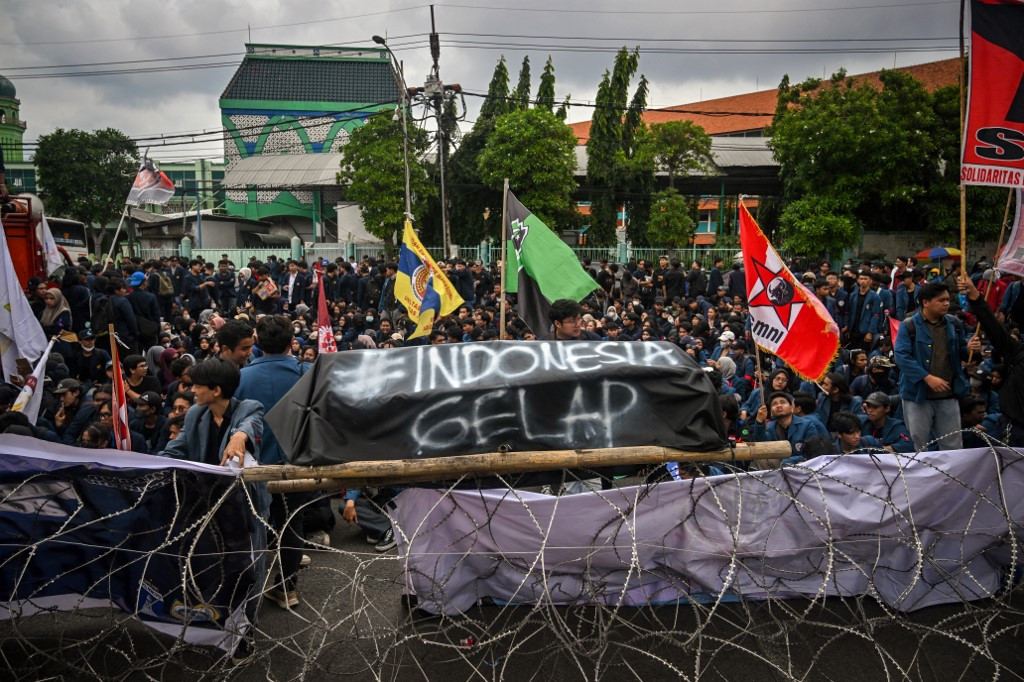 Students take part in an Indonesia Gelap (Dark Indonesia) rally on Feb. 17, 2025, in front of the East Java Legislative Council in Surabaya. (AFP/Juni Kriswanto)
T
wo decades ago, Indonesia witnessed one of the worst humanitarian disasters in modern history: The 2004 Indian Ocean earthquake and tsunami flattened entire towns in Aceh and Nias, wiped out infrastructure and exposed the fragility of local institutions. Yet in the midst of devastation, recovery became possible because governance itself was rebuilt.
The Rehabilitation and Reconstruction Agency for Aceh and Nias showed that meaningful recovery requires more than funds or engineering capacity: It also demands integrity, coordination and public trust.
Today, the republic is also experiencing the slow accumulation of what can be called an institutional tsunami: a rolling governance crisis marked by weakened oversight, politicized bureaucracy and the erosion of reasoned decision-making. The debris is not physical, but systemic: fragmented regulations, discretionary policymaking, shrinking civic space and state institutions that increasingly struggle to act as impartial guardians of the public interest.
Indonesia has actually risen in class as a nation. Beneath all its limitations, there was once both the awareness and the capacity to strengthen institutions as pillars of the republic. Over the past decade, however, the country appears to have been pulled into a “black hole” of institutional destruction. This crisis has deepened gradually through a series of political and administrative shifts that, taken together, have left the republic less capable of governing itself with justice, coherence or accountability.
There is now an expanding mismatch between an increasingly open democratic system and political actors who operate without ethics. Democratic instruments, such as elections, political parties, legislature, even the law, are too often used not to strengthen the republic but to push institutions toward self-destruction. This is the institutional tsunami that demands national-scale reconstruction and rehabilitation.
The first task is to restore institutional integrity: the moral and operational backbone of the republic.

Over the past decade, several developments reflect a worrying pattern. The weakening of the Corruption Eradication Commission (KPK) after revising legislation has significantly reduced the deterrent effect of anticorruption enforcement. The sharp rise in the political appointment of higher echelon officials has blurred the principle of meritocracy within the civil service.