TheJakartaPost
Please Update your browser
Your browser is out of date, and may not be compatible with our website. A list of the most popular web browsers can be found below.
Just click on the icons to get to the download page.


Popular Reads
Top Results
No results found. Please check your search term and try again
Can't find what you're looking for?
View all search results
Popular Reads
Top Results
No results found. Please check your search term and try again
Can't find what you're looking for?
View all search resultsAsia's stocks ride a reform wave, but rough seas lie ahead
The region's flagship index has jumped more than 25 percent this year as a wave of governance reforms and fresh domestic money has started to chip away at a decade-long valuation gap with the United States.
Change text size
Gift Premium Articles
to Anyone
Share the best of The Jakarta Post with friends, family, or colleagues. As a subscriber, you can gift 3 to 5 articles each month that anyone can read—no subscription needed!
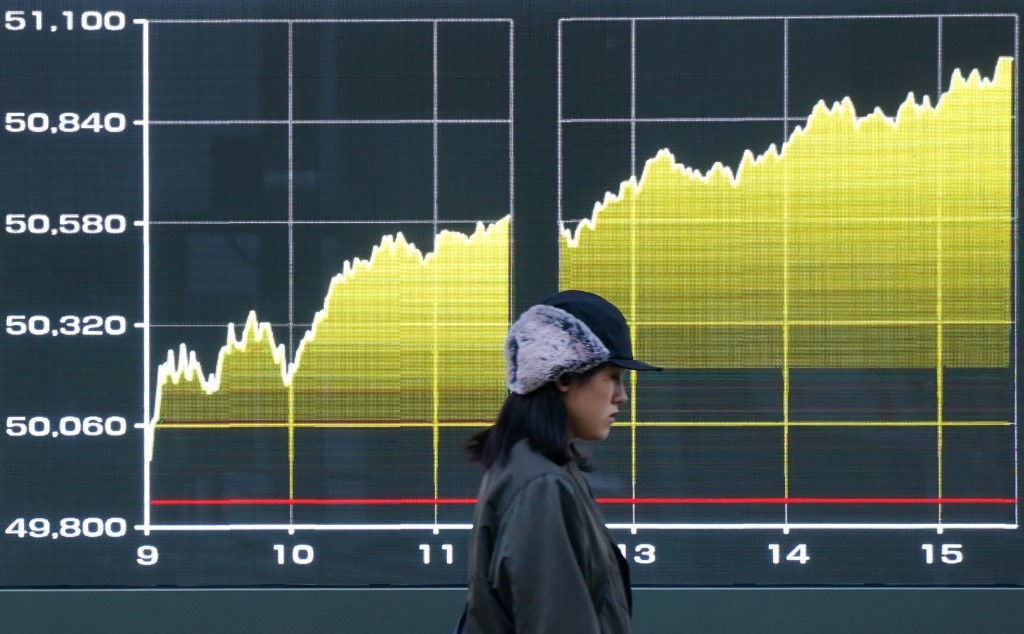 An electronic display board shows the daily movement of the Nikkei Stock Average on the Tokyo Stock Exchange on Thursday in Tokyo. (AFP/Kazuhiro Nogi)
A
sia's stock markets are finally fighting back. The region's flagship index has jumped more than 25 percent this year, outpacing the S&P 500's roughly16 percent gain, as a wave of governance reforms and fresh domestic money has started to chip away at a decade-long valuation gap with the United States.
Asian equities still trade at very low valuations relative to the US, meaning there could be room to run. But that may require the region's governments to tackle some politically challenging reforms.
Much of the recent ascent of North Asian equities reflects a so-called “rerating”. The MSCI Asia ex Japan index's price-to-book (PB) multiple has climbed from 1.8 in early 2025 to 2.1 today.
Enthusiasm for artificial intelligence has played a role, but a key catalyst has been corporate governance reforms.
Regulators throughout North Asia have pushed for a greater focus on shareholder value. They have encouraged companies to return excess cash to investors, trim balance sheets and lift return on equity (ROE).
China kicked things off in January 2023 when the state-owned assets regulator SASAC overhauled key performance indicators (KPIs) for state-owned enterprises (SOEs). Operating margin and net earnings were replaced by ROE and operating cash flow, with “market value management” added a year later. Listed Chinese companies have been encouraged to follow suit.

The Chinese securities regulator CSRC then sought to improve investor payouts. First, in August 2023, it restricted controlling shareholders of listed companies from selling shares in the secondary market if the company had not paid significant dividends over the previous three years. It then relaxed buyback rules in December 2023 and, in March 2024, urged companies to establish buyback plans.
In Japan, the push to reduce the country's unusually high number of chronically undervalued stocks accelerated in March 2023. The Tokyo Stock Exchange asked firms - particularly those trading below book value - to disclose capital efficiency improvement plans.
TSE later added a “name and shame” element by publishing a monthly list of companies that had disclosed such plans, thereby implicitly highlighting those that had not.
South Korea followed in February 2024 with its own plan to boost valuations. The Financial Services Commission announced the “Corporate Value Up Program,” which urged companies to prioritize shareholder returns in exchange for tax benefits. The government went further last July by amending the Commercial Law with a host of requirements to improve corporate governance.
The results have been uneven. China's average dividend payout ratio has risen sharply over the past three years, while Japan's has moved more modestly. South Korea's payouts jumped initially but subsequently declined.
Buybacks, by contrast, show a more consistent pattern across the region. All North Asian markets have increased share repurchases over the past three years, with Japan standing head and shoulders above the rest.
Governments have also stepped in to steer domestic savings toward equities.
In China, low interest rates and a collapsing property sector had already begun to push domestic investors towards stock. The authorities added a further nudge in January by encouraging state insurance companies to invest 30 percent of premium income in equities.
It is still early days, but the effect is visible: insurers' equity allocations rose from 12 percent of assets at the start of the year to 15.5 percent by the third quarter, helping to drive a 14 percent rally in China's CSI300 index.
The biggest success story for domestic investment is India. Financialization of savings began in 2014 with the introduction of basic bank accounts under a scheme designed to provide every household with access to financial services. Ultimately, this paved the way for gigantic, steady domestic investments into mutual funds through systematic investment plans (SIPs), which now exceed $3 billion a month.
In contrast, South Korea’s efforts, like lowering banks’ risk weights on equity investments, have failed to redirect domestic savings. The market remains driven by foreign money. Record-high net foreign institutional investor flows of US$17.7 billion since 2023 contrast with persistent domestic outflows into US stocks and ETFs, according to consultancy ETFGI.
However, South Korean equities' surge in the first half of 2025 suggests some policy measures are starting to bear fruit.
Several politically sensitive measures will now be a litmus test of governments’ resolve.
In China, 60 percent of household wealth remains in property, a sector still looking for the light at the end of the tunnel after a bruising downturn. Stabilizing this market is likely a prerequisite for convincing many savers to invest in other domestic risk assets, but doing so might involve some challenging measures, such as relaxing the urban "hukou" or residency permits.
Over in India, the retail investment boom has created new problems to solve, namely the proliferation of social media “finfluencers,” only 2 percent of whom are registered with the securities regulator. Protecting investors from their get-rich-quick advice, without choking off equity market participation, will be a challenge.
Finally, in South Korea, the government last week agreed to lower income tax on dividends and is considering cutting rates on inheritance. High inheritance taxes appear to have encouraged family owners of large firms - so-called chaebols - to suppress their companies’ market values.
More crucial would be dismantling chaebols' complex cross-shareholding structures to reduce their disproportionate control. However, given chaebols' political clout, that may be the hardest reform to implement.
Asia’s governments and regulators have made a good start in pushing through reforms to boost company valuations. However, we have seen similar valuation catch-ups fizzle before, so the real test starts now.
---
The writer is a founder and CEO of Emmer Capital Partners Ltd. The views expressed are personal.