TheJakartaPost
Please Update your browser
Your browser is out of date, and may not be compatible with our website. A list of the most popular web browsers can be found below.
Just click on the icons to get to the download page.


Popular Reads
Top Results
No results found. Please check your search term and try again
Can't find what you're looking for?
View all search results
Popular Reads
Top Results
No results found. Please check your search term and try again
Can't find what you're looking for?
View all search resultsWhy Indonesia needs mandatory disaster insurance
Countries with high disaster risk do not leave disaster protection to voluntary market behavior
Change text size
Gift Premium Articles
to Anyone
Share the best of The Jakarta Post with friends, family, or colleagues. As a subscriber, you can gift 3 to 5 articles each month that anyone can read—no subscription needed!
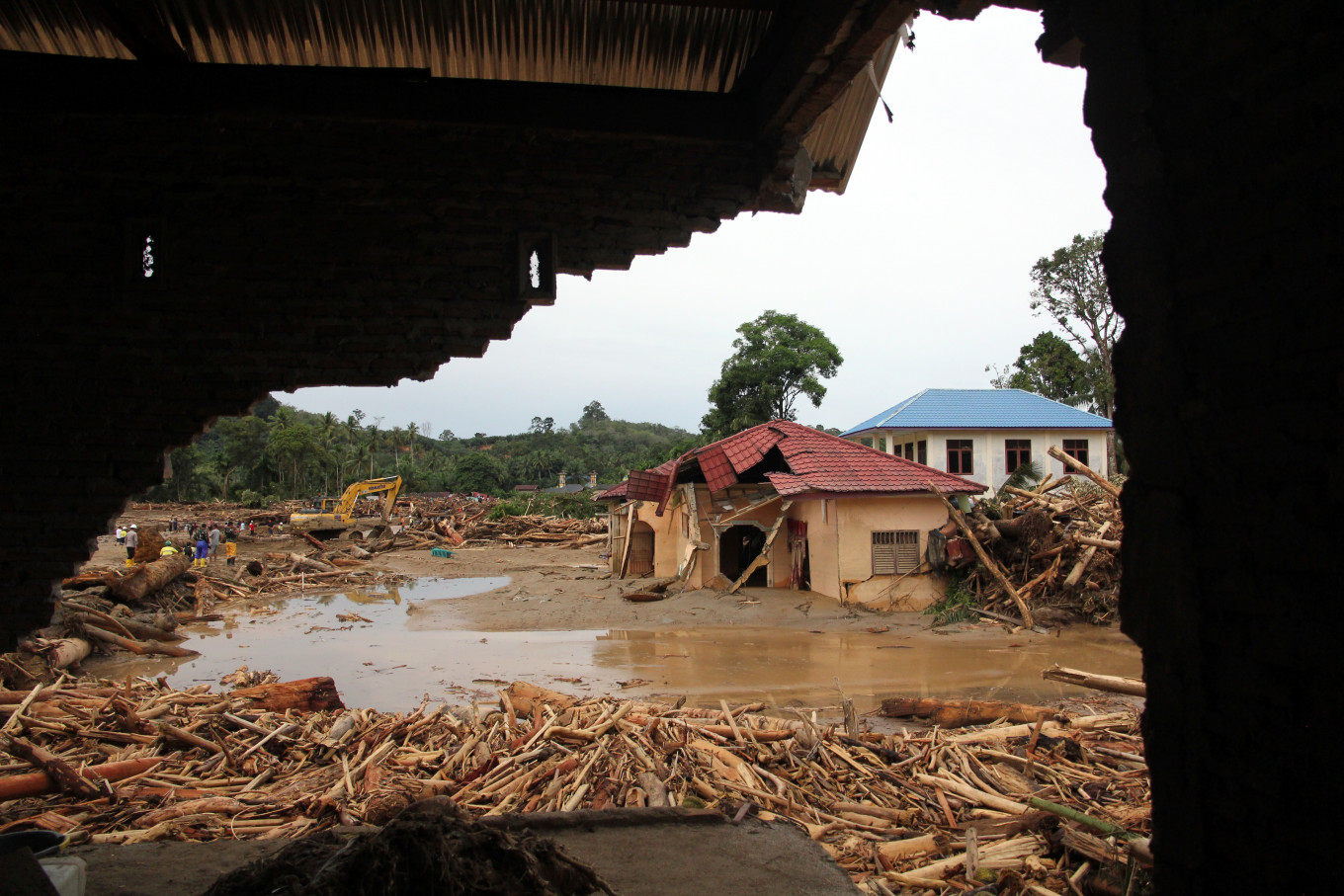 Damaged houses are seen on Nov. 28, 2025, after a flash flood in Batang Toru district, South Tapanuli regency, North Sumatra. (Antara/Yudi Manar)
T
he catastrophic floods and landslides that struck Sumatra did more than claim lives and destroy homes, they exposed a deeper fragility in Indonesia’s disaster-protection system.
More than 900 people have died, hundreds remain missing, thousands were injured and thousands of homes and hundreds of public facilities were destroyed in a matter of hours. Yet even this devastation only hints at the scale of the challenge faced by survivors.
When the waters receded, families were left not only grieving but financially stranded, with no structured mechanism to help them recover the assets, livelihoods and sense of stability that vanished overnight.
This tragedy is part of a broader pattern. In 2024 alone, Indonesia recorded 2,107 disasters, including floods, landslides and forest wildfires, damaging over 60,000 properties and nearly 1,000 public facilities, while leaving 489 dead and more than 10,000 injured.
These events often trigger both short- and long-term displacement, cutting families off from food, shelter, healthcare, education and employment. Displaced families face heightened disease risks, psychological trauma and severe economic hardship. The cumulative burden is immense and structurally debilitating.
According to the World Risk Index 2025, Indonesia is the third most disaster-prone country in the world, after the Philippines and India. The scale of potential losses is staggering. The National Disaster Mitigation Agency’s (BNPB) 2023 worst case scenario assessment estimates Rp 3.03 trillion (US$181.5 million) in physical damage and Rp 3.93 trillion in economic losses, a combined 33 percent of Indonesia’s gross domestic product. The numbers represent the enormous pressure natural disasters exert on households, local administrations, and the national budget.

Despite facing frequent and severe hazards, Indonesia still lacks a nationwide system that shields households from disaster-related financial ruin. Most families have no insurance coverage, no automatic compensation mechanism, and no dependable recovery mechanism.