The Jakarta Post
Please Update your browser
Your browser is out of date, and may not be compatible with our website. A list of the most popular web browsers can be found below.
Just click on the icons to get to the download page.


Popular Reads
Top Results
No results found. Please check your search term and try again
Can't find what you're looking for?
View all search results
Popular Reads
Top Results
No results found. Please check your search term and try again
Can't find what you're looking for?
View all search resultsBeyond the code: The geopolitical triad of AI
AI has become the center of a new world order, and we have entered the AI Triad, which consists of the politicization, securitization and weaponization of technology.
Change text size
Gift Premium Articles
to Anyone
Share the best of The Jakarta Post with friends, family, or colleagues. As a subscriber, you can gift 3 to 5 articles each month that anyone can read—no subscription needed!
 Set as preferred source
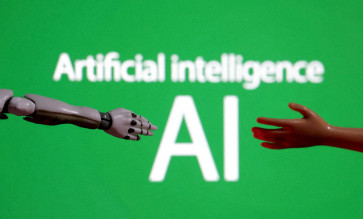
 Words reading “Artificial intelligence AI“, miniature of robot and toy hand are pictured in this illustration created on Dec. 14, 2023. (Reuters/Dado Ruvic)
O
n Dec. 4–5, I attended the Sydney Dialogue organized by the Australian Strategic Policy Institute to share Indonesia’s view on the risks of artificial intelligence. As leaders and experts gather for this meeting, the atmosphere feels very different from previous years because the time when we viewed AI simply as a tool for making work faster is over.
AI has become the center of a new world order, and we have entered what I call the AI Triad, which consists of the politicization, securitization and weaponization of technology.
These three concepts are driving a new cold war in the Indo-Pacific region. Politicization means AI is no longer just for efficiency, but is now a symbol of national pride, where a country’s AI program shows its power just like a flag does. This leads to securitization, where scientific research is seen as a national security issue, resulting in strict bans on sharing technology that look like the oil embargoes of the past. Finally, weaponization has moved from theory to reality, with autonomous drones and deepfake lies now being used to disrupt elections and destabilize countries.
However, this situation is made even more dangerous by three technical problems. The first is the attribution crisis, which means that in the digital world, we often cannot prove who attacked us, and without knowing who did it, we cannot stop them. The second is the alignment problem, which shows that AI systems built in Silicon Valley act differently from those built in Beijing because they have different values. The third problem is the quantum threat, where hackers steal encrypted data today hoping that powerful future computers will be able to unlock it (“Harvest Now, Decrypt Later”) making it impossible to keep secrets safe.
We can see these divisions clearly in the three different ways AI is being managed around the world. The United States model of surveillance capitalism focuses on profit, where companies collect user data to make money, but this risks taking power away from citizens. The Chinese model focuses on stability and safety, but this often comes with total government control and surveillance. Meanwhile, the European model focuses on strict rules and privacy, but this risks breaking the internet into small pieces and creating confusion where fake news can spread easily.
This complicated situation is made even harder by the return of Donald Trump to the White House. His America First policy brings back protectionism, which makes it difficult for countries like Indonesia to follow a strategy of working with everyone. This raises a difficult question for us regarding how we can build our digital infrastructure by collaborating with China without antagonizing Trump.

Indonesia refuses to be trapped by these choices, and we will not be just a market for American companies, a target for Chinese surveillance or a victim of European confusion. Instead, Jakarta must move forward with a strategy of resilience based on the framework of complex interdependence. It means that we must make ourselves so important to the global supply chain that both superpowers need us. This is an update to our traditional “free and active” foreign policy; while in 1955 this meant avoiding military alliances, in 2025 it means we must avoid depending on just one country for our technology.