The Jakarta Post
Please Update your browser
Your browser is out of date, and may not be compatible with our website. A list of the most popular web browsers can be found below.
Just click on the icons to get to the download page.


Popular Reads
Top Results
No results found. Please check your search term and try again
Can't find what you're looking for?
View all search results
Popular Reads
Top Results
No results found. Please check your search term and try again
Can't find what you're looking for?
View all search resultsGene editing in Indonesia: Can new biotechnology solve old agricultural problems?
Can gene editing truly support smallholder farmers and help Indonesia achieve food sovereignty, or will it simply revive the old controversies surrounding genetically modified crops?
Change text size
Gift Premium Articles
to Anyone
Share the best of The Jakarta Post with friends, family, or colleagues. As a subscriber, you can gift 3 to 5 articles each month that anyone can read—no subscription needed!
 Set as preferred source
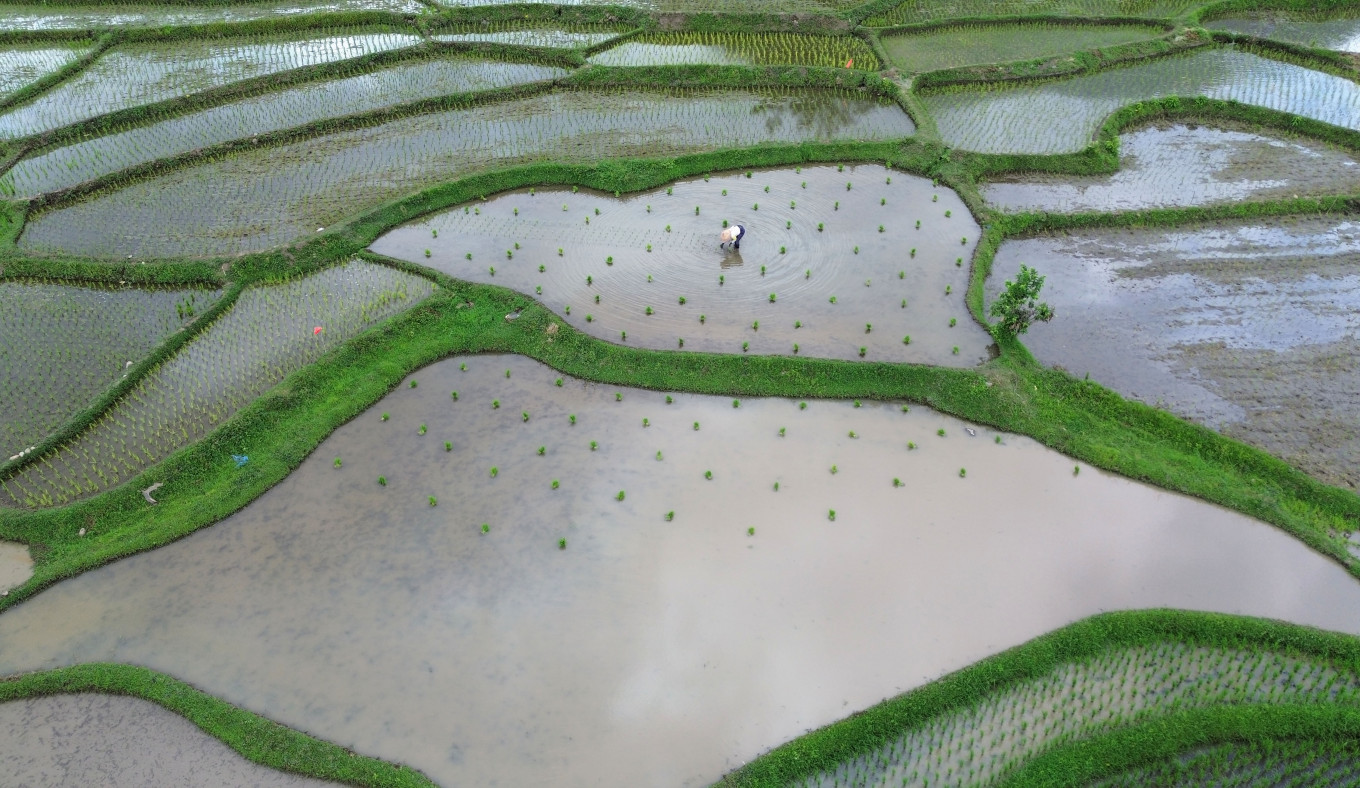 A farmer plants rice on Oct. 26, 2025 in Nagari Padang Laweh Malalo, Tanah Datar regency, West Sumatra. (Antara/Iggoy El Fitra)
L
ike other developing countries, Indonesia is facing a familiar dilemma: how to feed a growing population while protecting its extraordinary biodiversity.
Food security has become a pressing concern amidst drought, pests and climate shifts. Scientists are turning to new technologies for answers. Biotechnology, specifically gene editing, emerges as a potential solution.
However, Indonesians hold diverse views on gene editing. While some support the technology, others oppose it.
Scientists are enthusiastic about the opportunities to enhance staple crops like rice and improve nutritional security.
Yet many still have questions. Can gene editing truly support smallholder farmers and help Indonesia achieve food sovereignty? Or will it simply revive the old controversies surrounding genetically modified crops?
Our 2024 study involving Indonesian stakeholders highlights that technical fixes alone cannot solve food insecurity. For gene editing to succeed, it must address the social inequalities, such as unequal land access, that farmers face.

Both gene editing and genetic modification refer to organisms with genetic material altered by humans to introduce desirable traits, such as drought tolerance or disease resistance.
While genetic modification often involves inserting genes from one species into another, gene editing makes small, targeted changes within the organism’s own DNA. In other words, this technology improves crop quality without adding foreign genes.
Advocates argue that this makes gene editing safer, tastier and more acceptable to the public than older modification methods.
But critics warn that even with these new methods, the same old questions remain: who controls the technology? Who benefits? And who gets left behind?
Smallholder farmers dominate Indonesia’s agricultural landscape, where rice remains the main staple food crop.
Despite increases in rice production and several other agricultural yields, the country still needs to import key commodities like corn and soybeans from the United States to produce tempeh and tofu for daily consumption.
Similarly, livestock feed supplies still rely heavily on imports of genetically modified soybean meal from Argentina and Brazil.
To reduce this dependence on imports, the government revised regulations on genetically modified crops to enable domestic production.
The first commercial cultivation of modified crops, Bt cotton, took place between 2001 and 2002. However, the project ultimately failed after the provider, Monsanto, withdrew in 2003, citing difficult regulatory hurdles and limited land for cultivation.
Between 2003 and 2021, no commercial genetically modified crops were grown, apart from sugarcane in limited government-owned areas.
Following these setbacks, the government has looked towards gene editing. Since 2021, corn, potato and sugarcane varieties have been approved for commercial cultivation. While domestic production remains limited, Indonesia is a major importer of gene-edited commodities, particularly soybeans and corn, for both human consumption and livestock feed.
Today, researchers at the National Research and Innovation Agency (BRIN) are developing gene-edited varieties including rice, cassava and sorghum. The government remains optimistic, presenting gene editing as a way to boost productivity and reduce reliance on food imports.
Yet, questions remain over how this technology will reach farmers, and on whose terms
Gene editing is often promoted as a quick technical fix for complex agricultural challenges. Yet its success and public acceptance depend on far more than science. It hinges on broader social and economic systems: who has access to seeds, who controls the knowledge and who decides which genetic changes are needed.
Our study shows that many people still do not fully understand the technology. Between April and August 2024, we interviewed 11 stakeholders in Indonesia. This included farmer groups, government officials, researchers, NGOs and consumer associations.
Many participants from civil society and farmers’ unions pointed to the “problem of socialization”. They refer to a lack of shared understanding about the role gene technologies should play in Indonesia’s agricultural future. They also emphasized the importance of prioritizing smallholder farmers, who continue to dominate the sector.
Gene editing may yield more drought-tolerant crops. However, it cannot resolve unequal access to land, credit and markets, the main challenges for smallholders.
A representative from a consumer association highlighted risks of “capital bias”. They noted that farmers could end up as company ‘employees’ rather than independent producers if they are pushed to adopt new technologies without transparent information.
Participants from the Indonesian Farmers Union also raised concerns about seed patents. They warned that local farm seeds could be recreated in a laboratory, reclassified and then patented for profit.
Innovation is often treated as the domain of scientists. Meanwhile, the social and ethical implications are left for others to handle afterward. All participants agreed that public engagement is essential, yet none were ready to lead those efforts.
Gene editing could play an important role in Indonesia’s food future, but not if it follows a “technology first, consultation later” approach. Genuine communication requires discussing innovations beyond the scientists’ bubble and meaningfully involving those who shape agricultural and food systems, especially women.
As providers, cooks and household decision-makers, women farmers are well-positioned to play a crucial role in engaging and mobilizing their communities. Their resilience is a vital resource for regional progress. Policymakers and researchers need to invest not only in laboratories but also in building trust, fostering dialogue and developing genuine collaboration with farmers and local communities.
Biotechnology may offer powerful tools, but it is not a silver bullet. We need to understand the specific social and cultural landscape in each locale to determine if and where the technology can be truly useful.
Indonesia’s path forward will depend on recognizing that scientific innovation and social inclusion must grow together. Only by bringing both into alignment can gene editing truly contribute to a fair, sustainable and culturally grounded food system.
---
Emily A. Buddle is a senior research fellow at University of Adelaide. Gloria Fransisca Katharina Lawi is a biotechnology researcher at Gadjah Mada University. Joan Leach is a professor at Australian National University. This article is republished under a Creative Commons license.