The Jakarta Post
Please Update your browser
Your browser is out of date, and may not be compatible with our website. A list of the most popular web browsers can be found below.
Just click on the icons to get to the download page.


Popular Reads
Top Results
No results found. Please check your search term and try again
Can't find what you're looking for?
View all search results
Popular Reads
Top Results
No results found. Please check your search term and try again
Can't find what you're looking for?
View all search resultsThe soft coup against local democracy in Indonesia
The quasi-corporate approach to direct local elections is fundamentally flawed, as a price cannot be put on the democratic principle of popular sovereignty.
Change text size
Gift Premium Articles
to Anyone
Share the best of The Jakarta Post with friends, family, or colleagues. As a subscriber, you can gift 3 to 5 articles each month that anyone can read—no subscription needed!
 Set as preferred source
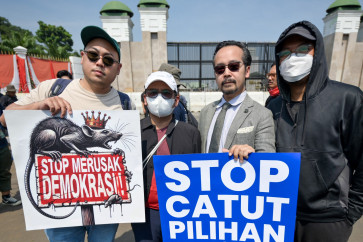
 Protesters holds placards that read 'Stop destroying democracy' (left) and 'Stop revoking our votes' (right) on Aug. 22, 2024, during a demonstration in front of the Senayan Legislative Complex in Central Jakarta to protest the House of Representatives’ plan to reverse the Constitutional Court ruling on nomination rules for regional elections. (AFP/Bay Ismoyo)
I
ndonesia’s democratic journey has long resembled a pendulum, oscillating between moments of openness and episodes of excessive control. The post-1998 reformasi era marked a decisive break from authoritarian centralism, most visibly through the introduction of direct local elections.
Yet today, that hard-won achievement is once again under threat. A growing discourse proposes returning the selection of governors, mayors and regents to regional legislative councils (DPRD), cloaked in the rhetoric of budget efficiency, social stability and anticorruption.
This debate must not be reduced to a technical disagreement over electoral design. At its core, it represents a systematic attempt to dilute popular sovereignty at the local level. Replacing direct elections with legislative selection would amount to a quiet but profound dispossession of citizens’ political rights, one that risks unraveling the democratic foundations painstakingly built over the past two decades.
Wrapped in managerial language, the proposal has been presented as pragmatic reform, yet history suggests otherwise.
Indonesia’s past experiments with political control by the elite rarely delivered genuine efficiency or stability and instead entrenched patronage, weakened accountability and distanced citizens from decision-making. The return of such ideas should therefore be read not as innovation but as regression.
At stake is more than an electoral mechanism. The proposal strikes at the normative core of decentralization itself: the idea that power, legitimacy and responsibility should flow upward from citizens, not downward from party elites.

The proponents of indirect local elections frequently argue that direct elections are prohibitively expensive and incentivize corruption as candidates seek to recoup campaign costs once in office.