TheJakartaPost
Please Update your browser
Your browser is out of date, and may not be compatible with our website. A list of the most popular web browsers can be found below.
Just click on the icons to get to the download page.


Popular Reads
Top Results
No results found. Please check your search term and try again
Can't find what you're looking for?
View all search results
Popular Reads
Top Results
No results found. Please check your search term and try again
Can't find what you're looking for?
View all search resultsWhen Lent and Ramadan converge: A shared spiritual season for Indonesia
As Indonesia experiences a rare spiritual convergence in 2026, the overlapping seasons of Lent and Ramadan offer a powerful "spiritual laboratory" to transform individual faith into a shared national strength.
Change text size
Gift Premium Articles
to Anyone
Share the best of The Jakarta Post with friends, family, or colleagues. As a subscriber, you can gift 3 to 5 articles each month that anyone can read—no subscription needed!
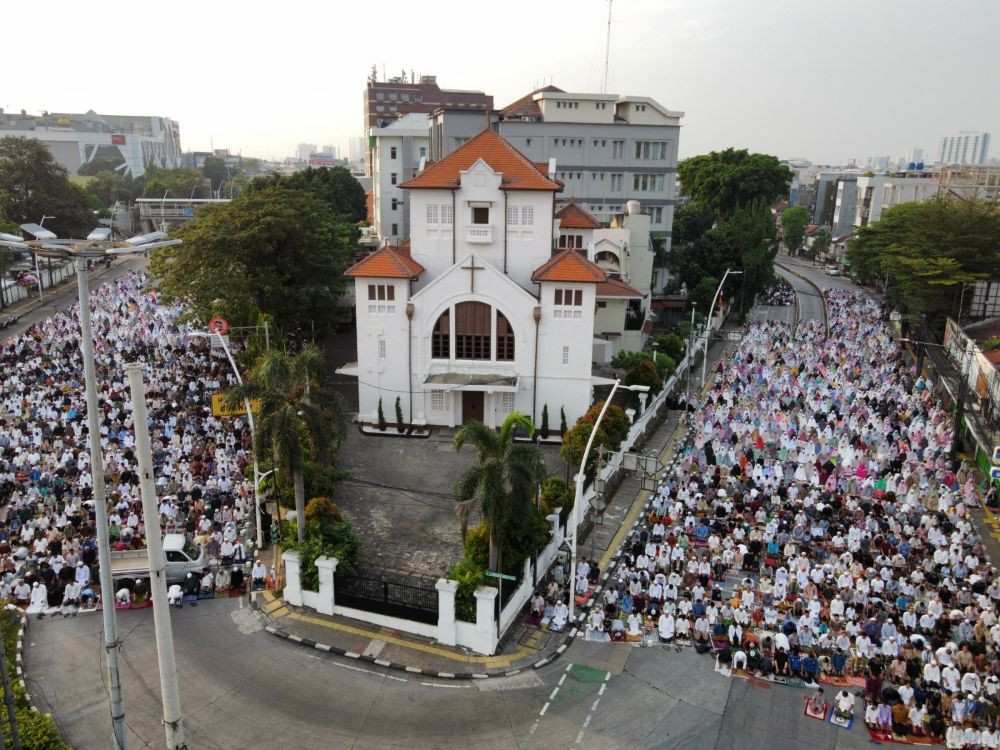 Sharing harmony: A large crowd of Muslims performs a mass prayer for Idul Adha (Day of Sacrifice) on June 6, 2025, in the street surrounding Koinonia Church in Jatinegara, East Jakarta. (JP/Iqro Rinaldi)
I
ndonesia, a nation celebrated for its religious diversity, finds itself in 2026 experiencing a rare spiritual convergence. The Christian season of Lent and the Islamic holy month of Ramadan unfold almost simultaneously this year.
For many believers, this overlap is a matter of liturgical calendars; but for Indonesia as a whole, it represents a profound moment of shared discipline, reflection and solidarity. It serves as a poignant reminder that beneath doctrinal differences lies a common human longing for renewal, compassion and justice.
Lent begins with Ash Wednesday, when Christians receive ashes on their foreheads as a sign of humility and mortality. The season stretches for 40 days, echoing Christ’s period of fasting in the desert. Traditionally, Lent is anchored by three pillars: fasting, prayer and almsgiving. In this context, fasting is not merely abstaining from food, but a spiritual exercise in self-control. Prayer deepens the believer’s relationship with the Divine, while almsgiving embodies compassion, urging Christians to share with the marginalized. The journey culminates in Easter, the celebration of the Resurrection, symbolizing hope’s victory over despair.
Similarly, for Muslims, Ramadan is the most sacred month of the year, commemorating the revelation of the Quran. From dawn to dusk, believers abstain from food, drink and temporal distractions. Yet this fast is as moral as it is physical; it teaches patience, humility and empathy. Through zakat and sadaqah, the blessings of Ramadan extend to the wider community, reinforcing bonds of solidarity during the nightly iftar. The month reaches its peak in Idul Fitri, a joyous festival of forgiveness and gratitude.
While these seasons arise from different theological narratives, their resonance is strikingly similar. Both are parallel journeys of transformation that master desire to redirect the heart. They remind us that true faith is not measured by ritual alone, but by the capacity to change hearts and inspire justice.
This simultaneous observance offers Indonesia a unique "spiritual laboratory". As Grand Imam of Istiqlal Mosque and Religious Affairs Minister Nasaruddin Umar has noted, tolerance is not passive acceptance but active respect, a recognition of the inherent dignity of others. This sentiment echoes the vision of Indonesia’s founding fathers, who anchored the nation in Pancasila. Its first principle, Belief in One God, affirms the centrality of faith while ensuring space for diverse expressions.

The late Abdurrahman “Gus Dur” Wahid, former president and leader of Nahdlatul Ulama, famously believed that religion should be a source of peace, not division. In the same vein, Catholic scholar Franz Magnis-Suseno argues that Indonesia’s success lies in its ability to embrace diversity without succumbing to sectarianism.