The Jakarta Post
Please Update your browser
Your browser is out of date, and may not be compatible with our website. A list of the most popular web browsers can be found below.
Just click on the icons to get to the download page.


Popular Reads
Top Results
No results found. Please check your search term and try again
Can't find what you're looking for?
View all search results
Popular Reads
Top Results
No results found. Please check your search term and try again
Can't find what you're looking for?
View all search resultsWhy the G20 is failing on climate, debt and inequality
The G20 has done exactly what it was set up to do; the problem is that the capitalist financial system is no longer sufficient to address the challenges of today's world.
Change text size
Gift Premium Articles
to Anyone
Share the best of The Jakarta Post with friends, family, or colleagues. As a subscriber, you can gift 3 to 5 articles each month that anyone can read—no subscription needed!
 Set as preferred source
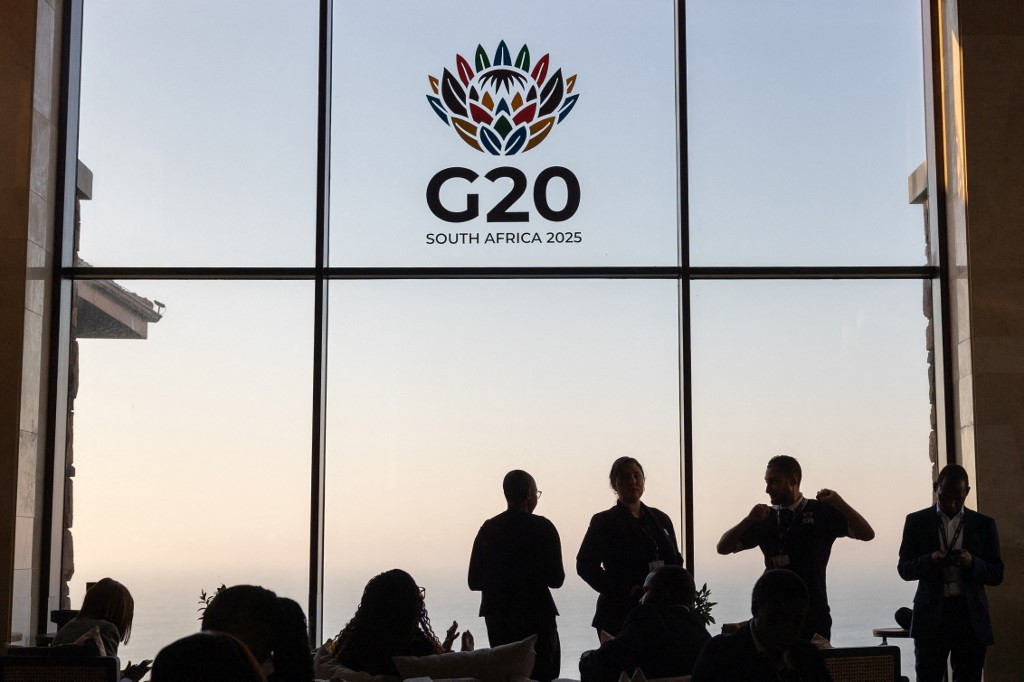 Delegates arrive at The Capital Zimbali hotel in Durban on July 17, 2025, ahead of the Group of 20 Finance Ministers and Central Bank Governors meeting in South Africa. (AFP/Rajesh Jantilal)

The Group of Twenty (G20) emerged from the financial turmoil that followed the collapse of the Thai currency in 1997, which rapidly spread financial instability from Thailand to the rest of Asia.
At that time, the finance ministers and central bank governors convened to forge a strategy to stabilize the global economy and prevent future crises. Their aim was to set up a forum to maintain global economic stability.
The G20 today is a voluntary international forum. It includes the Group of Seven (G7) advanced capitalist nations of Canada, France, Germany, Italy, Japan, the United Kingdom and the United States and the G7’s allies in the European Union, as well as the emerging and developing economies of Argentina, Australia, Brazil, China, India, Indonesia, Mexico, Russia, Saudi Arabia, South Africa, South Korea, Türkiye and the African Union in 2025.
As a scholar who critiques capitalism’s economic and social systems, I argue that the G20 has failed to recognize or address accelerated climate change, spiraling indebtedness and profound inequality.
These are overlapping crises. They’re happening at the same time and intensifying each other; in other words, a polycrisis.
The G20’s failure to acknowledge the polycrisis and take action against it is especially risky now. Social tensions are rising and political systems are becoming more unstable. Economic development is being stymied and the environmental situation continues to deteriorate. Meaningful global action is not just important now but critically urgent for our futures.

The G20’s shortcomings have their roots in its origins as a forum for finance ministers and central bankers. The aim was to safeguard the global capitalist financial system. In other words, the G20’s core purpose was to bring governments together so that they could keep money moving freely around the world and prevent the collapse of capitalism.
It is not surprising that the G20’s most decisive agreements since the 2008 global financial crisis have occurred when the capitalist system required rescuing. A prime example is the coordinated response to that crisis, when the US Federal Reserve led governments in buying up government and commercial bonds and assets as a way of injecting money into the economy.
This strategy had severe global repercussions. Central banks kept interest rates artificially low in order to make borrowing cheaper for ordinary people. But this only encouraged corporations to borrow what was then cheap money. They invested this in the stock market and property instead of building businesses that create jobs.
This created “asset bubbles” that could burst at any time. Speculators wanted fast profits on their investments and flooded faster-growing developing countries and emerging markets. The rush of money into countries like South Africa pushed prices up faster, causing higher inflation. To control it, the government cut back on public spending and raised interest rates. This made life harder for ordinary people.
In capitalist economies, capital can be deployed productively: building factories, expanding infrastructure and creating jobs. Capital can also be deployed speculatively: using money to get into a cycle of making profit out of profit.
The G20’s legacy so far has been to preserve capitalist financial systems over the cultivation of real and equitable development of the economy.
South Africa, like many other countries, has become profoundly over-financialized. This simply means that the economy is increasingly dominated by speculators spending money on chasing profits, rather than investment in productive enterprises such as innovative factories and job creation.
The human cost of over-financialization is devastating: Nearly one-third (31.9 percent) of South Africans are officially unemployed. This abysmal statistic only begins to reveal the true depth of the crisis.
Statistics South Africa has introduced a new indicator that measures how many people in the country are unemployed, underemployed (not working full-time) and discouraged from job hunting. In the third quarter of 2025, this group numbered 44.9 percent of the population.
This means that just under half of the country’s working-age population is being left behind, their potential untapped. They’re a stark testament to an economy failing to generate sufficient and meaningful work.
I argue that the G20 has done exactly what it was created to do: help protect and stabilize a capitalist system that is naturally prone to crises.
But today, in a world facing overlapping crises, from widespread state capture to the threat of ecological collapse, the G20’s statements are talk that lacks real, transformative action. There is no way in which climate change and its impact can be wished away. It has to be dealt with urgently.
Today, political economists and scientists are working on ways to adapt society and the environment to extreme weather. Part of this is ending the fossil fuel pollution that keeps heating up the earth and instead moving to green energy. The other part is spending money on climate adaptation. Yet African countries cannot transition away from fossil fuels and toward adaptation while trapped in debt.
A number of steps need to be taken.
African countries are spending more on debt repayment than they are on basic services, health, education and security. That’s not right, morally and ethically, and must stop. Wealthy countries must deliver the development aid they promised instead of driving Global South countries further into debt through climate loans.
The US is the G20 president in 2026. The Trump presidency no longer accepts South Africa as a member. South Africa should instead work with the countries and collective associations that truly want to work with it. It should develop a community of nations with an ethos of empathy.
South Africa should also rally working-class communities in the Global North to join it. Those communities have far more in common with the people of the Global South than they do with Global North billionaires and emerging trillionaires.
Private credit rating agencies often judge poorer countries unfairly and make it more difficult for them to borrow money. The influence of these agencies must be ended. Development finance must be channeled to climate adaptation projects in the Global South. The African Union and other African forums must replace outdated global structures where countries like the US dominate the rest of the world.
The African Union represents the most excluded countries in the world. Its members must work together to ensure that the continent always has one global position on the most important economic issues of today: climate finance, debt justice and development aid.
---
The writer is chief director at the Tshwane University of Technology, an associate research fellow of the Tellus Institute and a trustee of the Canon Collins Trust. This article is republished under a Creative Commons license.