The Jakarta Post
Please Update your browser
Your browser is out of date, and may not be compatible with our website. A list of the most popular web browsers can be found below.
Just click on the icons to get to the download page.


Popular Reads
Top Results
No results found. Please check your search term and try again
Can't find what you're looking for?
View all search results
Popular Reads
Top Results
No results found. Please check your search term and try again
Can't find what you're looking for?
View all search resultsWhy hazards continue to turn into disasters in Indonesia
Like many other regions in the Global South, Aceh’s vulnerability can be traced back to colonialism. Post-colonial development continues to reinforce it.
Change text size
Gift Premium Articles
to Anyone
Share the best of The Jakarta Post with friends, family, or colleagues. As a subscriber, you can gift 3 to 5 articles each month that anyone can read—no subscription needed!
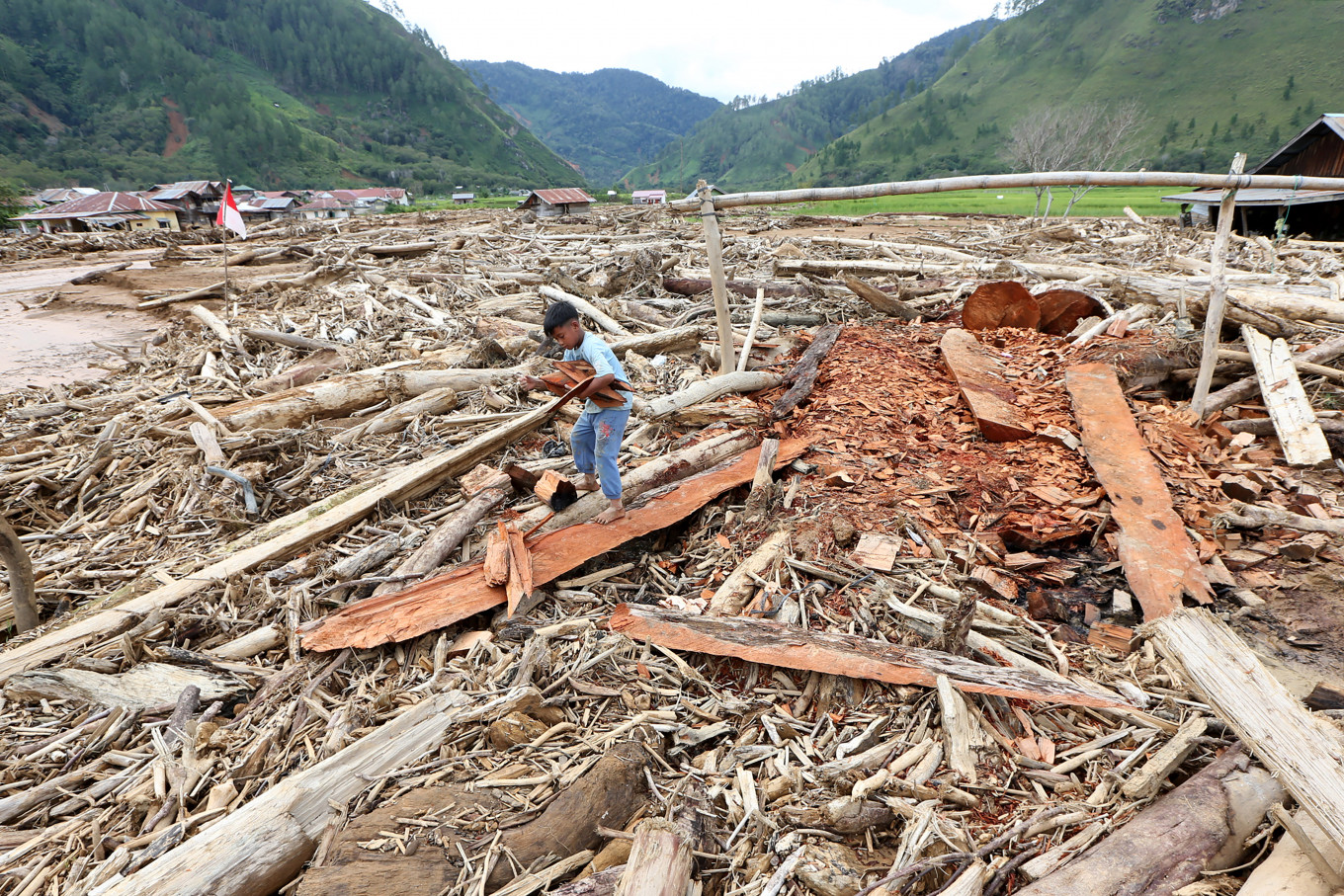 A boy collects firewood on Jan. 02, 2026, from piles of logs carried by landslides in Toweran Uken, Lut Tawar, Central Aceh, Aceh. (Antara/Irwansyah Putra)
W
eeks after Cyclone Senyar made landfall in northern Sumatra, the province of Aceh continues to struggle. The cyclone passed through the Strait of Malacca in late November, bringing heavy rains and causing widespread flooding in parts of Indonesia, Malaysia and Thailand. More than 500 people were killed and 250,000 people displaced in Aceh alone.
The cyclone’s unusually high death toll and catastrophic impacts have been attributed to a range of factors, including warming ocean temperatures due to climate change, deforestation and other environmental changes, Aceh’s unique geographical and topographical setting and how rarely cyclones occur near the equator.
What is missing from the discussion is the root cause of why Aceh was ill-prepared for the hazard. Like many other regions in the Global South, Aceh’s vulnerability can be traced back to colonialism, which created an inequitable distribution of power, wealth and resources. Post-colonial development continues to reinforce it.
The impact of Cyclone Senyar has drawn parallels with the 2004 Aceh tsunami that devastated the province and surrounding areas. Since then, disaster preparedness in Aceh has come a long way. Yet the aftermath of Senyar suggests that disaster preparedness efforts have not tackled Aceh’s underlying vulnerabilities.
The national meteorological agency gave multiple warnings of the hazard well in advance. But neither the national agency responsible for disaster management, the National Disaster Mitigation Agency, nor the Aceh provincial Disaster Mitigation Agency were able to translate warnings into effective action or effectively lead emergency response efforts. Such institutional failures are among the challenges that contribute to vulnerability in Aceh.
In our ongoing research among coastal communities in Aceh, we explore how their livelihoods have been impacted by external shocks, as well as the diverse ways they have adapted to navigate these stresses.

Starting in the late 16th century, the Dutch colonial government established infrastructure and policies to facilitate resource extraction in Indonesia. The focus of European colonizers was on the eastern part of the archipelago to control the spice trade in the Maluku region. However, it was Aceh that the Dutch spent the most resources to conquer.
The Dutch East India Company opened the port of Kuala Langsa in 1907, in the same area where Cyclone Senyar made landfall. That was followed by large-scale investment in rubber and palm oil plantations. Colonialists supported top-down governance and implemented policies that gave lasting economic and political advantages to those who aligned themselves with the Dutch.
An example is the Ethical Policy, among other things, it provided educational opportunities to local elites with the aim of helping the Dutch lead the colony. Local elites were also given land that had previously been communal, to expand agriculture and exploit natural resources, creating divisions within the Acehnese.
Colonial rule also had a lasting impact on the natural environment: highly biodiverse forests were converted to monocrop plantations, ports were expanded to accommodate larger ships and both land and seas were exploited for resources.
Post-independence governments have maintained the top-down institutions put in place by the Dutch. They have also emphasized a continued economic focus on extractive industries, such as pepper, copra and petroleum to fuel Indonesia’s rapid economic growth. These coupled together continue to have devastating impacts on the environment and on the livelihoods of the communities.
In the 1970s, communities in Kuala Langsa, a village in the city of Langsa along Aceh’s east coast, shifted their livelihoods to intensive tiger prawn aquaculture as part of the push to develop marine fisheries under then-president Soeharto’s “New Order” political economy regime.
However, a viral disease outbreak led to the collapse of the tiger prawn industry in the early 1990s. Intensive prawn aquaculture significantly degraded the coastal mangrove forests and reduced water quality. That, in turn, undermined the viability of small-scale fisheries that local communities had traditionally relied on.
The conflict between the government and separatists in Aceh from 1976 to 2005 led to an influx of migrants to Kuala Langsa from other parts of the province, putting additional pressures on the environment.
The 2004 tsunami destroyed many mangrove forests along Langsa’s coastline, further negatively affecting the livelihoods of communities that depended on shrimp, crab and fish living in the mangroves.
The hazard that struck Langsa and other parts of Aceh did not turn into such a devastating disaster due to climatic and geophysical factors alone. Hazards turn into disasters due to decisions made by those in power that make people vulnerable.
Between 1990 and 2024, almost 160,000 hectares of land was deforested to make way for palm oil monoculture plantations under permits issued by the central government. Land converted into monoculture plantations loses its capacity to absorb rainwater, turning torrential rain into runoff that can create landslides. The forest on which communities depended for fruits such as durian, mangoes, rambutan and medicinal plants were impacted, affecting local incomes and sources of food, as well as their local knowledge associated with them.
Aceh’s vulnerability stems from environmental degradation from rampant resource extraction, instability and displacement due to armed conflict, top-down, centralized decision-making by the government and weak institutions stemming from poor governance and corruption.
Measures to strengthen disaster preparedness in Aceh have not tackled the region’s underlying vulnerabilities. Oftentimes, projects meant to promote resilience and development do not address the factors and processes that decrease the vulnerability of the most marginalized.
Disaster contingency plans continue to focus on geological hazards instead of taking a multi-hazard approach. These plans have not been successful in strengthening the preparedness of institutions responsible for reducing disaster risk.
As the fourth-most flood-prone region in Indonesia, local and provincial authorities in Aceh need to prepare for extreme weather events so future events like Cyclone Senyar do not wreak such havoc.
As climate change increases the frequency and intensity of storms, it is imperative that disaster risk reduction efforts center on reducing vulnerability and social justice. Equitable distribution of wealth, power and resources can only be realized when local and indigenous knowledge is acknowledged to help build sustainable communities.
---
Lisa Hiwasaki is an assistant professor on management of international cooperation and humanitarian action at Université Laval. Haekal A. Haridhi is an associate professor on marine sciences at Syiah Kuala University. This article is republished under a Creative Commons license.