TheJakartaPost
Please Update your browser
Your browser is out of date, and may not be compatible with our website. A list of the most popular web browsers can be found below.
Just click on the icons to get to the download page.


Popular Reads
Top Results
No results found. Please check your search term and try again
Can't find what you're looking for?
View all search results
Popular Reads
Top Results
No results found. Please check your search term and try again
Can't find what you're looking for?
View all search resultsAsian defense firms may be the surprise winners of rising geopolitical tensions
The arms game among Western countries is turning increasingly toward cheaper alternatives from manufacturers in Asia, where indigenization is trending amid ongoing geopolitical tensions.
Change text size
Gift Premium Articles
to Anyone
Share the best of The Jakarta Post with friends, family, or colleagues. As a subscriber, you can gift 3 to 5 articles each month that anyone can read—no subscription needed!
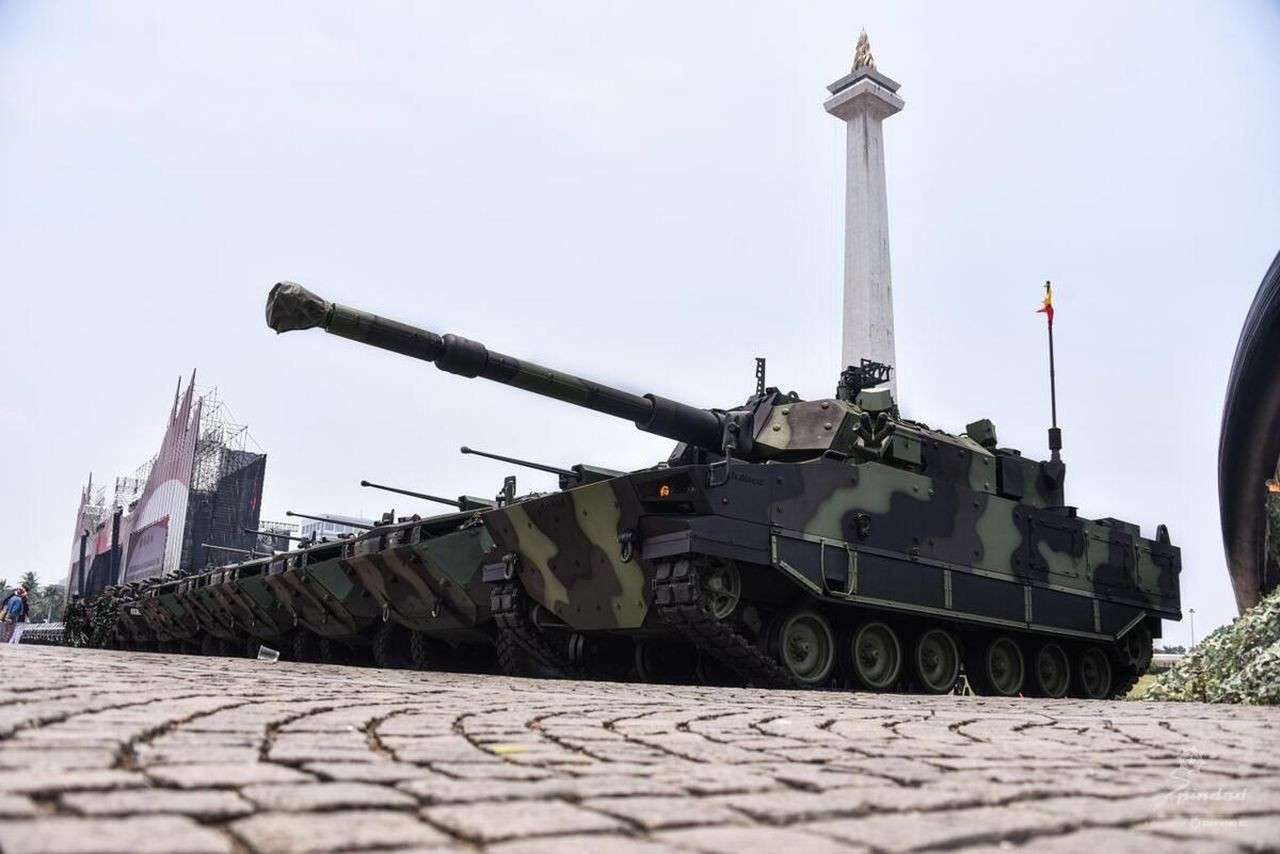 A Harimau medium tank (front), made by state-owned land weapons and ammunition maker PT Pindad, is parked next to Pandur II 8x8 armored combat vehicle against the backdrop of the National Monument (Monas) at Merdeka Square in Central Jakarta on Oct. 2, 2024, ahead of an event to mark the 79th anniversary of the Indonesian Military (TNI). (kompas.com/PT Pindad)
G
eopolitical tensions were sky-high in 2025, and United States (US) President Donald Trump's recent military actions in Venezuela and bid for Greenland suggest the international temperature won’t be dropping any time soon. One surprising market winner from all this could be Asian defense firms.
Defense expenditures are rising across the world. NATO countries committed in June to spend 2.8 percent of their gross domestic product (GDP) on defense in 2026 and increasing that figure to 5 percent by 2035.
Key member Germany has an interim target of 3.5 percent of GDP by 2029. Japan is also planning to double defense spending to 2 percent of GDP by 2027, and Trump wants to boost the 2027 US military budget to US$1.5 trillion from the $901 billion approved by Congress for 2026.
Given this backdrop, it's unsurprising that defense companies’ shares outperformed strongly in 2025. European defense exchange-traded funds (ETFs) almost doubled from the beginning of 2025 through early January 2026, while the high-flying “magnificent seven” US tech stocks appreciated just over 20 percent. In that period, Asian and US defense stocks were up around 75 percent and 50 percent, respectively.
Looking to the next 12 months, Asian defense companies have the potential to outstrip European defense majors because they benefit from two trends: rising exports to the European Union and a sharp increase in domestic defense manufacturing across Asia as countries seek to replace imports.
Europe's armaments demand is being increasingly met by Asian defense companies, with South Korean firms taking the lead. The East Asian country is the world’s 10th-largest arms exporter, accounting for 2 percent of total arms exports from 2020-24, according to the Stockholm International Peace Research Institute (SIPRI). Over this period, 53 percent of South Korea’s defense exports went to Europe, with 46 percent going to Poland alone.

Some European countries, notably Poland, are now buying more from Asian companies than from their US counterparts. Timely supplies and cheaper prices for products of equivalent quality are often tilting the balance in favor of Korean firms.
South Korea is not the only game in town, however. SIPRI’s list of the top 100 arms producers features 23 Asian companies: eight Chinese, five Japanese, four South Korean, three Indian and one each from Taiwan, Singapore and Indonesia. With the exception of the Chinese firms, all have seen their revenues grow meaningfully over the past year.
The Asian defense story is also rooted in the rising “insourcing” of defense manufacturing. Based on the belief that an effective national security strategy demands a homegrown military industrial complex, Asian countries are increasingly focusing on domestic manufacturing to replace imports.
Several ASEAN states have set aggressive defense indigenization goals. For example, Indonesia plans to raise local content in major defense equipment from 40 percent in 2026 to 60 percent by 2030, while Vietnam aims to boost the portion of domestic inputs in defense radars, simulators and artificial intelligence from around 32 percent in 2025 to 50 percent by 2030.
The pole position is occupied by India, the world's second-largest arms importer, according to SIPRI. In 2015, India set a defense indigenization target of 70 percent by 2027, up from 35-40 percent at that time. It is well positioned to reach this target, with 65 percent of India’s defense equipment manufactured locally as of 2025. Much of this growth has come at the expense of Russia, which has seen its average arms exports to India fall significantly over the past decade.
Relatively attractive valuations may also propel Asian defense stocks in 2026. Just look at a sample of 20 firms from SIPRI's top 100 arms producers. These include industry leaders in Europe and the US as well as Asian firms with market caps above $10 billion and available consensus earnings estimates.
A stock with an earnings growth forecast that higher than its price-to-earnings multiple is usually treated as cheap. In investment parlance, the multiple of its price-earnings-to-growth, or PEG, is less than one.
By this metric, nine stocks out of our sample of 20 qualify as cheap, and six of them are Asian. Four of the six are Korean defense giants: Korea Aerospace, Hanwha Aerospace, Hyundai Rotem and LIG Nex1. China’s Jonhon Optronic and Japan’s Kawasaki Heavy Industries also squeeze into the cheap silo.
Even within this bucket, growth is tilted toward Asian firms. Four of the five companies with the highest earnings growth forecasts here are Korean. Germany’s Rheinmetall is the only non-Asian defense firm from this sample that qualifies as both cheap and high-growth.
While Asian defense firms appear well-positioned to outperform this year, significant headwinds remain. Most importantly, American and European firms continue to lead in cutting-edge areas like AI, quantum communications, hypersonics and advanced autonomous systems, as the Australian Strategic Policy Institute points out. Supply chain vulnerabilities also remain for Asian manufacturers, as seen recently when China halted exports of rare earths and other critical dual-use materials to Japan.
To sustain Asian companies' rapid growth, therefore, research and development efforts will likely need to expand robustly and the uninterrupted flow of critical materials will need to be ensured.
European defense companies enjoyed a rapid rise last year, but investors’ attention may now shift toward Asian market leaders as they look for strong growth and more attractive valuations.
---
The writer is founder and CEO of Emmer Capital Partners Ltd. The views expressed are personal.