The Jakarta Post
Please Update your browser
Your browser is out of date, and may not be compatible with our website. A list of the most popular web browsers can be found below.
Just click on the icons to get to the download page.


Popular Reads
Top Results
No results found. Please check your search term and try again
Can't find what you're looking for?
View all search results
Popular Reads
Top Results
No results found. Please check your search term and try again
Can't find what you're looking for?
View all search resultsWhy power makes leaders see threats everywhere
Increased power, perhaps counterintuitively, appears to breed increased fear of weaker competitors. This can trigger preventive action such as foreign interventions that, to outsiders, may look illogical.
Change text size
Gift Premium Articles
to Anyone
Share the best of The Jakarta Post with friends, family, or colleagues. As a subscriber, you can gift 3 to 5 articles each month that anyone can read—no subscription needed!
 Set as preferred source
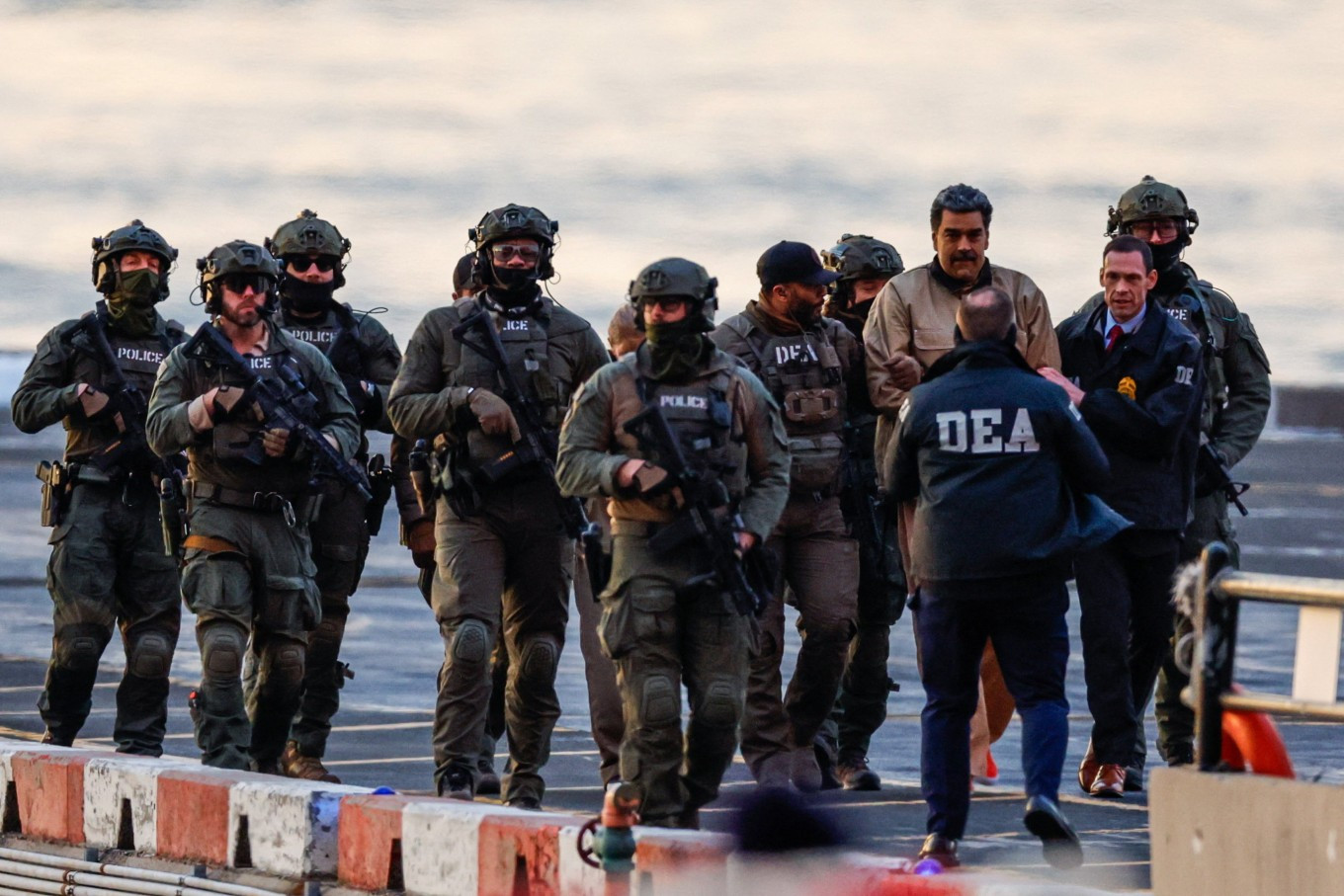 Captured Venezuelan President Nicolas Maduro arrives on Jan. 5, 2026, at the Downtown Manhattan Heliport as he heads toward the Daniel Patrick Manhattan United States Courthouse for an initial appearance to face US federal charges including narco-terrorism, conspiracy, drug trafficking, money laundering and others in New York City, the US. (Reuters/Eduardo Munoz)
F
rom Moscow to Washington, big power politics have returned to the global stage. It would be easy to dismiss the actions of the last few years as large nations doing what they have always done, but recent insights in the field of behavioral geopolitics point to a different dynamic.
Increased power, perhaps counterintuitively, appears to breed increased fear of weaker competitors. This can trigger preventive action such as foreign interventions that, to outsiders, may look illogical.
This new geopolitical era was arguably kicked off in 2022 with Russia's full-scale invasion of its much smaller neighbor, Ukraine. But the shift back toward "big power" thinking truly went into hyperdrive with President Donald Trump's return to the White House.
First came the global trade war, with the United States president making it clear that he expected to set the terms of any trade negotiation, and then came the release of the administration’s National Security Strategy that resurrected the concept of "spheres of influence”.
But the real turning point came when the calendar turned to 2026. In less than one month, the Trump administration has conducted a military raid on Venezuela to seize the country's president, threatened to intervene in Iran and pursued a bellicose campaign to acquire Greenland (which at least for now, looks like it is de-escalating).
One way to make sense of what we're seeing is to look at geopolitics through the lens of behavioral psychology. In two papers from 2023 and 2025, Caleb Pomeroy from the University of Toronto used research on the impact of power on business leaders' thinking and actions to analyze international policymaking.

This research identified a broad range of behavioral patterns, from the benign to the consequential.
For example, people who feel powerful tend to make the opening argument in a debate or a negotiation, which typically gives them an advantage. But the research found that those who feel powerful also rely more heavily on stereotypes and discount others' views, which can lead them to ignore important input when making decisions.
That last feature can become especially troubling as people move up corporate and government hierarchies, where the issues they face become harder to resolve. As president Dwight D. Eisenhower reportedly said, “No easy problems ever come to the President of the United States. If they are easy to solve, somebody else has solved them”.
As a result of the increasing complexity of the problems at hand and the limited availability of data on how to resolve them, business executives typically rely more on what Nobel-winning psychologist Daniel Kahneman called "System 1 thinking": fast, intuitive decision-making based on heuristics, emotions and experience rather than deliberate thought and deep analysis.
One major downside of System 1 thinking is that it often increases the fear of being challenged. Criticism naturally triggers our innate fight or flight instincts. And in a work setting, distancing oneself from the challenger is often not possible, creating a perception of being attacked without the possibility to deflect the criticism.
Pomeroy’s research argues that these findings from the business world can translate to foreign relations. Using surveys and government documents, he demonstrates that, in many cases, the more dominant a politician thinks their country is, the more they typically fear other nations, big and small.
For example, in a 2020 survey among Russian policy elites, politicians who perceived Russia to be more powerful than the average respondent felt more threatened not only by the US and the potential eastward expansion of NATO, but also by neighboring Ukraine. No other psychological or demographic factor increased the perception of Ukraine as a threat to Russians.
Pomeroy also analyzed US diplomatic cables from the Cold War era. He showed that US politicians and diplomats who expressed a stronger sense of US global power perceived the Soviet Union, China and the Viet Cong (during the Vietnam War) to be bigger threats than those who were more circumspect about American might.
Indeed, an increased perception of power can turn even dovish people into foreign policy hawks. This may help explain ill-fated military interventions such as the US invasion of Iraq in 2003 or the Soviet invasion of Afghanistan in 1979.
Of course, feeling threatened by a less powerful neighbor does not mean that the more dominant country will act on that perception, particularly if the nation's institutions inhibit rash actions. Moreover, there are plenty of examples throughout history of countries that have attacked other nations when they felt their grip on power slipping.
But Pomeroy's research highlights one unexpected way that power may distort the decision-making process of policy elites, something investors should keep in mind when trying to navigate this new, rapidly evolving geopolitical landscape.
---
The writer is an investment strategist at independent investment bank Panmure Liberum. The views expressed are personal.