The Jakarta Post
Please Update your browser
Your browser is out of date, and may not be compatible with our website. A list of the most popular web browsers can be found below.
Just click on the icons to get to the download page.


Popular Reads
Top Results
No results found. Please check your search term and try again
Can't find what you're looking for?
View all search results
Popular Reads
Top Results
No results found. Please check your search term and try again
Can't find what you're looking for?
View all search resultsSafeguarding nations beyond: Indonesia’s naval transition to blue-water reach
Indonesia's newly announced dynamic resilience doctrine necessitates wider naval reach, but without rigorous planning and fiscal discipline, its blue-water ambitions will remain merely symbolic.
Change text size
Gift Premium Articles
to Anyone
Share the best of The Jakarta Post with friends, family, or colleagues. As a subscriber, you can gift 3 to 5 articles each month that anyone can read—no subscription needed!
 Set as preferred source
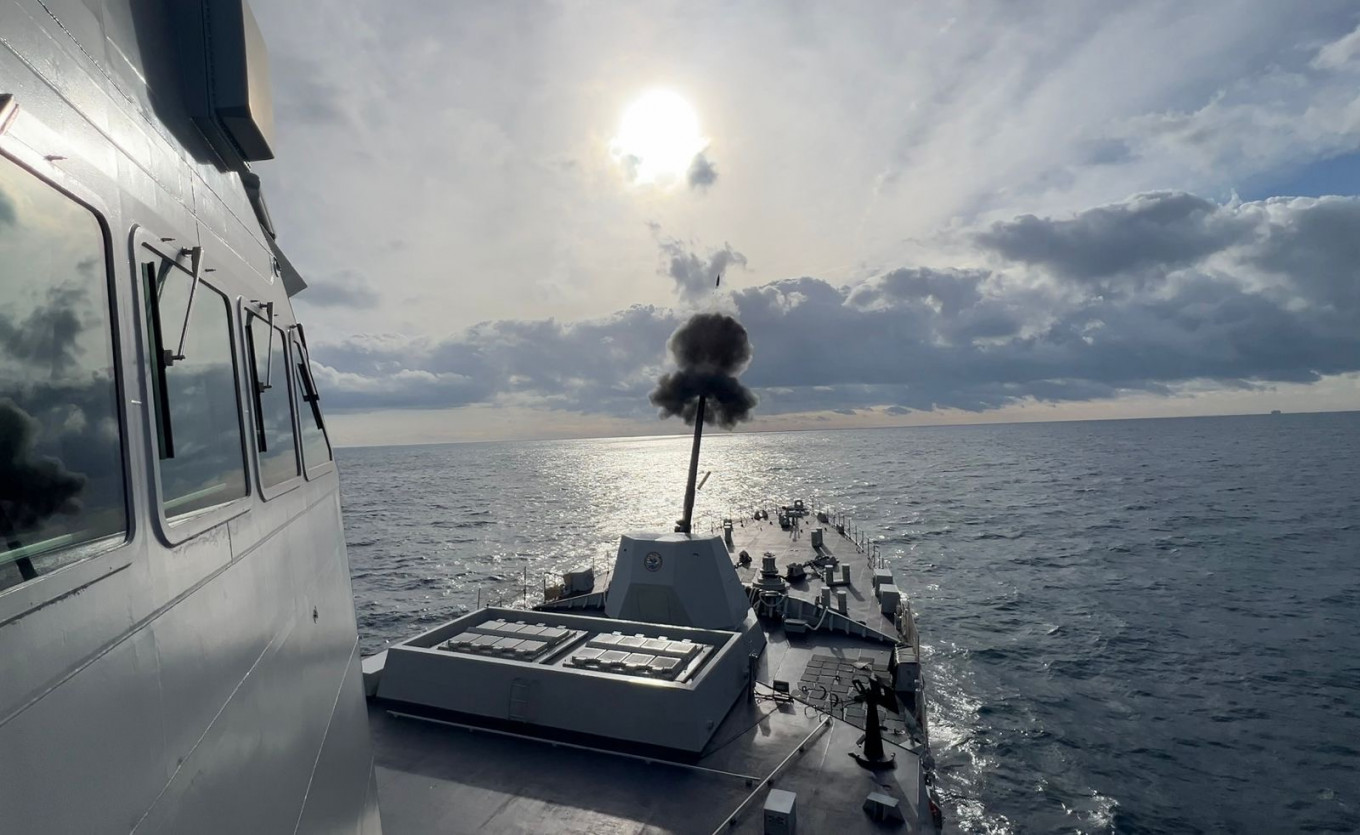 The Indonesian Navy’s KRI Prabu Siliwangi-321, a Brawijaya-class frigate, test-fires Leonardo’s OTO 127-millimeter Vulcano onboard gun on Jan. 27, 2026, during an exercise in an undisclosed area in Italian waters. (Courtesy of Indonesian Navy/-)
A
mid today’s fragmenting global order and intensifying geopolitical competition, Indonesia faces strategic challenges that require it to look beyond its traditional maritime realms.
During his annual press statement on Jan. 14, Foreign Minister Sugiono presented the "dynamic resilience" doctrine, which seeks to secure policy space, protect citizens abroad and, perhaps most importantly, enable international engagement from a position of strength.
The minister's choice of vocabulary is telling: He emphasized a clear synergy between foreign and defense policy. Crucially, this framework suggests that military power, particularly the role of naval forces, serves as an essential bedrock of diplomatic influence.
Under Law No. 3/2025, the Indonesian Navy (TNI AL) is entrusted with naval diplomacy to support the state’s foreign policy goals. This is not merely theoretical. For the past 16 years, the Navy has deployed warships to Lebanon as part of the United Nations Interim Force in Lebanon (UNIFIL) Maritime Task Force. Although this specific deployment concluded on Jan. 5 following the decision of the UN Security Council (UNSC) to sunset the mission by late 2026, Indonesia’s humanitarian reach continues to expand.
On Jan. 18, 2024, Indonesia dispatched the hospital ship KRI Dr. Radjiman Wedyodiningrat to Gaza to deliver vital humanitarian aid. The Navy is reportedly prepared to deploy all three of its hospital ships for peacekeeping missions in the region, pending a UNSC mandate.
Parallel to these humanitarian commitments, defense cooperation has surged since 2019. Joint naval exercises in particular have bolstered trust with a diverse array of global partners including India, Pakistan, the United States, Japan, France, China and Russia, a commodity that is invaluable in an increasingly uncertain world.

Despite its active role abroad, the Navy’s capabilities have long been characterized as those of a green-water navy. For years, the fleet was optimized for operations in coastal and marginal seas, possessing limited capacity for sustained deep-sea missions. Since 2010, force development was governed by the minimum essential force (MEF) road map, which aimed to establish a credible coastal defense consisting of patrol, strike and support elements.
By the time the MEF formally concluded in 2024, it had delivered a significant qualitative uplift in coastal capabilities. Data from the IISS Military Balance+ indicates that the number of patrol and fast attack craft (FAC) tripled from 37 ships in 2010 to 115 by 2025. During the same period, the fleet of diesel attack submarines doubled from two to four, while the inventory of landing platform docks (LPD) and hospital ships, which share a common platform, increased from three to seven.
Conversely, the data reveal that the number of blue-water combatants, such as corvettes and frigates, remained largely stagnant. Indonesia possessed 23 corvettes and six frigates in 2010, and these figures remained virtually unchanged by 2025. The pace of construction for these oceangoing vessels failed to offset the decommissioning of aging hulls, primarily due to perennial budget constraints.
The MEF was originally designed to balance military requirements with economic conditions, with defense spending capped between 0.7 percent and 1 percent of gross domestic product. This strategy relied on the optimistic assumption of 7 percent annual economic growth. However, with growth averaging only 5 percent over the past decade, the resulting fiscal space was narrower than anticipated. This shortfall ultimately constrained the defense budget and prevented the MEF from achieving its quantitative targets for larger surface combatants.
To address these shortcomings, President Prabowo Subianto has prioritized the strengthening of Indonesia's defense capabilities. The new modernization program is anchored in the optimum essential forces (OEF) framework, which builds upon the Perisai Trisula Nusantara (Nusantara Trident Shield) master plan. This plan is significantly more ambitious, targeting multi-domain integration and network-centric operations by 2029.
Budgetary support has shifted to match this ambition. Defense expenditure has reached Rp 335 trillion (US$20 billion), or approximately 1.3 percent of GDP. Furthermore, the financing scheme is now more flexible, allowing for full loan arrangements without the requirement of Rupiah Murni Pendamping (rupiah-denominated matching funds), thereby accelerating procurement and decision-making.
As it gains momentum, the Navy is evolving from a coastal posture toward selective blue-water capabilities. Recent acquisitions signal a step change in operational reach rather than simple fleet renewal. Notable projects include the procurement of multipurpose offshore patrol vessels (PPA) from Italy’s Fincantieri, midlife upgrades for existing frigates to equip them with modern combat management systems and advanced sensors as well as the launch of the first Merah Putih frigate and the upcoming construction of Scorpene Evolved submarines.
The question remains whether these improvements will suffice to safeguard Indonesia’s vast maritime domain. Domestically, threats such as illegal fishing, piracy and gray zone coercion near outer islands remain persistent. Globally, the need to protect citizens, secure sea lines of communication (SLOCs) and defend subsea infrastructure underscores a rising risk profile.
The capacity to deter adversaries and defend Indonesia’s sovereign interests is now an indispensable pillar of national security. Current discourse even touches upon aviation-capable platforms, illustrating a newfound willingness to test the upper bounds of Indonesia’s naval ambition.
Overall, President Prabowo’s outward-looking foreign policy necessitates a navy that can operate beyond traditional spheres. The evolution of the Indonesian Navy into a force with blue-water reach is no longer just a goal; it is a strategic inevitability. However, this ambition must be matched by rigorous planning and fiscal discipline; otherwise, these advancements may remain more symbolic than operational.
***
The writer is a defense research analyst at PT Semar Sentinel Indonesia. The views expressed are personal.