The Jakarta Post
Please Update your browser
Your browser is out of date, and may not be compatible with our website. A list of the most popular web browsers can be found below.
Just click on the icons to get to the download page.


Popular Reads
Top Results
No results found. Please check your search term and try again
Can't find what you're looking for?
View all search results
Popular Reads
Top Results
No results found. Please check your search term and try again
Can't find what you're looking for?
View all search resultsTrade deals flourish in an era of tariff wars
Globalization is alive and well despite its latest challenge, Trump's tariffs, as countries have move to realign partnerships through free trade agreements.
Change text size
Gift Premium Articles
to Anyone
Share the best of The Jakarta Post with friends, family, or colleagues. As a subscriber, you can gift 3 to 5 articles each month that anyone can read—no subscription needed!
 Set as preferred source
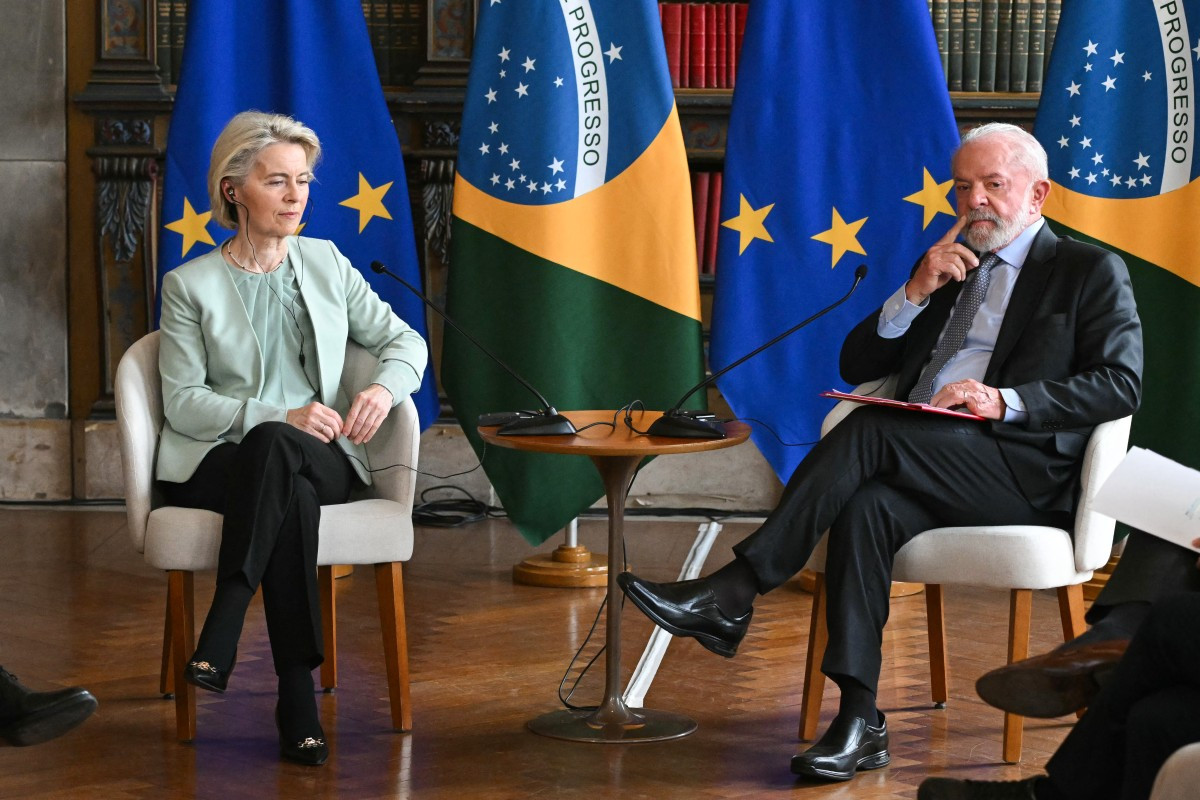 European Commission President Ursula von der Leyen (left) and Brazilian President Luiz Inácio Lula da Silva attend a meeting related to the European Union-Mercosur trade agreement on Jan. 16, 2026, at Itamaraty Palace in Brasília. (AFP/Mauro Pimentel)
H
istorians may look back at the winter of 2026 as a period of burgeoning new trade agreements after a year of United States President Donald Trump’s tariff tantrums. On Jan. 17, the European Union and Mercosur, South America’s largest free trade zone, signed a free trade agreement (FTA), creating a market of 735 million people. On Jan. 27, the EU and India signed an FTA, creating another market of 2 billion people.
The EU also has existing FTAs with Canada, Japan, Mexico, South Korea and the United Kingdom, among others. With the new agreements in 2026, the bloc now has FTAs with nations that have 35 percent of the world population and produce 42 percent of the world’s gross domestic product (GDP).
Other nations are moving quickly to secure new trade deals. In January, Canadian Prime Minister Mark Carney visited China and agreed to reduce trade tensions. This follows a year of diplomatic maneuvering by Carney to diversify Canada’s export markets with an eye to doubling non-US exports by 2030.
Nations in the Middle East are busy making trade deals as well. On Feb. 3, Turkish President Recep Tayyip Erdogan arrived in Riyadh to finalize a long-awaited FTA between Turkey and the Gulf Cooperation Council comprising Saudi Arabia, the United Arab Emirates, Qatar, Kuwait, Bahrain and Oman. This will create a trading bloc with GDP worth US$2.4 trillion.
Meanwhile, India is continuing to look for FTA partners, including an FTA with the UK early in 2026. Southeast Asian nations such as Indonesia, Malaysia, the Philippines and Vietnam are pursuing trade agreements with partners around the world. Indonesia, for example, reached comprehensive economic partnership agreements (CEPAs) with the EU and Canada in September.
South Korea, which Trump targeted along with Canada in a recent tariff tantrum, is working to strengthen many of its trade agreements. Currently, the country has 22 FTAs in force, covering 59 countries and over 85 percent of the world’s GDP.

These are impressive statistics that suggest globalization is alive and well despite years of populist efforts, on the right and the left, to derail it. Why has globalization remained so resilient?
Critiques of globalization first emerged on the political left with the Occupy Wall Street protests in the early 2010s. Globalization was then castigated as a ploy by large corporations to increase profits by shipping production to low-wage countries at the expense of manufacturing jobs in developed countries.
By 2016, the critique had gained traction on the political right as populist politicians such as Trump and the UK’s Nigel Farage blamed “globalist elites” and immigrants for the plight of the working class. The populist wave pushed Brexit over the top and put Trump in the White House.
Following the one-term presidency of Joe Biden, an unshackled Trump spent his first year back in the White House throwing tariff tantrums, most of which were aimed at traditional US allies including South Korea. Trump justified his tariffs as a tool of coercion and a way to bring manufacturing back to the US.
He also thinks that tariffs will make the country rich. However, they end up costing American consumers of imports, not the exporters abroad.
One year in, events have proved Trump wrong. Repeated bullying of traditional US allies through tariff tantrums has weakened alliances that were critical to projecting US power and influence after World War II. They have not collapsed yet, but trust has been broken. In response, bullied allies have moved quickly through FTAs to reduce their reliance on the now unreliable US.
Trump claims that his actions have spurred NATO allies to increase defense spending, but Russia’s invasion of Ukraine in 2022 already prompted much of that surge.
Meanwhile, manufacturing jobs in the US have not come back. Instead, they have declined even though economic growth has been strong. Consumer spending, long the main driver of the US economy, remains strong. The AI boom has become another source of growth. Advances in AI and automation suggest that manufacturing jobs will continue to decline.
Inflation has come down since the post-COVID-19 highs, but it remains above the Federal Reserve Board’s target of 2 percent. The tariffs’ effects on inflation have been muted, but they remain inflationary.
Amid this turmoil, globalization has survived and even prospered because it provides a stable framework for economic growth.
When economic actors leverage their competitive advantages through free trade, productivity and innovation drive economic growth, which in turn lifts living standards and creates prosperity. The US knows this too, and will most likely recommit to globalization as the Trump era winds down.
---
The writer is a former associate professor of Korean language education at Seoul National University. The views expressed are personal.