The Jakarta Post
Please Update your browser
Your browser is out of date, and may not be compatible with our website. A list of the most popular web browsers can be found below.
Just click on the icons to get to the download page.


Popular Reads
Top Results
No results found. Please check your search term and try again
Can't find what you're looking for?
View all search results
Popular Reads
Top Results
No results found. Please check your search term and try again
Can't find what you're looking for?
View all search resultsHow past choices left Sumatra vulnerable to flooding
Decades of damaging forest governance decisions degraded landscapes, turning heavy rain into catastrophe.
Change text size
Gift Premium Articles
to Anyone
Share the best of The Jakarta Post with friends, family, or colleagues. As a subscriber, you can gift 3 to 5 articles each month that anyone can read—no subscription needed!
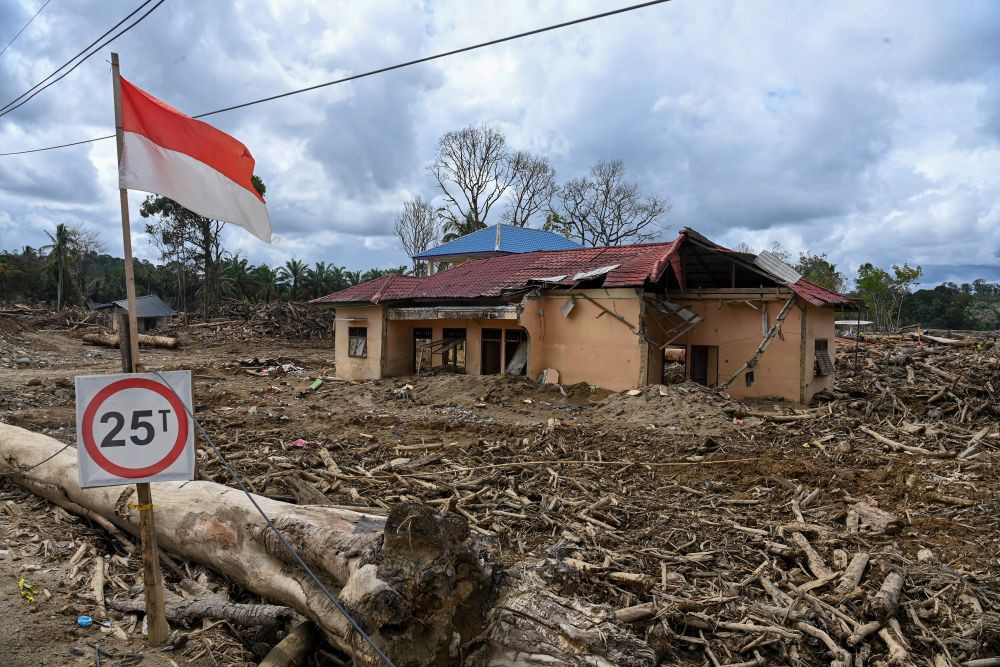 A partially collapsed house stands vacant on Jan. 29, 2026 in Garoga village of Batang Toru district, South Tapanuli regency, North Sumatra, over two months after flooding swept across three northern provinces on Sumatra in late November 2025. (Antara/Indrianto Eko Suwarso)
M
any observers have linked the Sumatra floods in late 2025 to extreme rainfall associated with climate change. Heavy rain caused rivers to overflow and landslides to occur, destroying communities in Aceh, North Sumatra and West Sumatra and costing many people their lives and livelihoods.
Climate conditions were clearly important, but focusing only on weather misses a deeper structural issue. To explain how severe these floods became, it is necessary to look at the long-standing institutional arrangements governing Indonesia’s forestry sector.
In Indonesia, particularly in Sumatra, studies show that upstream watersheds have undergone decades of forest degradation. Logging, both legal and illegal, combined with plantation expansion, mining and infrastructure development, has fragmented forest cover and compacted soils.
Historical institutionalism is a way of understanding why certain problems persist over time. It looks at how today’s political systems and decisions are shaped by past choices, traditions and power structures. In particular, it examines how the interests of powerful groups, shared ideas about how things should work and the original design of government institutions influence what happens later. The approach highlights how policy choices made early on can lock countries into particular institutional paths, which reinforce themselves over time, making those systems difficult to reform.
In the archipelago, forests have long been treated as economic resources under state control. During the Dutch colonial period, forest regulation served the extraction of resources and the exercise of territorial control. After independence in 1945, this logic was consolidated rather than dismantled. The Basic Forestry Law in 1967 placed vast forest areas under central state authority and enabled the expansion of large-scale timber concessions as part of a national development strategy.
As it evolved, the system came to be defined by centralized authority, concession-based management and the routine neglect of local land rights. Forestry agencies developed administrative routines oriented toward licensing and revenue generation rather than ecosystem protection. Once entrenched, these arrangements proved difficult to reverse, even as their environmental consequences became increasingly apparent.

The political changes that followed Indonesia’s transition to democracy in the late 1990s reshaped parts of forest governance, but left its overall direction largely intact. Decentralization transferred certain administrative powers to district governments, yet it also generated new incentives for forest exploitation, as local authorities sought revenue through permit issuance.
In practice, decentralization changed who participated more than how the system functioned. Extractive arrangements remained largely intact, even as additional actors entered the field. Ministries retained significant authority, while local administrations operated within overlapping and sometimes contradictory regulatory frameworks. This institutional complexity often weakened enforcement and accountability, particularly in remote upstream areas critical for watershed protection.
From a historical institutionalist perspective, this represents institutional layering rather than displacement: new rules were added without removing old ones, allowing extractive practices to persist under altered administrative arrangements.
This situation then strengthened the case for recentralization. The status quo prompted a set of laws and regulations related to the forestry sector to support this shift, including the Regional Autonomy Law in 2014, which further narrowed regional authority in this sector.
Over the past 20 years, Indonesia has launched a series of efforts to strengthen forest governance. These include social forestry programs, moratoriums on primary forest clearing, certification schemes and participation in international climate initiatives such as Reducing Emissions from Deforestation and Forest Degradation (REDD+). Although these measures have produced important gains, their impact on flood risk has been uneven.
One of the main challenges is the clash between competing policy priorities. Conservation programs run in parallel with development policies that continue to encourage plantation growth, mining and infrastructure projects in or around fragile watershed areas. Spatial planning often prioritizes economic growth, treating environmental considerations as secondary constraints rather than core determinants of land use.
The ability to enforce rules remains uneven across regions. Forest governance has long been shaped by political influence and regulatory capture, while local communities, despite suffering the most significant environmental impacts, often lack the authority to safeguard surrounding forests. As a result, institutional incentives continue to favor short-term extraction over long-term risk reduction.
Now, climate change functions as a threat multiplier rather than a primary cause. In Sumatra, rising rainfall intensity interacts with degraded landscapes to produce disproportionately severe outcomes. Forests that once moderated hydrological extremes have been removed, and river systems altered by sedimentation and land-use change now respond more violently to precipitation shocks.
Climate change exposes vulnerabilities created by decades of governance decisions and magnifies their consequences. Without institutional change, adaptation measures risk becoming increasingly reactive, costly and insufficient to prevent future disasters.
Reducing flood risk in Sumatra requires more than technical fixes or post-disaster responses. It calls for a shift in forestry governance toward prevention and ecological resilience, moving beyond concession-based land allocation to integrated landscape management.
Forestry policy must align with spatial planning, water governance and disaster management. Forests, especially in upstream watersheds, should be treated as public safety infrastructure, not as a separate environmental issue. Strengthening community forest management and local land rights can improve protection.
Above all, accountability must move upstream, with land-use decisions assessed for flood risk before permits are issued.
The flash floods in Sumatra are more than climate-driven disasters. They expose long-standing institutional choices in Indonesia’s forestry governance that have favored extraction over ecological resilience. How Indonesia reorients its forestry institutions will shape the way future climate extremes are experienced.
---
The writer is a senior lecturer and chair of the Department of International Relations at Andalas University. This article is republished under a Creative Commons license.