The Jakarta Post
Please Update your browser
Your browser is out of date, and may not be compatible with our website. A list of the most popular web browsers can be found below.
Just click on the icons to get to the download page.


Popular Reads
Top Results
No results found. Please check your search term and try again
Can't find what you're looking for?
View all search results
Popular Reads
Top Results
No results found. Please check your search term and try again
Can't find what you're looking for?
View all search resultsSoft power in retreat, fear in ascent
US rhetoric and policy signal a move from persuasion to deterrence, unsettling allies and heightening global strategic tensions.
Change text size
Gift Premium Articles
to Anyone
Share the best of The Jakarta Post with friends, family, or colleagues. As a subscriber, you can gift 3 to 5 articles each month that anyone can read—no subscription needed!
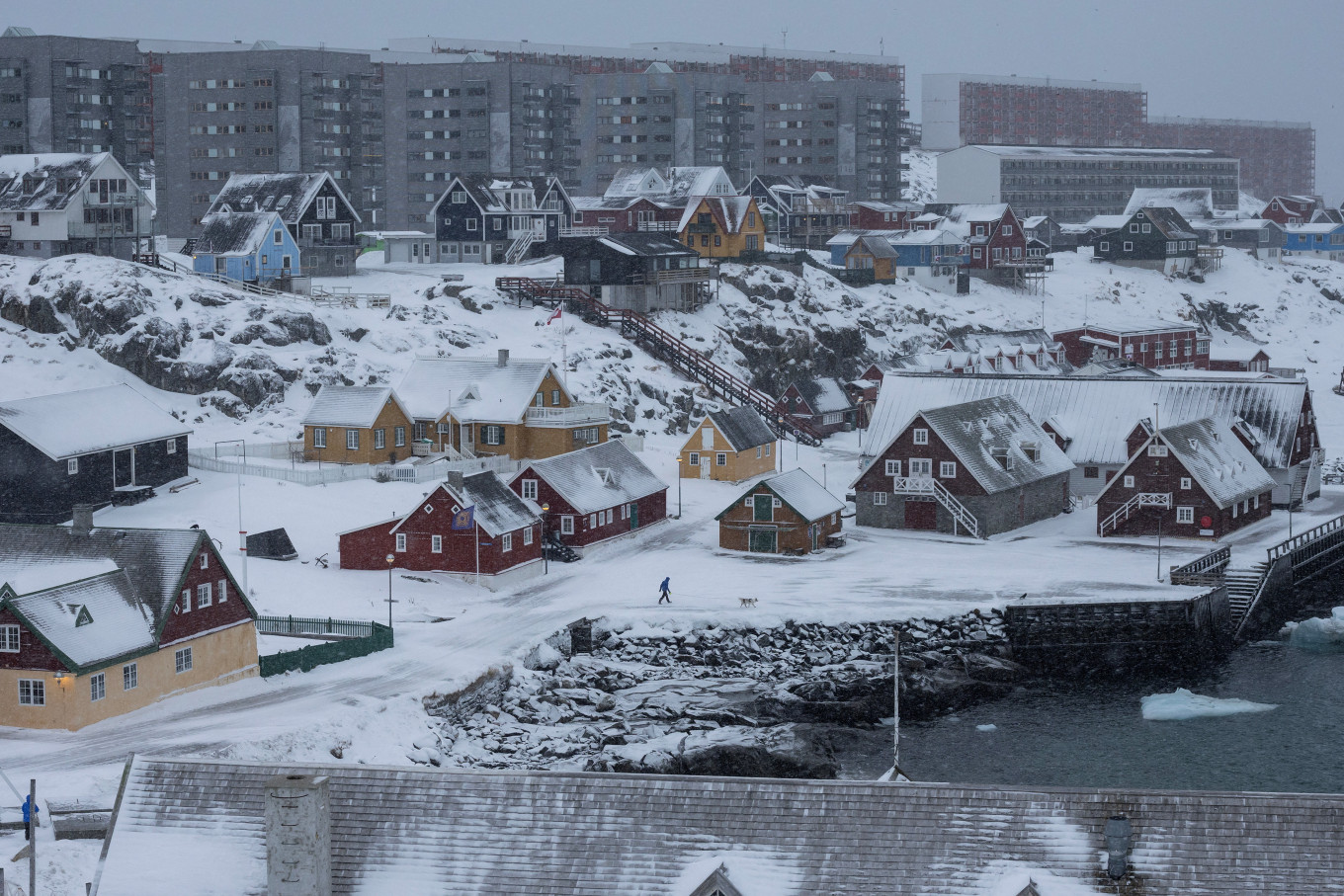 A man walks a dog on Jan. 18 at Nuuk’s old harbor. (Reuters/Marko Djurica)
T
he Caribbean and the Arctic seem to have little in common. The same cannot be said of Venezuela and Greenland, which, with the turn of the new year, have found themselves on the same geopolitical menu.
There has been much speculation, and it continues to grow, regarding the real motivations behind the United States intervention in Caracas and the increasing ambitions toward the island of ice. Some analysts have highlighted economic motives, traceable to the rich deposits of oil and rare earth elements present in both the Venezuelan and Greenlandic subsoil.
Others have emphasized the geopolitical angle, citing, on one hand, deposed Venezuelan President Nicolas Maduro’s close ties with Russia’s leader Vladimir Putin and China’s Xi Jinping, and on the other, the Sino-Russian military and commercial penetration of the Arctic. Still others have not ruled out psychoanalytical motivations, pointing to the US President Donald Trump’s will to power.
US soft power, which has already been in decline for at least two decades, primarily due to Middle Eastern wars, has perhaps never been so deeply called into question. Here, the reference goes particularly to the ruling classes and public opinion of those countries, especially Europeans, that, until recently, believed or deluded themselves into thinking they had a special relationship, almost an amicable one, with the hegemonic power.
Soft power is not only undermined by the Trump’s communication: its historical institutional roots have been, and are being, hit at their core. From USAID (United States Agency for International Development), the humanitarian arm of US soft power, which was dissolved and its functions partially absorbed by the State Department; to the USAGM (United States Agency for Global Media), which oversees Voice of America and Radio Free Europe/Radio Liberty (pillars of US soft power during the Cold War), whose budget was reduced and placed under greater political control; and finally to the NED (National Endowment for Democracy), downsized and now under the aegis of the State Department.
These measures seem to stem not only from a desire to strike institutions opposed to the new course but also from a specific vision of international politics and US power.

This vision is clearly captured in the speech of Vice President J.D. Vance delivered on May 23, 2025, at the conclusion of the academic year at the US Naval Academy in Annapolis. “In the wake of the Cold War,” Vance explained, “our leaders traded hard power for soft power. We stopped making things […] because too many of us believed that economic integration would naturally lead to peace by making countries like China more like the United States.”
The hopes of that era have faded, and the entire scaffolding of soft power is seen as nothing more than dead weight: the new administration intends to rely on hard power. This does not only mean strengthening the armed forces and boosting the military industry, but returning, even from a rhetorical standpoint, to inspiring fear.
Beyond dismantling key pillars of US soft power, Trump’s administration appears prepared to deploy tactics commonly described as “cognitive warfare”, a concept widely used in NATO assessments of Russian and Chinese information operations. In doing so, Washington risks adopting tools it has long criticized in its strategic competitors.
This is clearly seen in the case of Greenland. Following Trump’s statements that Greenland should belong to the US for national security reasons, remarks by Deputy Chief of Staff Stephen Miller caused an uproar. In an interview with CNN, Miller sought to undermine the very legitimacy of Danish sovereignty over Greenland: “What is the basis of their territorial claim? What is their basis of having Greenland as a colony of Denmark?” These statements are comparable in form and content to the “strategic narratives” that have often been attributed to Moscow and Beijing in recent years.
What will be the consequences of the decline of US soft power? This is the question that naturally arises after listing the three factors contributing to Washington’s current reputational crisis: Trump’s statements, the structural disinvestment in institutions dedicated to public diplomacy and the rhetorical offensives against partners, allies and satellites.
One hypothesis can and must be formulated: the crisis of soft power risks accelerating the decline of US power in the world, activating and speeding up centrifugal dynamics that might otherwise have taken years to fully manifest. If inspiring fear is indeed a strategy to reaffirm US interests in a world moving away from unipolarity, recent developments could paradoxically act as a historical accelerator of that very trend.
---
The writer is a PhD candidate at the Catholic University of the Sacred Heart. This article is republished under a Creative Commons license.