The Jakarta Post
Please Update your browser
Your browser is out of date, and may not be compatible with our website. A list of the most popular web browsers can be found below.
Just click on the icons to get to the download page.


Popular Reads
Top Results
No results found. Please check your search term and try again
Can't find what you're looking for?
View all search results
Popular Reads
Top Results
No results found. Please check your search term and try again
Can't find what you're looking for?
View all search resultsHidden deprivations behind poverty metrics
Multidimensional data show that deprivation in Indonesia often clusters long before a family is officially classified as poor.
Change text size
Gift Premium Articles
to Anyone
Share the best of The Jakarta Post with friends, family, or colleagues. As a subscriber, you can gift 3 to 5 articles each month that anyone can read—no subscription needed!
 Set as preferred source
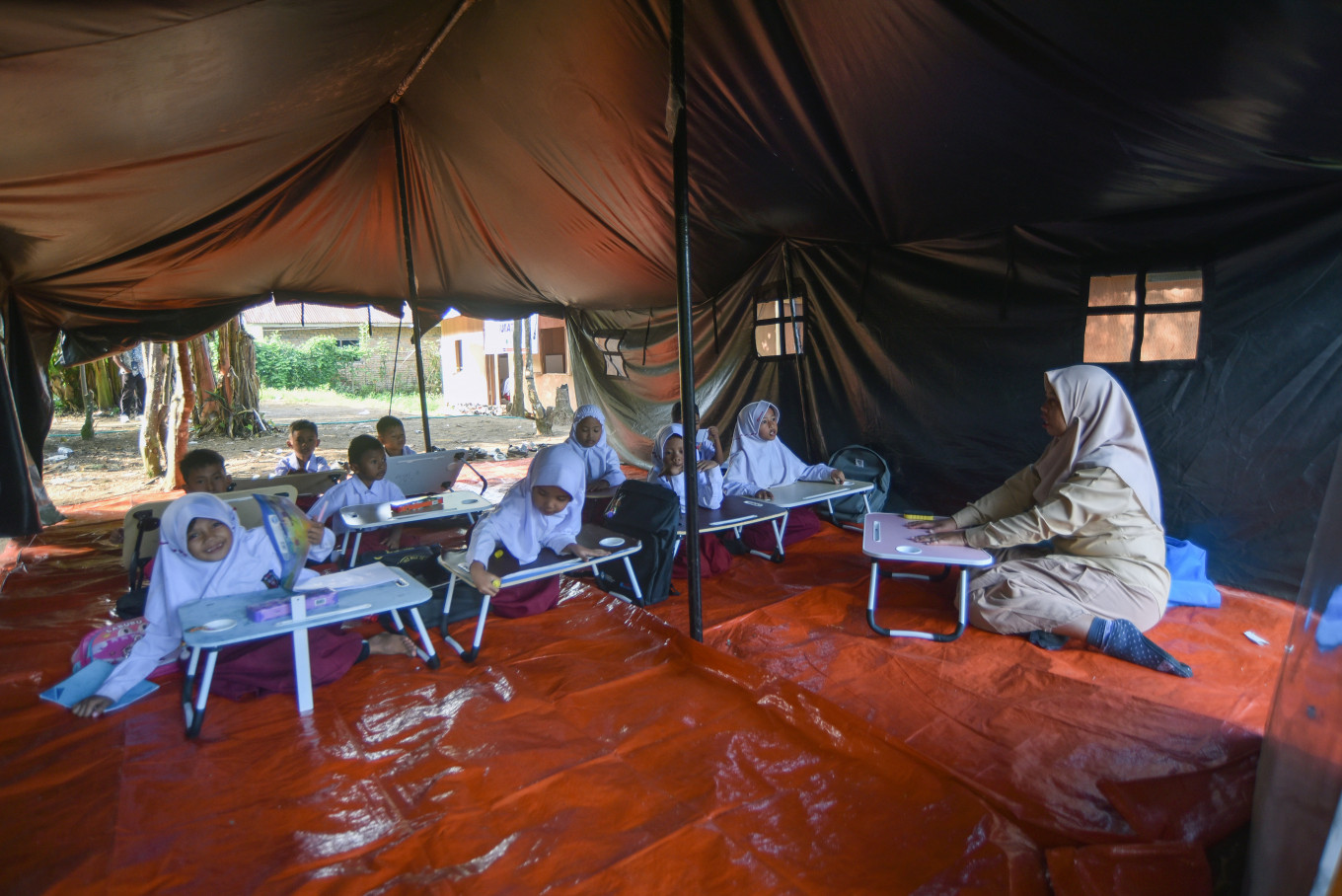 Students of SD 14 Labuah state elementary school in Sungai Batang village, Tanjung Raya, Agam regency, West Sumatra, attend a class under a tent Jan. 27, 2026. (Antara/Iggoy el Fitra)
T
he tragedy in East Nusa Tenggara (NTT), which saw a young child taking his own life last month after his family struggled to afford schoolbooks and pens, is a reminder of how vulnerability can build quietly over time.
Poverty and vulnerability rarely arrive in a single moment; it often accumulates across schooling, health coverage and access to basic services. The deeper question, then, is how can we strengthen our systems so that such vulnerability is recognized earlier and addressed sooner?
If signals of deprivation, i.e., irregular school attendance, lack of documentation, gaps in basic services, are detected in time, support can be mobilized before distress becomes overwhelming. It is crucial that we start to think about building a development approach that sees families more clearly and responds more quickly, so that no child feels that a schoolbook stands between them and their future.
Indonesia’s poverty metrics rely primarily on household consumption, yet many “non‑poor” households still lack basic services. Children feel these hidden deprivations first, revealing the limits of such monetary measures.
The United Nations Children's Fund (UNICEF) says children face deprivations differently and often more severely than adults; even above the poverty line, they may lack legal identity, schooling, sanitation, electricity or other essential services.
In NTT, multidimensional indicators examining deprivation across different aspects of life, following those measured within the global Multidimensional Poverty Index (MPI), illustrate how different deprivations cluster.

Recent indicator headcounts using National Socio-Economic Survey (Susenas) 2025 data show that 12 percent of individuals are deprived of school attendance (these are individuals living in a household where at least one child aged 0-18 is not in school), 7.7 percent of individuals lack actual access to health insurance, despite universal health care through Indonesia’s universal health insurance BPJS, 13.6 percent lack safe water according to UN Sustainable Development Goal (SDG) definitions, 19.7 percent lack adequate sanitation according to SDG definitions, 12.7 percent lack access to on-the-grid electricity, 7.5 percent experience child labor (these are individuals living in a household where at least one child aged 0-18 in the household records having worked in the last week), 9.9 percent lack preschool access (these are individuals living in a household where a child aged 0-6 years old is not in pre-school).
These figures, and global MPI and Multiple Overlapping Deprivation Analysis (MODA) computations for Indonesia, reveal that hardship, particularly for children, rarely comes in isolation.
Multidimensional poverty broadens our understanding beyond income alone to include concrete deprivations. The MPI offers a clearer map of lived hardship than income alone, making visible the layered vulnerabilities that often accumulate quietly before a crisis emerges.
Indonesia already has the data to construct multidimensional poverty tools to underlie evidence-based policies. Statistics Indonesia (BPS) gathers multidimensional data like Susenas that covers education, health, housing, sanitation, water and assets, and village level potential assets and liabilities data (Podes).
The real gap lies in how these data are used. Socio-economic data in Indonesia are still used primarily for administrative purposes: classifying households as poor, determining eligibility, and monitoring national development targets. Yet the challenges we face today extend beyond categorization, as cases like the one in NTT remind us. Deprivation can emerge long before a family is officially classified as poor.
For example, reports from the Women’s Empowerment and Child Protection Ministry indicate that some children in NTT lack birth certificates, which may result in the absence of a National Identification Number. Without legal identity, these children risk exclusion from social protection programs and even from basic public services.
Importantly, birth registration information is already captured in national surveys such as Susenas. This means early identification is possible. The real gap, therefore, is not in data availability, but in how these data are mobilized, shifting from administrative classification toward proactive, preventive action that addresses vulnerability before it gets worse.
Turning to policy responses, Indonesia has a strong tradition of grassroots, community-driven development. Mechanisms such as musrenbang (village deliberations) institutionalize participatory planning from the village level upward. Decentralization has long been framed to bring policy closer to citizens. But implementation often remains sectoral and siloed: education addressed separately from health, housing separated from social protection. Poor households, however, experience deprivation as interconnected realities. Here, the MPI can serve as a bridge.
Multidimensional indicators help villages and local administrations see which deprivations cluster, schooling, sanitation, electricity or child labor, so they can plan together. Used locally, the MPI aligns national data with community realities and shifts development toward real well‑being outcomes.
This shift in measurement has direct implications for Indonesia’s flagship social protection programs. Cash transfers for poor families and education assistance for deprived families have played an important role in supporting vulnerable households and keeping children in school. Yet targeting is still largely based on household economic status recorded in administrative registries, leading to possible inclusion and exclusion errors. A multidimensional lens could refine this approach.
Looking beyond numbers, at a more moral economy, Indonesia’s founding vision was never about growth statistics alone. The Constitution speaks of social justice for all Indonesians. Indonesia’s first vice president Mohammad Hatta’s idea of ekonomi kerakyatan (people’s economy) placed people, not markets or aggregates, at the center of development.
The NTT tragedy was not only about income, but also about dignity, opportunity and civil rights. A schoolbook is not a luxury good; it is an entry point into citizenship. When poverty is measured multidimensionally, development policy becomes less about thresholds and more about lived realities. It recognizes that deprivation in education, health and basic needs is not peripheral. It is foundational to human flourishing.
---
Putu Geniki L. Natih is head of the poverty and wellbeing research group at University of Indonesia's Institute for Economic and Social Research (LPEM UI) and a research associate specializing in poverty measurement at the University of Oxford. Rina Karlina is a policy analyst at the Finance Ministry.