TheJakartaPost
Please Update your browser
Your browser is out of date, and may not be compatible with our website. A list of the most popular web browsers can be found below.
Just click on the icons to get to the download page.


Popular Reads
Top Results
No results found. Please check your search term and try again
Can't find what you're looking for?
View all search results
Popular Reads
Top Results
No results found. Please check your search term and try again
Can't find what you're looking for?
View all search resultsTrump’s Board of Peace meeting raises more questions than answers
The Board of Peace meeting was long on showmanship and short on substance.
Change text size
Gift Premium Articles
to Anyone
Share the best of The Jakarta Post with friends, family, or colleagues. As a subscriber, you can gift 3 to 5 articles each month that anyone can read—no subscription needed!
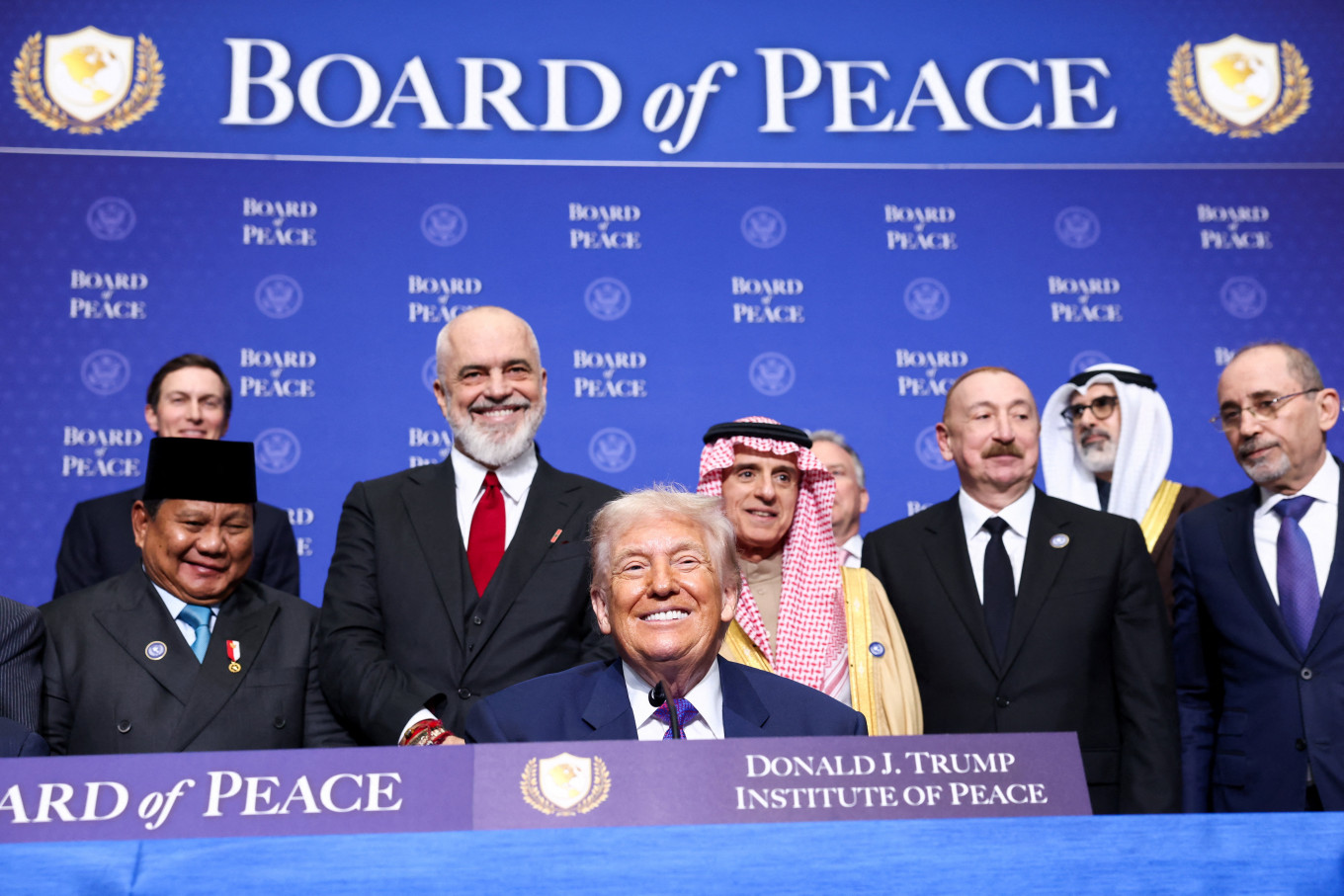 US President Donald Trump (center), President Prabowo Subianto (from left), Albania's Prime Minister Edi Rama, Saudi Minister of State for Foreign Affairs, Cabinet Member, and Climate Envoy Adel Al-Jubeir, Azerbaijani President Ilham Aliyev, and Jordan's Foreign Minister Ayman Safadi attend the inaugural Board of Peace meeting at the US Institute of Peace in Washington, DC, on Feb. 19, 2026. (Reuters/Kevin Lamarque)
F
or all United States President Donald Trump’s claims that last week’s Board of Peace meeting marked a step toward peace in Gaza, it raised more questions than answers about how his plan will be operationalized, when in the first phase, Israel has violated the ceasefire with impunity.
Significant in Trump’s rambling speech were his threats to Hamas, without whose buy-in the peace plan cannot work, and to Iran, which he said will face military action if it did not reach an agreement with the US. He declared the war in Gaza was over despite daily Israeli military strikes that continue to claim Palestinian lives.
Israeli military actions have killed over 600 Palestinians since the ceasefire came into force in October. Days before the Washington meeting, Israel threatened to resume the war if Hamas did not comply with its 60-day ultimatum for it to disarm.
The participation in the Board of Peace meeting by many countries, including Pakistan, (with the noticeable absence of almost all Western European countries) did nothing to obscure the board’s lack of legitimacy. The absence of Palestinian representatives but with Israel, which committed genocide, a board member, exposed the lack of evenhandedness. One party to the conflict has been denied a role in shaping Gaza’s future while the other party’s presence assures its ability to influence the process and protect its interests.
This makes the peace effort a one-sided affair. Any doubts on that score were laid to rest by a video shown at the meeting. This blamed Hamas for leaving Gaza in ruins but made no mention of Israel’s role in the devastation and decades-long occupation.
Despite widespread expectation of clarity about the next, tangible steps in the stalled second phase of Trump’s Gaza plan, there was ambiguity, even silence, on core issues. They included the International Stabilization Force’s (ISF) mandate, Gaza’s demilitarization and a timetable for withdrawal of Israeli forces and end to occupation.

The Washington meeting turned into a pledging session but with no details about how the money will be spent. Trump announced the US would contribute US$10 billion to the board while nine Muslim countries promised $7 billion in Gaza relief.
President Trump announced five countries, Indonesia, Morocco, Albania, Kosovo and Kazakhstan, had committed troops for the ISF while Egypt and Jordan would train the police. The ISF would eventually be a 20,000-strong force and operate in five sectors starting with Rafah. Neither Trump nor US Gen. Jasper Jeffers, who addressed the meeting as ISF head, said anything about the ISF’s mandate and rules of engagement by which it would operate.
The question whether its tasks would include disarming Hamas was left unanswered. There was no word about the ISF’s deployment on the borders. Hamas responded to this by saying international forces are only acceptable if they serve as a buffer force along the border and monitor the ceasefire but do not interfere in Gaza’s “internal affairs”.
Details were sparse about how demilitarization would take place. Negotiations on this have yet to progress toward an outcome. Nickolay Mladenov, appointed “high representative” for Gaza under the Board of Peace, told the meeting that a framework for a weapons decommissioning program had been “fully agreed” with mediating countries Qatar, Egypt and Turkey.
But details of the implementation plan still have to be negotiated with “factions on the ground”. This means a crucial part of the plan remains to be finalized, which Israel uses as a pretext to not withdraw its forces. For its part, Hamas says it will not give up arms until Israel withdraws. A Hamas official said in a recent interview “resistance is a right as long as the occupation exists”.
Assessment of the Board of Peace meeting cannot be isolated from realities on the ground and ongoing developments in the West Bank and Gaza. Just ahead of the meeting, Israel announced a plan to convert large areas of the occupied West Bank into “state property”, a land grab and expropriation of Palestinian land that violates international law and amounts to de facto annexation.
This would bury any chance of a two-state solution. Israel’s move provoked global outrage. Hamas denounced the plan as an attempt to steal Palestinian land. Some 85 countries at the United Nations condemned the Israeli action and rejected any form of annexation. UN Secretary-General António Guterres called on Israel to reverse the “unlawful” move.
But Israel’s action, which its finance minister described as a “settlement revolution” elicited no comment from Washington. The US said and did nothing. This strengthened the impression that Tel Aviv had tacit US endorsement, following Israel Prime Minister Benjamin Netanyahu’s visit to Washington. Israel had for months been tightening its grip over the West Bank, stepping up military assaults, intensifying repression, carrying out ethnic cleansing and encouraging settler violence.
The alarming situation in the West Bank and continuing Israeli attacks on Gaza were ignored by the board meeting. This raises the question of what kind of truncated peace is the Board of Peace pursuing if it fails to stop illegal Israeli actions in the West Bank. A settlement of the Palestinian issue cannot be predicated on addressing Gaza alone and excluding the West Bank. That denudes the peace effort of seriousness and means abandoning any possibility of establishing a unified Palestinian state.
Mention of an eventual Palestinian state was missing from Trump’s speech at the Board of Peace meeting. This was unsurprising as he is hardly committed to this goal but several Muslim countries called for it during the meeting. However, with Trump having decisive authority on the board, the views of Muslim states will remain just rhetoric aimed at audiences at home.
In Gaza, Palestinians view the Board of Peace with skepticism and as a “way to further Israel’s illegal occupation” according to news reports. For Hamas the real test of the board is its “ability to compel the [Israeli] occupation to end its violations of the ceasefire” and aggression. The Board of Peace has so far failed that test. As for the Washington meeting, which was long on showmanship and short on substance, it lacked the seriousness and credibility needed to end the tragedy of the Palestinian people.
---
The writer is a former Pakistani ambassador to the United States, United Kingdom and United Nations.