TheJakartaPost
Please Update your browser
Your browser is out of date, and may not be compatible with our website. A list of the most popular web browsers can be found below.
Just click on the icons to get to the download page.


Popular Reads
Top Results
No results found. Please check your search term and try again
Can't find what you're looking for?
View all search results
Popular Reads
Top Results
No results found. Please check your search term and try again
Can't find what you're looking for?
View all search resultsBlistering EM equity rally can't keep this pace up. Can it?
Even the most ardent EM bull must be wondering if this blistering rally can continue.
Change text size
Gift Premium Articles
to Anyone
Share the best of The Jakarta Post with friends, family, or colleagues. As a subscriber, you can gift 3 to 5 articles each month that anyone can read—no subscription needed!
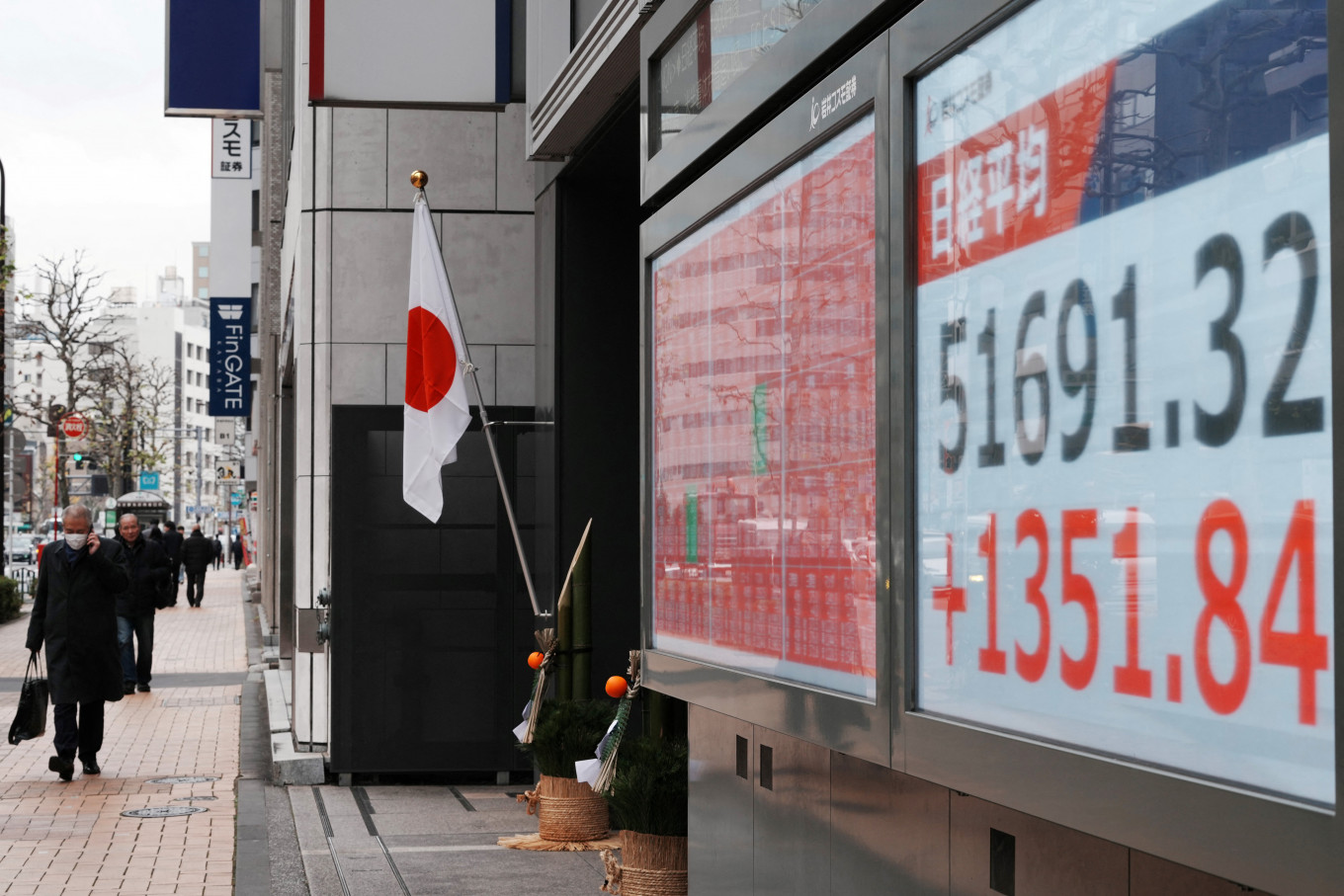 An electronic quotation board displays numbers of the Nikkei Stock Average on Jan. 5 at the Tokyo Stock Exchange in Tokyo. (AFP/Kazuhiro Nogi)
T
he 50 percent surge in South Korean stocks in the first two months of 2026 is grabbing headlines, but other emerging markets (EM) are also boasting double-digit gains. Even the most ardent EM bull must be wondering if this blistering rally can continue.
The figures out of South Korea are staggering. The benchmark KOSPI index has doubled in the last six months, and is up 175 percent from the depths of United States President Donald Trump's "Liberation Day" tariff chaos last April. This follows a 75 percent rise in the calendar year 2025.
Zooming in, shares in tech giant Samsung, the world's top memory chipmaker, have almost doubled in value this year, and have more than tripled in six months.
Capital has been drawn into the country by market-friendly tax and regulatory reforms, booming semiconductor industry and growing artificial intelligence prowess.
As a result, the Korean won on Thursday was trading at its strongest level against the US dollar in four months.
What's more, the KOSPI's parabolic rise has pushed wider financial conditions to the loosest levels on record, according to Goldman Sachs, or at least the loosest in the 24 years since the bank launched its South Korea financial conditions index.

The speed of the KOSPI's rise might suggest fevered speculation is at play. But even though "FOMO" might be a factor, it is not the main story. The KOSPI is actually trading at its lowest multiple, based on 12-month forward earnings, since June.
In other words, many investors are buying for the very rational reason that they expect to be rewarded with bumper earnings growth moving forward.
The KOSPI may be an outlier in terms of the scale of its gains in early 2026, but not the direction of travel. MSCI's benchmark emerging market and Asia ex-Japan indices are both up 15 percent this year, while the main equity indices in Taiwan and Brazil are up nearly 25 percent and 20 percent, respectively.
Taiwan, home to the world's largest maker of the chips used in AI applications, Taiwan Semiconductor Manufacturing, plays a pivotal role in the global AI supply chain for companies such as Nvidia and Apple.
Reflecting the expected AI windfall, Taiwan's statistics office just raised the country's 2026 GDP growth forecast to 7.7 percent from the 3.5 percent it predicted in November. That's an astonishing revision in just a few months.
This all suggests that the presumed US advantage in tech and AI, once at the heart of the "American Exceptionalism" narrative, is eroding rapidly. Emerging countries, especially in Asia, are catching up, and investors are reallocating accordingly.
Bank of America's latest global fund manager survey showed that the rotation out of US stocks and into emerging markets surged in February, and investors are now the most overweight EM stocks they have been in five years.
Indeed, investors' biggest overweight position in any asset or sector is now emerging markets, the survey showed.
Analysts at TS Lombard are certainly committed to the cause. Their EM equity allocation is the highest ever and is currently double their allotment to US stocks. Investors haven't been this bullish on emerging markets for more than 20 years, they reckon.
This hyper-optimism smacks of a bubble in the making. But if you think the global AI story has a long runway, and Nvidia's latest bumper sales and outlook suggest it does, then this reallocation away from the US makes strategic sense.
And it may make financial sense too. The S&P 500's valuation premium over MSCI's benchmark EM index may have shrunk a bit this year but remains historically high. So despite the outperformance in recent months, EM stocks are still relatively cheap.
And against a relatively benign global macroeconomic backdrop of a softer dollar, stable Treasuries market and dovish-leaning Federal Reserve, capital may have plenty of reasons to keep flowing towards emerging markets.
This rotation has been fierce, but it may still have room to run.
---
The writer is a columnist for Reuters. The views expressed are personal.