The Jakarta Post
Please Update your browser
Your browser is out of date, and may not be compatible with our website. A list of the most popular web browsers can be found below.
Just click on the icons to get to the download page.


Popular Reads
Top Results
No results found. Please check your search term and try again
Can't find what you're looking for?
View all search results
Popular Reads
Top Results
No results found. Please check your search term and try again
Can't find what you're looking for?
View all search resultsToo close to Trump: Gambling sovereignty, humanity for US’ approval
The trajectory is clear: Jakarta is tilting toward Washington at a cost many fear will be borne by ordinary Indonesians.
Change text size
Gift Premium Articles
to Anyone
Share the best of The Jakarta Post with friends, family, or colleagues. As a subscriber, you can gift 3 to 5 articles each month that anyone can read—no subscription needed!
 Set as preferred source
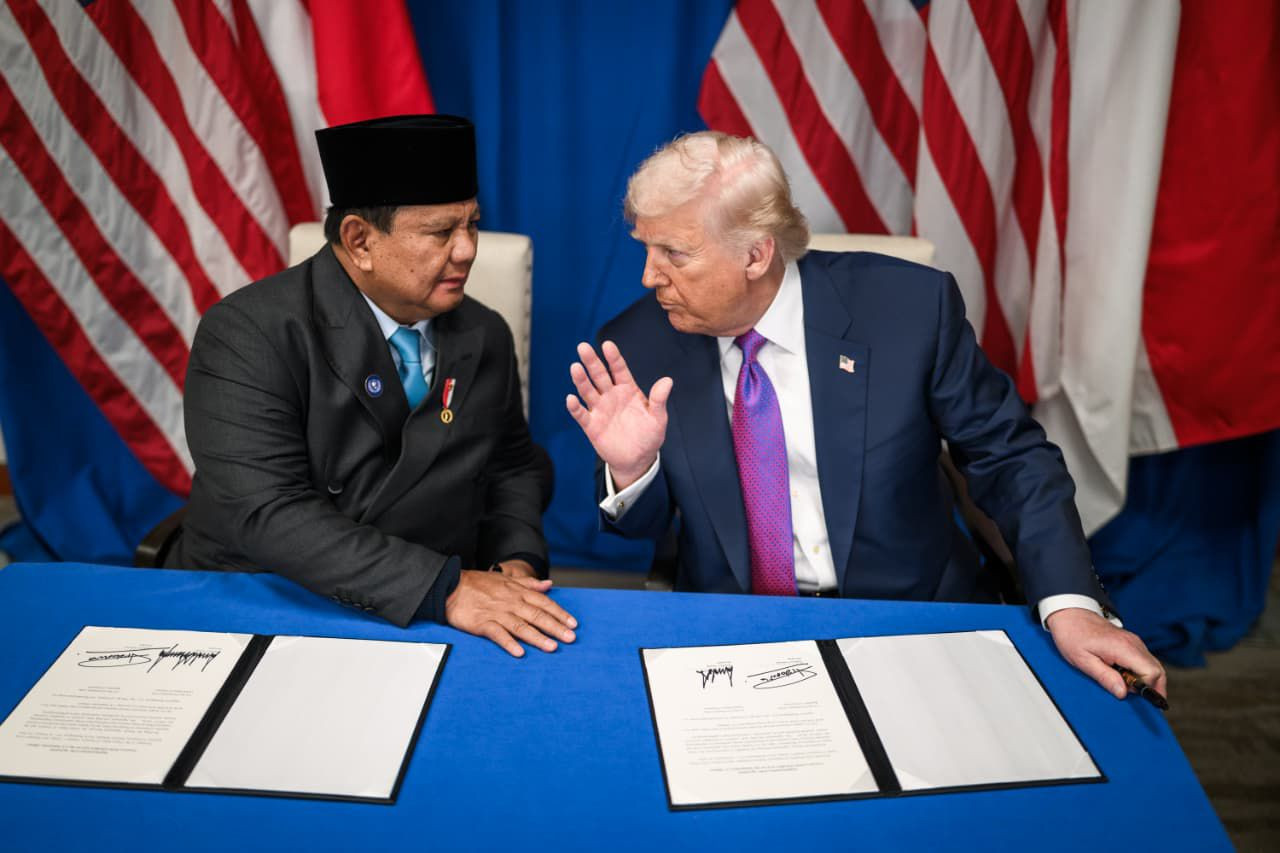 President Prabowo Subianto (left) speaks to United States President Donald Trump during the signing of the US-Indonesia Agreement on Reciprocal Tariffs (ART) in Washington, DC, on Feb. 19, 2026. (Courtesy of Presidential Secretariat/White House)
T
he Indonesian public has grown increasingly uneasy with President Prabowo Subianto’s foreign policy pivot toward the United States. From Indonesia’s decision to join the Board of Peace initiated by US President Donald Trump to the signing of the Agreement on Reciprocal Trade (ART) on Feb. 19, the trajectory is clear: Jakarta is tilting toward Washington at a cost many fear will be borne by ordinary Indonesians.
Prabowo once framed his diplomacy as rooted in resilience, autonomy and national interests. However, in practice, his recent maneuvers suggest a readiness to align closely with Trump’s agenda, even if it means diluting Indonesia’s bargaining position.
Prabowo’s efforts to draw Indonesia closer to the US under the Trump administration raise serious doubts about his underlying motives. Rather than clearly advancing long-term national interests, these efforts appear driven by transactional calculations and short-term gains.
Prabowo had been barred from entering the US for a decade over alleged human rights violations tied to 1998. The ban was lifted in 2020 when he served as defense minister during Trump’s first term.
The lifting of the ban drew harsh criticism from human rights groups such as Amnesty International for providing impunity over the violations of which he was accused. It was also condemned by prominent US lawmakers like Senator Patrick Leahy, author of the US human rights legislation known as the Leahy Law, who stated Prabowo was legally ineligible to enter the country.
Indonesia's foreign policy appears to be repurposed as a vehicle to polish Prabowo's international standing.

Today, his closeness to Trump signals more than diplomacy. Rather, it also suggests a personal redemption arc playing out on the global stage, from a figure who was once rejected by Washington to one who now stands shoulder to shoulder with the White House.
Trump’s public praise of Prabowo as a “tough” leader at the Board of Peace summit was symbolically powerful.
What is unfolding looks less like statecraft and more like image management. Indonesia’s foreign policy appears to be repurposed as a vehicle to polish Prabowo’s international standing.
Trump’s foreign policy stance is defined by transactional deals and loyalty politics, moving far from human rights issues or democratic values, which were previously the main guidelines for his predecessors in conducting foreign policy. Prabowo’s leadership style appears strikingly compatible.
In international relations, transactionalism or transactional diplomacy refers to a strategy that prioritizes short-term gains and treats statecraft much like a business deal. It favors bilateral over multilateral agreements, with a tendency toward a zero-sum world view, disregarding value-based policy-making and longer-term strategic diplomatic goals.
Eric Jones wrote in this newspaper (“Prabowo leans into history on visit to the US”, The Jakarta Post, Feb. 28, 2026) that the Prabowo-Trump relationship reflects a “strongman’s mirror”, a psychological and political alignment between two leaders who view power as something personalized, not institutional. Trump relies on loyalty and patronage, while Prabowo appears comfortable with similar transactional logic. Both project a performative, personality-driven style of leadership.
This model could work to Prabowo’s advantage. Under Trump, lingering human rights concerns regarding Prabowo are no longer a diplomatic obstacle. The recent trade agreement, which reduces Indonesia’s export tariffs to the US from 32 percent to 19 percent, could even be framed as a quick diplomatic win for Prabowo, in line with transactional diplomacy’s emphasis on tangible, immediate outcomes.
The compatibility between Trump’s and Prabowo’s leadership styles could therefore produce smoother, more flexible ties than if the US were led by an administration that prioritizes institutional norms and liberal values.
Indonesia’s long-standing bebas aktif (free and active) foreign policy has defined its identity since independence and emphasized strategic autonomy amid great-power rivalry. For many Indonesians, Prabowo’s alignment with Trump’s transactional approach has drawn criticism and anger, as it signals a shift away from that principle and may erode diplomatic independence.
The decision to join the Board of Peace has also sparked concerns over potentially weakening Indonesia’s position as one of the first countries to support Palestinian independence.
Closer ties with the US under Trump’s controversial leadership do not automatically betray Indonesia’s national interest. However, overreliance on transactionalism, at the expense of enduring principles, risks making the relationship volatile. The recent pushback by the US Supreme Court against Trump’s tariff policy shows how quickly US policy can change.
Indonesia’s real strength lies not in personal ties to certain leaders, but in its consistency in maintaining autonomy and balance. Its free and active politics is a strategic asset, not a slogan to be traded for short-term legitimacy at the cost of credibility and sovereignty.
---
The writer is an international relations lecturer at the Indonesian Islamic University (UII) in Yogyakarta. This article is republished under a Creative Commons license.