The Jakarta Post
Please Update your browser
Your browser is out of date, and may not be compatible with our website. A list of the most popular web browsers can be found below.
Just click on the icons to get to the download page.


Popular Reads
Top Results
No results found. Please check your search term and try again
Can't find what you're looking for?
View all search results
Popular Reads
Top Results
No results found. Please check your search term and try again
Can't find what you're looking for?
View all search resultsMideast oil shock signals supply crunch
The sudden and acute disruption to Middle East oil supplies caused by the US-Israeli war with Iran is forcing buyers to tap every available barrel, rapidly dismantling forecasts of an oil glut this year.
Change text size
Gift Premium Articles
to Anyone
Share the best of The Jakarta Post with friends, family, or colleagues. As a subscriber, you can gift 3 to 5 articles each month that anyone can read—no subscription needed!
 Set as preferred source
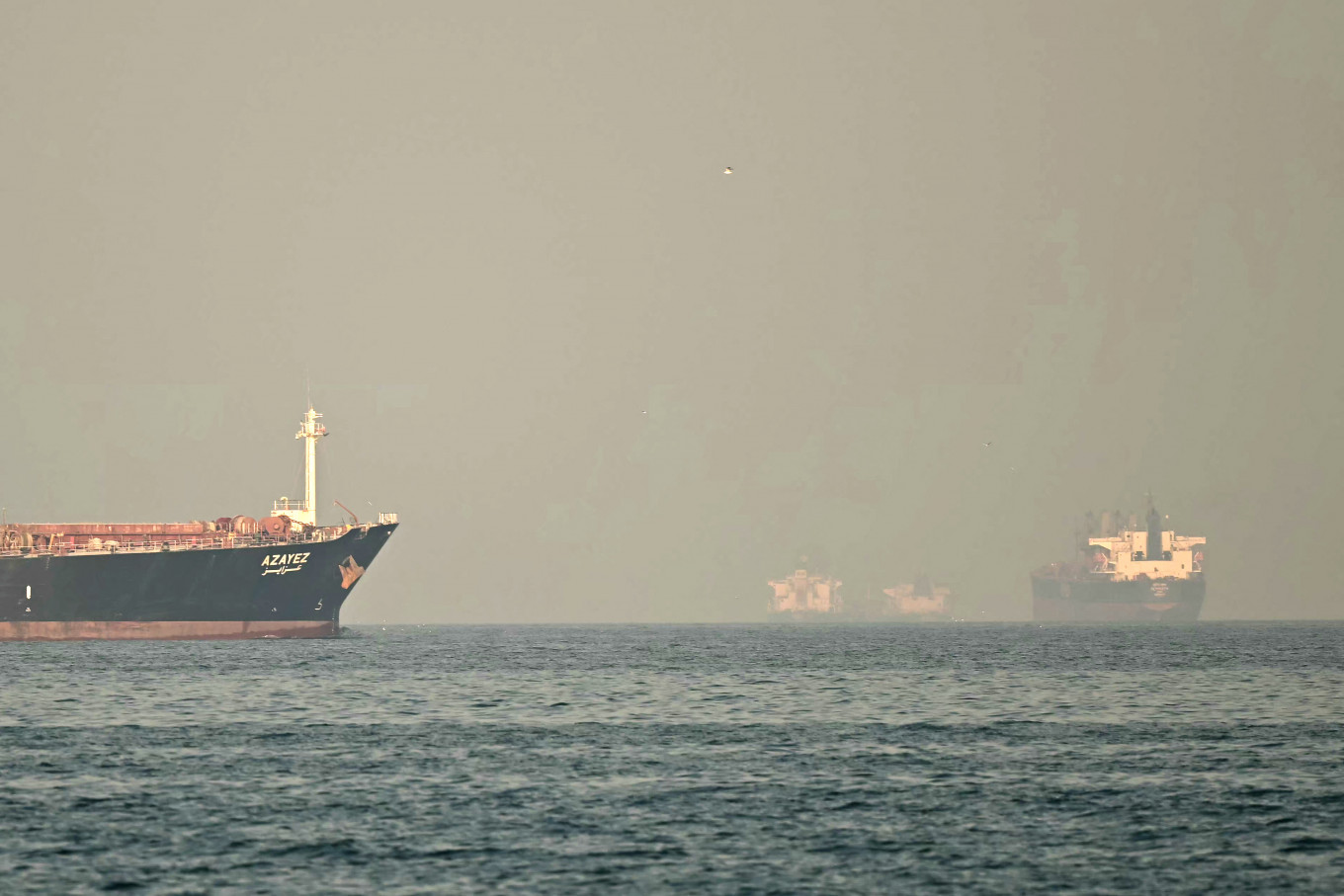 Cargo ships and tankers are seen on Feb. 25, 2026, in the Strait of Hormuz off the coast of Fujairah, in the United Arab Emirates. (AFP/Giuseppe Cacace)
T
he sudden and acute disruption to Middle East oil supplies caused by the United States-Israeli war with Iran is forcing buyers to tap every available barrel, rapidly dismantling forecasts of an oil glut this year.
In February, the International Energy Agency (IEA) forecast that global oil supply would exceed demand by around 3.7 million barrels per day (bpd) in 2026, with the surplus extending into the following year. A month later, that projection appears redundant.
Nearly 15 million bpd of crude production, plus another 4.5 million bpd of refined fuels, remain effectively stranded in the Persian Gulf after the near‑complete closure of the Strait of Hormuz.
The loss of such a vast volume of supply, equivalent to almost a fifth of global daily consumption, has sent shockwaves through oil markets and the wider economy. Asia, which sources around 60 percent of its crude imports from the Middle East, is bearing the brunt.
In the Gulf, producers are running out of options. With exports blocked, crude is being pushed into onshore storage tanks and offshore tankers.
Iraq, which has limited storage options, has already shut off at least a quarter of its 4.3 million bpd of production. Kuwait, the United Arab Emirates and Saudi Arabia, the world’s largest exporter, have some remaining storage capacity available, but it’s measured in days, not weeks.

Saudi Arabia and the UAE can divert some crude through alternative export routes, but these only partially offset the loss of Hormuz. As storage fills, more producers will be forced to cut output and idle refineries.
Shutting oil fields safely is a complex process. Restarting them can take days or even weeks before production returns to full capacity, extending the market impact well beyond any eventual reopening of the strait.
Meanwhile, refiners, particularly in Asia, are scrambling for barrels.
The good news is that inventories have been building in recent months, thanks to rising output from producers including Organization of the Petroleum Exporting Countries (OPEC). Global observed oil inventories rose by 1.3 million bpd, or 477 million barrels, in 2025, reaching their highest level since March 2021, according to the IEA.
Around 80 million barrels of oil are currently stored on tankers at sea, data from analytics firm Kpler show, with nearly two‑thirds in Asia.
About three‑quarters of that “floating storage” originated from Iran, Venezuela and Russia, all subject to Western sanctions, meaning much of it is inaccessible to most buyers. Iranian crude alone accounts for roughly 50 million barrels.
Some of that oil is starting to move, however. The US on March 5 granted India a waiver to buy Russian crude to help refiners with the supply squeeze. New Delhi had sharply cut imports last month as part of a trade deal with Washington.
Russian crude in floating storage has already fallen from 7.7 million barrels just before the strikes on Iran to 4.5 million barrels by March 6.
Independent Chinese refiners, which have absorbed the bulk of Iran’s crude exports in recent years, are likely to pick up the lion’s share of Iranian barrels that are either located outside the Persian Gulf or able to get through the strait.
At the same time, Middle East producers are almost certainly drawing on their overseas storage to meet contractual obligations with buyers.
If the disruption persists, pressure will grow on governments to tap their own reserves. Organisation for Economic Co-operation and Development (OECD) members hold strategic petroleum reserves created in the 1970s specifically to deal with supply shocks. Under IEA rules, net oil‑importing countries must hold stocks equivalent to at least 90 days of imports.
The US, the world’s largest oil producer and consumer, currently holds more than 400 million barrels in its strategic petroleum reserves. That’s well below its capacity of roughly 700 million barrels, but given it is no longer a net importer of energy, the risk of cutting into its reserves is limited.
The most critical unknown is China. Beijing has quietly accumulated vast oil reserves in recent years, adding an average of around 300,000 bpd last year alone, according to the IEA. So far, it has not signaled any intention to release stocks, though it has instructed refiners to curb fuel exports.
Assuming some of the Gulf oil production is diverted, offsetting a supply disruption of 15 million bpd would require more than 100 million barrels of oil from storage in a week. At that pace, an extended outage would rapidly erode global inventories.
If stocks are depleted, governments and traders would obviously need to rebuild them, implying higher demand for crude, as well as higher prices, in the coming year. The Middle East supply shock is already flipping expectations of a glut into a far more plausible scenario of undersupply.
---
The writer is a columnist for Reuters. The views expressed are personal.