TheJakartaPost
Please Update your browser
Your browser is out of date, and may not be compatible with our website. A list of the most popular web browsers can be found below.
Just click on the icons to get to the download page.


Popular Reads
Top Results
No results found. Please check your search term and try again
Can't find what you're looking for?
View all search results
Popular Reads
Top Results
No results found. Please check your search term and try again
Can't find what you're looking for?
View all search resultsHow ‘ocean peacebuilding’ can help calm global conflicts
History and research both show that the ocean can be used as a catalyst for building peace, even in the most unexpected places and amid the sharpest geopolitical tensions.
Change text size
Gift Premium Articles
to Anyone
Share the best of The Jakarta Post with friends, family, or colleagues. As a subscriber, you can gift 3 to 5 articles each month that anyone can read—no subscription needed!
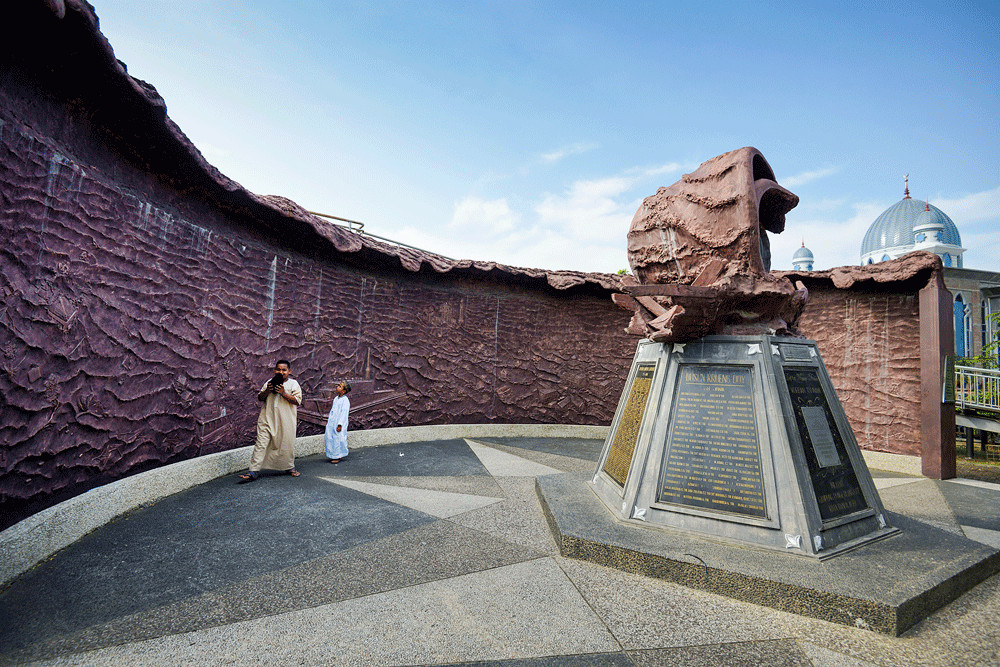 Two boys walk in front of a memorial monument dedicated to victims of the 2004 Indian Ocean earthquake and tsunami at the Tsunami Educational Park in Banda Aceh, Aceh. (AFP/Chaideer Mahyuddin)
C
onflict and turmoil are seemingly rife in the ocean. Choked shipping lanes. Sabotaged seabed cables and pipelines. Migrants risking dangerous sea passages. Collapsed fish populations. Coastlines washed away by a changing climate.
But if we only consider the ocean in terms of conflict, our policymakers start to focus just on threats, borders, extraction and defense, and we miss a key opportunity. Despite the friction, powerful solutions already exist and can be scaled up.
Research shows that the ocean can be a catalyst for proactive peacebuilding. “Ocean peacebuilding” is the use of marine scientific cooperation, sustainable resource management and conservation efforts to anticipate and prevent conflict while fostering trust among nations.
Ocean peacebuilding is already underway, even in the most unexpected places and those shaped by the sharpest geopolitical tensions. It happens in three key ways.
First is building bridges. By embracing diversity of thought when tackling problems, stereotypes and biases can be challenged, simplistic assumptions crumble and common humanity can emerge. This “contact hypothesis” has been key to ocean peacebuilding in the Gulf of Mexico. One hundred miles of water separates the Florida Keys from Cuba, plus several decades of geopolitical tensions.
Beneath the water’s surface, marine ecosystems know no such boundaries. Coral larvae, endangered sharks, turtles and fish travel the currents of the gulf. Remove a key nesting site or a stop along a migratory corridor, and those species could disappear for everyone.

Marine biologists from Cuba, Mexico and the United States began quietly meeting in the 2000s to discuss conservation of marine wildlife and share data, despite the diplomatic standoff between the US and Cuba.
When relations thawed in 2014, then-US president Barack Obama and former Cuban president Raul Castro reestablished diplomatic relations between their countries. Together they established the “Redgolfo” network of marine protected areas (MPAs) across the Gulf of Mexico.
MPAs are parts of the ocean or coastline where human activity is restricted to protect natural resources, biodiversity or cultural heritage.
Scientific cooperation became a trusted foundation for heads of state to sign agreements and shake hands. Things improved.
Second is building standards. The world never stands still. Politicians come and go, priorities shift, norms evolve. The second mechanism of ocean peacebuilding is the spreading of norms that empower civil society.
Designating MPAs without consultation and excluding local or indigenous communities can end in failure and even spark conflict. So, when 14 serving heads of state came together in 2018 to establish the High Level Panel for a Sustainable Ocean Economy, their flagship commitment was to ensure 100 percent sustainable management within their respective jurisdictions by 2025, through designing sustainable ocean plans.
They not only all agreed to this; they also agreed that these plans must be developed in an inclusive way and be underpinned by the best available science and indigenous knowledge.
A group of countries that collectively account for 50 percent of Earth’s coastlines had agreed on shared standards of how to plan ocean conservation and use. It relied on inclusion, consultation and empowerment of civil society.
Third is building trust. In 2004, the armed conflict in Aceh entered its 29th year, and then another disaster struck: An earthquake triggered a devastating tsunami that swept across the region. More than 230,000 people died. The shock was profound.
One former combatant said, “My family was gone, the people were gone, the enemy was gone. What is there to fight for?” Within months, a peace deal was signed.
In the following months, efforts to establish an Indian Ocean tsunami early warning system began. Over time, the system was expanded and improved. Ocean scientists and seismologists in the region began working together. In Aceh, the government started multiple initiatives to install tsunami buoys and improve its early warning system.
The government was taking steps to improve the well-being of its people. This led to collaboration that reestablished and built trust in public institutions; a critical priority in a post-conflict setting.
Today, US-Cuba relations seem to be spiraling toward conflict. What difference could ocean peacebuilding make?
History shows that even amid acute tension, ocean science is a vital, diplomatic back channel. It keeps dialogue alive and gives a sense of shared prosperity, and that ecological loss is a cost born by all.
At the height of the Cold War and nuclear arms race, the US and the USSR entered into a détente program of ocean science collaboration. Known as the Polymode program, it focused on studying the structure of currents and eddies in the Atlantic Ocean.
For years, hundreds of scientists from the two countries worked together, sharing data, vessels, ports and equipment. Science advanced. Yet when the USSR invaded Afghanistan in 1979, everything stopped.
So, while we need new narratives, we cannot afford to be naive. Ocean peacebuilding won’t stop all wars, but it may help prevent some from starting and others from returning.
In Northern Ireland, an environmental organization called the Loughs Agency shows how cross-border institutions can sustain peace while stewarding shared marine ecosystems.
The more deeply peace is built into institutions, processes and standards, the stronger the prospects for avoiding future conflict.
---
Robert Blasiak is an associate professor who leads ocean stewardship programs at the Stockholm Resilience Centre at Stockholm University, where Paul Conville is a research assistant on climate resilience. This article was republished under a Creative Commons license.