The Jakarta Post
Please Update your browser
Your browser is out of date, and may not be compatible with our website. A list of the most popular web browsers can be found below.
Just click on the icons to get to the download page.


Popular Reads
Top Results
No results found. Please check your search term and try again
Can't find what you're looking for?
View all search results
Popular Reads
Top Results
No results found. Please check your search term and try again
Can't find what you're looking for?
View all search resultsDysfunctional opposition and the sedition charge
The August 2025 protests were a sign of public pressure building, but mass mobilization without leadership or clear direction can easily tip into chaos that only benefits those already in power.
Change text size
Gift Premium Articles
to Anyone
Share the best of The Jakarta Post with friends, family, or colleagues. As a subscriber, you can gift 3 to 5 articles each month that anyone can read—no subscription needed!
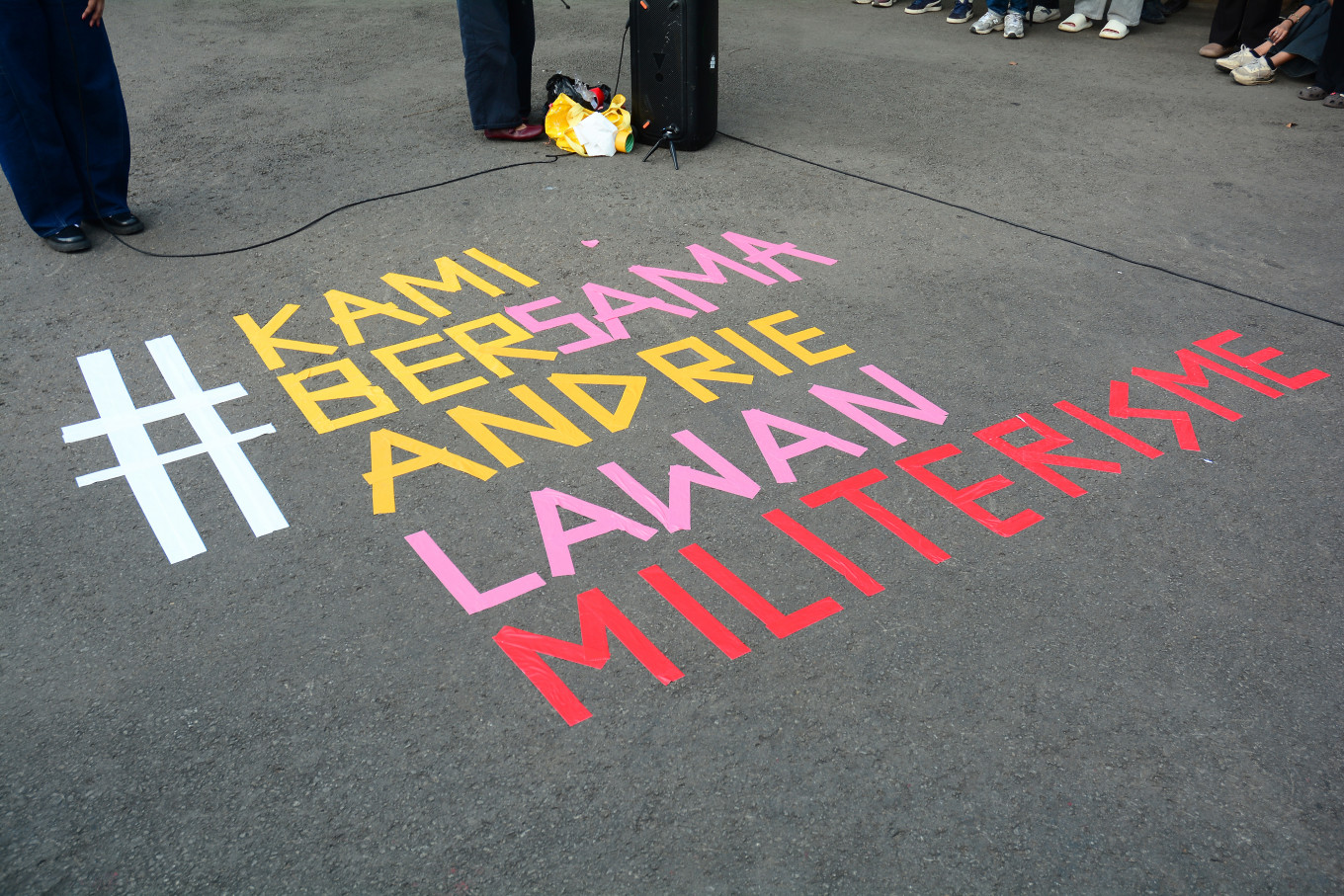 A banner reading “We stand with Andrie against militarism” is displayed by human rights activists affiliated with the Justice for Victims Solidarity Network on April 2 during the 902nd “Kamisan” protest across from Merdeka Palace in Jakarta. The demonstrators called for a thorough investigation into the acid attack against Andrie Yunus, urging the formation of a joint fact-finding team and demanding that those responsible be tried in a civilian court. (JP/Iqro Rinaldi)
T
he treason accusations that erupted after a video of political scientist Saiful Mujani speaking at a post-Idul Fitri gathering went viral reveal something deeply troubling: the democratic heart of this nation is suffering from arterial blockage, clogged by the accumulated fat of unchecked power.
Saiful’s words, in my opinion, were not a call to overthrow the government. They were a defibrillator, a jolt meant to wake us up to the fact that Indonesian democracy is gravely ill. Scholars have been sounding the alarm since 2016, warning that the country is caught in a slow spiral of "democratic backsliding".
The most recent data from the Varieties of Democracy project (V-Dem, 2026) puts Indonesia at a score of 0.30, officially reclassifying the country not as a democracy, but as an electoral autocracy.
Gone are the days when democracies collapsed through military coups or brazen power grabs. Nancy Bermeo’s influential 2016 study showed that today’s democratic decay is quieter and more insidious. It doesn’t happen because citizens stop believing in democracy. It happens because elected leaders, from within the system, methodically hollow it out.
The mechanism Bermeo identifies is "executive aggrandizement": the gradual, calculated expansion of executive power at the expense of every other institution. Legislatures are neutralized. Courts are brought to heel. Independent voices are silenced. The end goal is total dominance.
This is precisely what began unfolding during Joko “Jokowi” Widodo’s second term. Under the banner of “national consensus”, Jokowi’s government absorbed its rivals rather than tolerating them. Even Prabowo Subianto— once a fierce opponent — was brought inside the tent and given a ministerial post. With everyone coopted, there was no one left to push back.

Prabowo, now president, has continued down the same path. And this is where the deeper problem lies: a democracy saddled with a dysfunctional opposition is a democracy in name only. The checks and balances that keep power honest have been stripped away. The artery is blocked.