The Jakarta Post
Please Update your browser
Your browser is out of date, and may not be compatible with our website. A list of the most popular web browsers can be found below.
Just click on the icons to get to the download page.


Popular Reads
Top Results
No results found. Please check your search term and try again
Can't find what you're looking for?
View all search results
Popular Reads
Top Results
No results found. Please check your search term and try again
Can't find what you're looking for?
View all search resultsAnalysis: Danantara bets on logistics merger, stronger firms may foot the bill
Change text size
Gift Premium Articles
to Anyone
Share the best of The Jakarta Post with friends, family, or colleagues. As a subscriber, you can gift 3 to 5 articles each month that anyone can read—no subscription needed!
 Set as preferred source
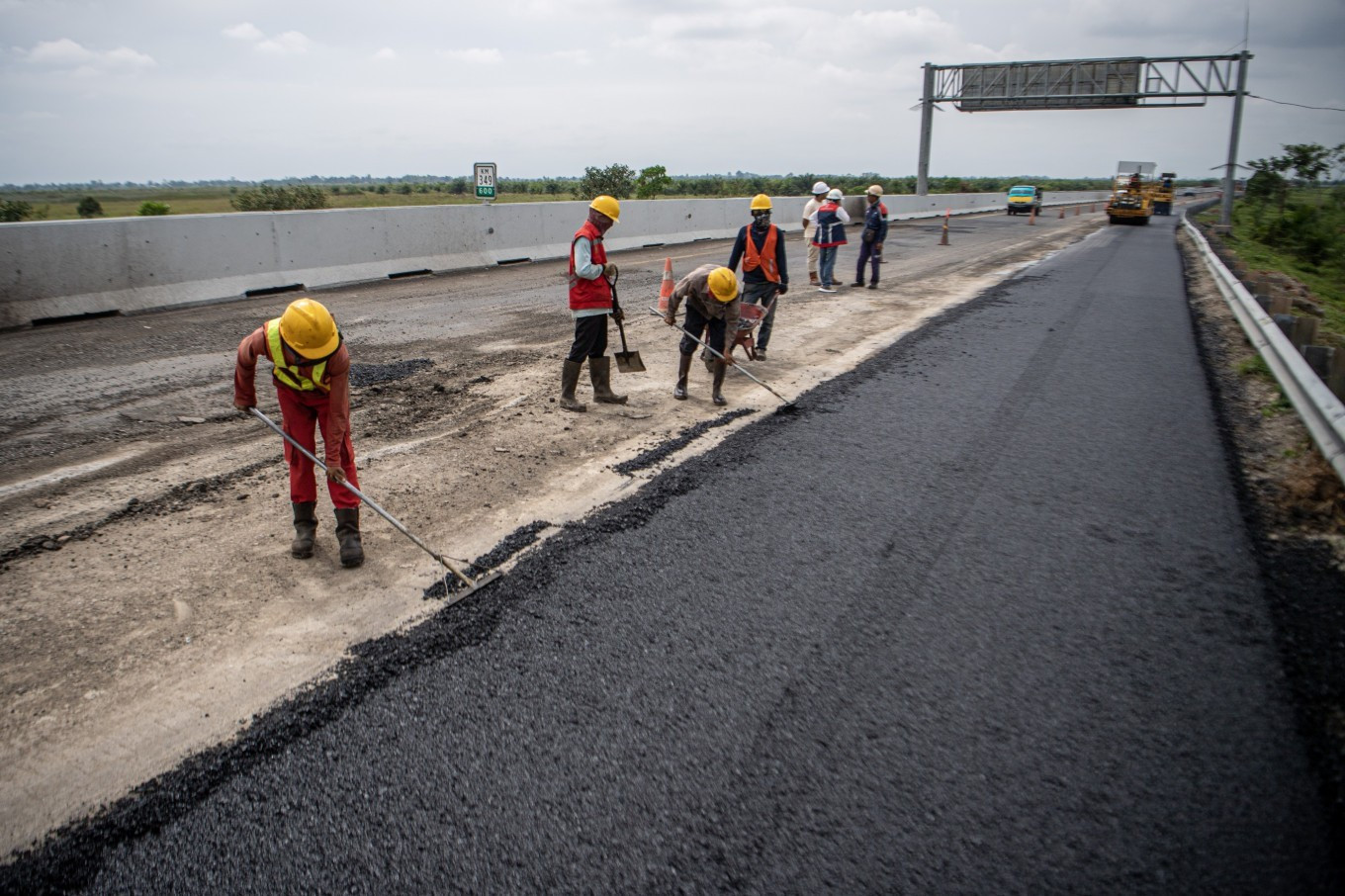 Workers from PT Waskita Sriwijaya, a subsidiary of state-owned construction firm Waskita Karya, use rakes on April 3, 2023, to spread asphalt along a section of the Trans-Sumatra Toll Road in Ogan Komering Ilir regency, South Sumatra. (Antara//Nova Wahyud)
D
anantara Indonesia has announced plans to consolidate 15 state-owned enterprises (SOEs) and their logistics arms into a single “super” logistics entity in an effort to address longstanding structural issues in Indonesia’s state-owned logistics sector. The consolidation spans multiple segments, from railway distribution to fertilizer distribution, and combines both profitable and loss-making firms under the ambition of building a more integrated and efficient national logistics backbone.
According to the plan, the consolidation includes Pupuk Indonesia Logistik and Semen Indonesia Logistik, both of which recorded significant losses in their recent financial reports. Pupuk Indonesia Logistik posted losses of Rp 90.52 billion (US5.24 million) in 2024, while Semen Indonesia Logistik reported losses of Rp 30.29 billion in the same year, which then widened to Rp 188.35 billion in 2025.
This financial strain is closely tied to policy mandates imposed on these firms. In the case of Pupuk Indonesia and its logistics arm, subsidized fertilizer is sold at government-set prices that remain far below market rates, even as the cost of imported raw materials such as phosphate rock and diammonium phosphate, along with other feedstocks, has risen in recent years. Prices initially surged during the pandemic and increased again amid conflict in the Middle East. This persistent mismatch between controlled selling prices and rising production and distribution costs, compounded by the large volumes required under Indonesia’s subsidy program, has continued to pressure margins across the fertilizer supply chain.
A similar pattern can be seen at Semen Indonesia and its logistics subsidiary, which have played a major role in supporting large-scale infrastructure development, particularly projects classified under the government’s National Strategic Projects (PSN) program introduced during the administration of former president Joko “Jokowi” Widodo. While these projects have generated demand for cement and logistics services, many have operated under thin margins or even losses due to pricing pressures and execution constraints. As a result, participation in these state-driven initiatives has not always translated into financial sustainability, contributing to the broader pattern of losses across construction and logistics SOEs.
On the other end of the spectrum, several profitable logistics SOEs are expected to help offset weaker entities under the consolidation scheme. These include Pos Indonesia, which will serve as the holding company for the new logistics entity, alongside Pelindo Terminal Petikemas, ASDP Indonesia Ferry, Pelni, KAI Logistik and Integrasi Logistik Cipta Solusi. All of these companies have recorded consistent profits since at least 2023.
However, this profitability is not necessarily the result of stronger operational efficiency or healthy market competition. While struggling SOEs face rigid policies that suppress margins through subsidized pricing schemes or participation in low-margin national projects, stronger-performing firms benefit from regulatory structures that grant them protected, and often exclusive, access to lucrative market segments.

Take Pos Indonesia as an example. Despite losing market share in the consumer parcel business to on-demand delivery services such as J&T Express and Shopee Express, its profitability remains supported by regulatory advantages. As the state postal operator, Pos Indonesia retains exclusive access to government social assistance distribution programs such as the Family Hope Program (PKH) and staple food packages (Sembako) in remote regions, handles official state documents and passport deliveries, and operates the country’s only nationwide postal financial network through PosPay under a universal service obligation mandate.