TheJakartaPost
Please Update your browser
Your browser is out of date, and may not be compatible with our website. A list of the most popular web browsers can be found below.
Just click on the icons to get to the download page.


Popular Reads
Top Results
No results found. Please check your search term and try again
Can't find what you're looking for?
View all search results
Popular Reads
Top Results
No results found. Please check your search term and try again
Can't find what you're looking for?
View all search resultsGovernment in no rush to revise cyberlaw
Team tasked with gathering opinions to identify problematic, discriminatory provisions
Change text size
Gift Premium Articles
to Anyone
Share the best of The Jakarta Post with friends, family, or colleagues. As a subscriber, you can gift 3 to 5 articles each month that anyone can read—no subscription needed!
T
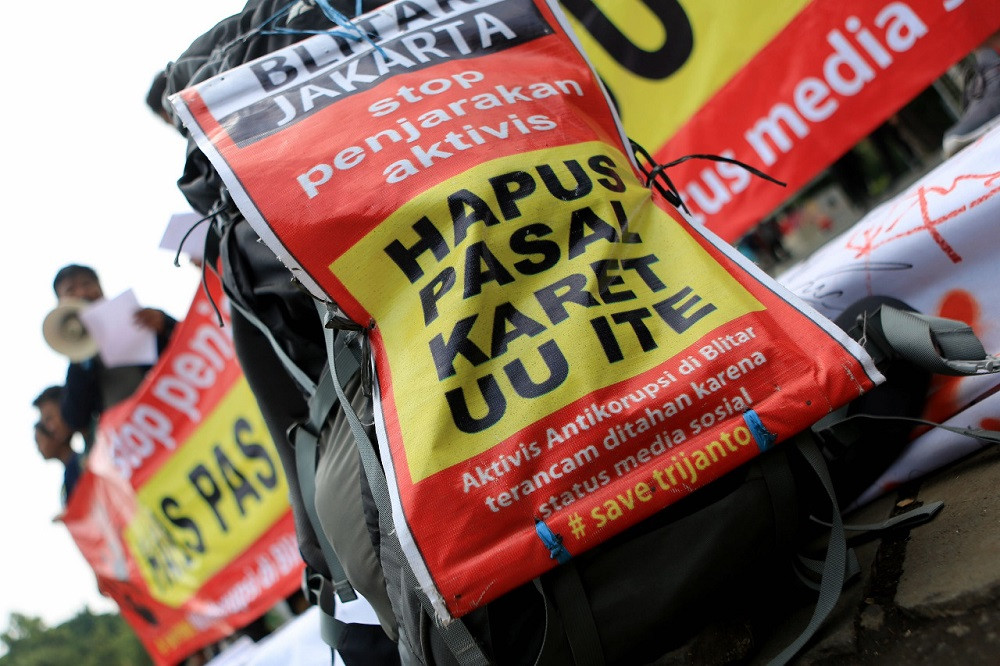
he government appeared to be in no rush to revise the Electronic Information and Transactions (ITE) Law after President Joko "Jokowi" Widodo called last week for an amendment that could end criminalization of online speech.
The reason was that the government needed time to identify the problems with the draconian law before deciding whether or not a revision was necessary and urgent.
“We are studying whether [issuing] guidelines [for the use of the ITE Law for the police and other law enforcers] is sufficient or if the law needs to be revised,” said Donny Gahral Adrian, the lead expert staffer at the Executive Office of the President.
The assessment is being led by the Office of the Coordinating Political, Legal and Security Affairs Minister, which has formed a team to devise the police guidelines and another team to identify how “problematic and discriminatory” the provisions are. The second team will gather opinions from government stakeholders, experts and activists.
“If [we find that the Iaw] needs a revision then let’s revise it,” Coordinating Political, Legal and Security Affairs Minister Mahfud MD said.
The government's apparent second thoughts put in question the seriousness of its plan to revise the cyberlaw, particularly after Jokowi sent a strong message last week that the law itself was “the source” of the problems and its revision was “in particular to remove vague provisions".
Read also: Ball in Jokowi’s court on ITE Law revisions
This was a disappointment for Ika Ningtyas of the Southeast Asia Freedom of Expression Network (SAFEnet), who said the government could use existing studies on problematic articles by civil groups as an alternative to full assessment from scratch.
She said the planned guidelines were a mere quick fix that the government should not rely on too much to end online criminalization. “We are concerned that the interpretation [of the guidelines] is actually even more threatening to our freedom of expression.”
Lawmakers previously said in response to Jokowi’s statement that the House was ready to amend the controversial law this year, but the initiative should come from the government. They said if the government was resolute about pushing its plan, it could include proposed revisions to the law on the National Legislation Program's (Prolegnas) 2021 priority list given that the House has yet to agree on the list. The House is expected to resume deliberating this year’s Prolegnas priority list in the upcoming sitting session, which will commence on March 8.
Read also: Pressure on for Indonesian police to end online witch hunt
For Baiq Nuril Maknun, whose defamation case attracted widespread attention in 2019, it was clear that the law needed to be revised to avoid being misused by people for various motives.
The former school teacher from Mataram in West Nusa Tenggara was convicted of defaming her alleged sexual harasser, a then-principal of her school, by circulating details of a recorded call in which he detailed an affair he had with another woman. She reportedly taped the call as circumstantial evidence to stop him, but it was leaked to the public by her colleague.
“With the President saying that [he wants to] revise the law, I hope the law will soon be revised so that there will be no other victims like me,” Baiq told a Saturday online discussion organized by rights group Amnesty International Indonesia.
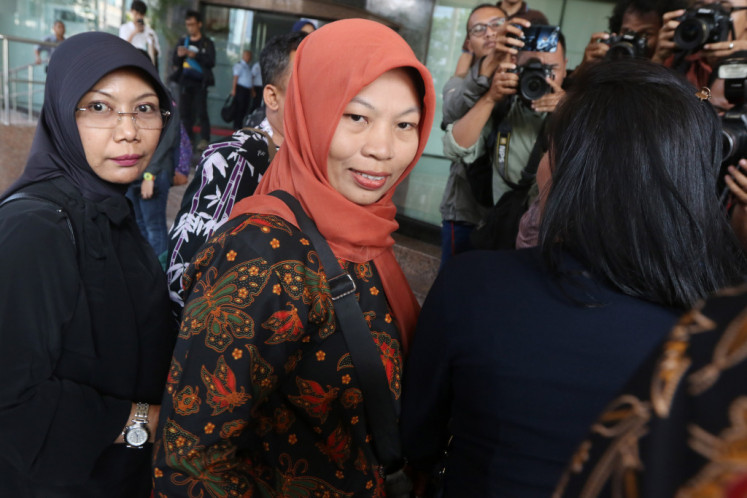
A district court found her not guilty and acquitted her of all charges in 2017, but a year later, following an appeal filed by prosecutors, the Supreme Court found her guilty of circulating a lewd recording. She also lost a review of her case at the Supreme Court before Jokowi eventually granted her amnesty in 2019.
Read also: Nuril finally gets amnesty after five-year struggle
Proposed by the administration of Susilo Bambang Yudhoyono, the ITE Law was introduced in 2008 despite objections from pro-democracy activists. While the law was initially passed to regulate electronic transactions, it has been repeatedly used to penalize defamation and hate speech, with most cases happening under Jokowi’s administration.
The only revision to be passed was in 2016 following an initiative by Jokowi's administration. The revision did not make many changes to the controversial provisions that permit prosecution for online defamation, but reduced the maximum penalty from six to four years in prison and the fine from Rp 1 billion (US$71,388) to Rp 750 million.
Before Jokowi made the call last week, a separate plan to revise the law was included in the five-year Prolegnas last year -- listed under the House's initiative. But lawmakers have decided not to list it as a priority to date.