TheJakartaPost
Please Update your browser
Your browser is out of date, and may not be compatible with our website. A list of the most popular web browsers can be found below.
Just click on the icons to get to the download page.


Popular Reads
Top Results
No results found. Please check your search term and try again
Can't find what you're looking for?
View all search results
Popular Reads
Top Results
No results found. Please check your search term and try again
Can't find what you're looking for?
View all search resultsEurope’s skepticism about US firms reaches Asia
As geopolitical tensions rise between Washington and Brussels, US companies are increasingly exposed to reputational and regulatory risk in Europe. This shift has consequences for global trade and open economies, including in Asia.
Change text size
Gift Premium Articles
to Anyone
Share the best of The Jakarta Post with friends, family, or colleagues. As a subscriber, you can gift 3 to 5 articles each month that anyone can read—no subscription needed!
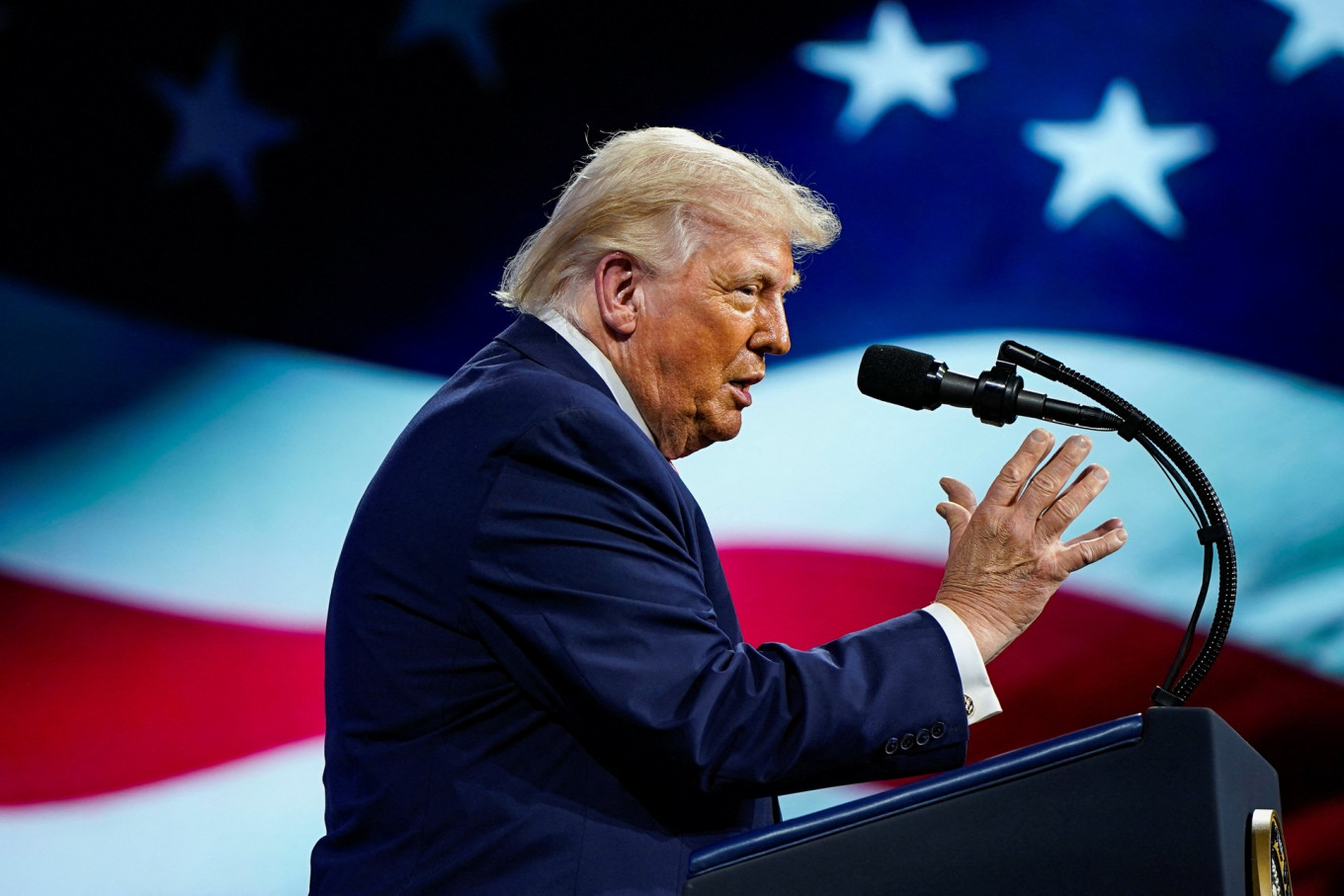 United States President Donald Trump delivers remarks on March 27, 2026, at a summit of the Future Investment Initiative (FII) Institute at the Faena Forum in Miami Beach, Florida. (Reuters /Elizabeth Frantz)
F
or much of the past three decades, American companies operating overseas benefited from a powerful assumption: that despite periodic political turbulence at home, the United States remained a predictable and broadly reliable commercial partner. That assumption is now under growing strain in Europe, and the consequences are likely to extend well beyond the transatlantic relationship.
US President Donald Trump’s increasingly aggressive foreign policy posture is doing more than unsettling markets or complicating diplomacy. It is reshaping how European policymakers assess American business as a whole. US companies are finding themselves exposed to political risk that originates not from their own conduct but from Washington’s treatment of allies.
For European policymakers, the “Greenland episode” reinforced a broader concern that US trade and foreign policy are becoming more openly transactional, less constrained by established norms and more willing to use economic leverage to pursue geopolitical goals.
And now, there is the conflict in Iran. Exclusive research conducted by Penta in late 2025 illustrates the scale of the reputational impact that was already underway before the most recent flare-up.
Among European Union policymakers, favorability toward US business fell sharply over the course of a year, declining 28 percentage points from 72 to 44 percent. In Brussels, American firms dropped from the fourth most favorably viewed business community to ninth, ranking only marginally ahead of companies from China, Saudi Arabia and Russia.
For global businesses accustomed to viewing the EU as a stable and rules-based market, that shift should not be underestimated. Policymaker sentiment matters: It influences regulatory discretion, enforcement priorities, procurement decisions and ultimately, the ease with which companies can operate across borders.

Indonesia sits at the intersection of these dynamics. As a regional headquarters for many US multinationals and a critical node in global supply chains linking Europe and Asia, it is especially exposed to changes in how jurisdictions assess political and reputational risk.